

(XBX26) (ZCU26) (ZSU26) (ZWN26) (CORN) (WEAT) (SOYB) (TAGS) (DBA)
“European Corn Surges as US Market Eyes El Niño”
by Jim Roemer - Meteorologist - Commodity Trading Advisor - Principal, Best Weather Inc. & Climate Predict - Publisher, Weather Wealth Newsletter and Climatelligence
Scott Mathews - Editor and Co-Producer of Climatelligence
- June 26, 2026
We posted a more extensive version of this article on the Substack Climatelligence page:
European Corn Surges as US Market Eyes El Niño
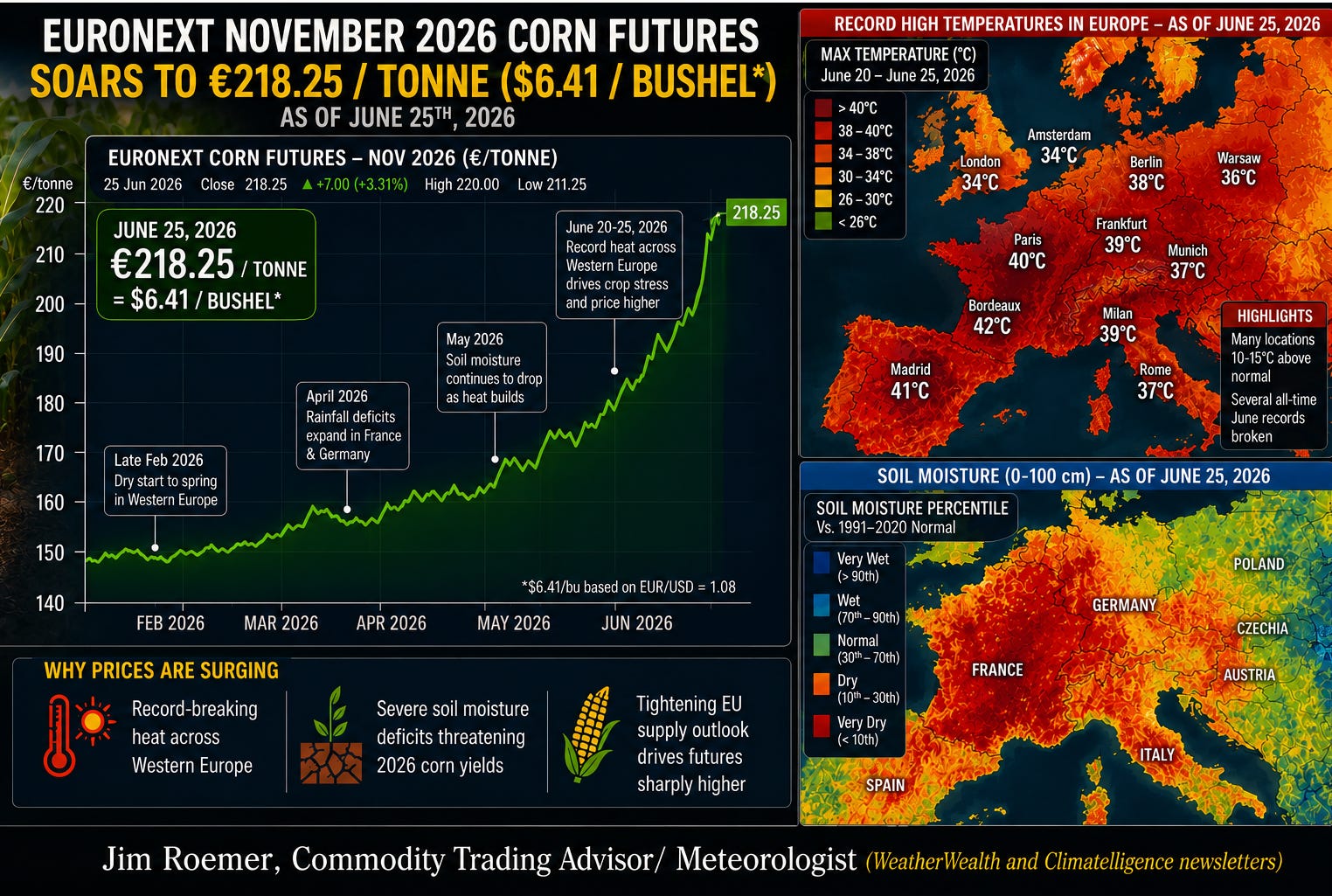
Image Source: concept by Jim Roemer, rendered by ChatGPT
Jim Roemer’s Corn Overview:
In late May, I turned bearish on US corn while many traders remained focused on strong export demand and the potential geopolitical risk premium from the Middle East conflict. My view was that those bullish factors had already been largely priced into the market. What was being underestimated was the weather.
From a meteorological standpoint, the atmosphere was lining up for one of the most favorable spring planting seasons across much of the Corn Belt in years. Timely rainfall, adequate soil moisture, and the absence of prolonged flooding or planting delays allowed producers to make rapid planting progress. History shows that when crops get planted on time under favorable early-season conditions, yield potential increases significantly. Markets quickly shifted their attention away from geopolitical headlines and back toward the prospect of abundant US production.
What resulted was a sharp 10–15% decline in corn futures, exactly as I anticipated.
The next major catalyst arrives with the USDA Planted Acreage Report on June 30. If planted acreage exceeds expectations, the market could remain under pressure. However, if acreage comes in below expectations or if the report reveals fewer corn acres than traders currently anticipate, prices could stabilize or even rally. Another developing wildcard is Europe. An unusually intense early-summer heat wave is spreading across major agricultural regions, with temperatures exceeding 100°F (38°C) in parts of France, Spain, Italy, and the Balkans. Heat arriving this early in the growing season increases crop stress, particularly if accompanied by below-normal rainfall. European maize prices have already begun to climb as traders reassess production risks.
The key question now is whether Europe’s weather problems can offset the increasingly favorable US crop outlook. Corn markets often shift rapidly from local weather stories to global supply concerns. While the long-term US production outlook remains favorable, adverse weather in Europe—or later this summer in the US during pollination—could signal that corn has established an important seasonal bottom.
As always, weather remains the single most important variable determining grain prices. Understanding atmospheric patterns before they become widely recognized is often where the greatest market opportunities emerge.
To find out more about our global commodity weather forecast and market outlook, please visit our Climatelligence page on SubStack https://climatelligence.substack.com where you can download the SubStack app
Remember, when trading commodities, always apply risk management, such as stop-loss orders and position sizing, and consider using spreads to isolate the seasonal component of a particular market move.
Thanks for your interest in Commodity Weather Intelligence!
Jim Roemer, Scott Mathews, and the BestWeather Team
Mr. Roemer owns Best Weather Inc., offering weather-related blogs for commodity traders and farmers. He is also a co-founder of Climate Predict, a detailed long-range global weather forecast tool. As one of the first meteorologists to become an NFA-registered Commodity Trading Advisor, he has worked with major hedge funds, Midwest farmers, and individual traders for over 35 years. With a special emphasis on interpreting market psychology, coupled with his short-term and long-term trend forecasting in grains, softs, and energy markets, he holds a unique standing among advisors in the commodity risk management industry.


/Nvidia%20logo%20by%20Konstantin%20Savusia%20via%20Shutterstock.jpg)