




Earnings season kicked off last week with some big banks and airlines reporting. Despite the holiday shortened week, it’s going to be busy with lots of big names reporting. This week we have Morgan Stanley (MS), Goldman Sachs (GS), United Airlines (UAL), Netflix (NFLX), Proctor & Gamble (PG), Charles Schwab (SCHW), Alcoa (AA) and Schlumberger (SLB) all set to report.
Before a company reports earnings, implied volatility is usually high because the market is unsure about the outcome of the report. Speculators and hedgers create huge demand for the company’s options which increases the implied volatility, and therefore, the price of options.
After the earnings announcement, implied volatility usually drops back down to normal levels.
Let’s take a look at the expected range for these stocks. To calculate the expected range, look up the option chain and add together the price of the at-the-money put option and the at-the-money call option. Use the first expiry date after the earnings date. While this approach is not as accurate as a detailed calculation, it does serve as a reasonably accurate estimate.
Tuesday
MS – 3.5%
GS – 3.0%
UAL – 6.0%
IBKR – 4.4%
Wednesday
SCHW – 3.9%
AA – 7.9%
KMI – 2.4%
PNC – 3.7%
Thursday
PG – 2.9%
NFLX – 9.9%
Friday
SLB – 3.8%
ALLY – 7.0%
Option traders can use these expected moves to structure trades. Bearish traders can look at selling bear call spreads outside the expected range.
Bullish traders can sell bull put spreads outside the expected range, or look at naked puts for those with a higher risk tolerance.
Neutral traders can look at iron condors. When trading iron condors over earnings, it is best to keep the short strikes outside the expected range.
When trading options over earnings, it is best to stick to risk defined strategies and keep position size small. If the stock makes a larger than expected move and the trade suffers a full loss, it should not have more than a 1-3% effect on your portfolio.
Stocks With High Implied Volatility
We can use Barchart’s Stock Screener to find other stocks with high implied volatility.
Let’s run the stock screener with the following filters:
- Total call volume: Greater than 2,000
- Market Cap: Greater than 40 billion
- IV Percentile: Greater than 70%
This screener produces the following results, ranked by implied volatility percentile:

You can refer to this article for details of how to find option trades for this earnings season.
Last Week’s Earnings Moves
Last week’s actual versus expected moves are shown below:
TLRY -6.4% vs 12.4% expected
KBH -2.9% vs 7.6% expected
BAC +2.2% vs 4.7% expected
BLK 0.0% vs 4.6% expected
C +1.7% vs 5.3% expected
DAL -3.5% vs 5.1% expected
JPM +2.5% vs 4.0% expected
UNH -1.2% vs 3.3% expected
WFC +3.3% vs 5.0% expected
Overall, there were 9 out of 9 that stayed within the expected range.
Most Active Options
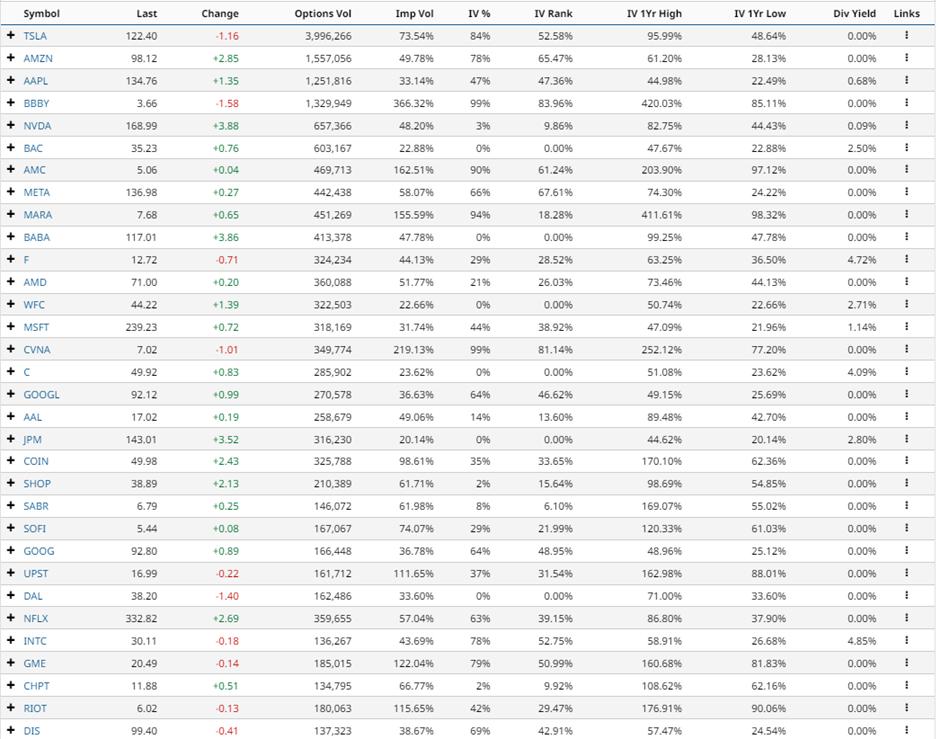
Tesla (TSLA), Amazon (AMZN), Apple (AAPL), Bed Bath & Beyond (BBBY) Nvidia (NVDA) and Bank of America (BAC) were the stocks with the most active options last week.
Other stocks with the most active options are shown below:
Please remember that options are risky, and investors can lose 100% of their investment. This article is for education purposes only and not a trade recommendation. Remember to always do your own due diligence and consult your financial advisor before making any investment decisions.
More Stock Market News from Barchart
- In-the-Money GOOG Options Still Look Attractive To Value Buyers
- Earnings, PPI, Housing and Other Key Themes To Watch This Week
- EQT Corp Options Have High Implied Volatility, Ideal for a Jade Lizard Strategy
- Stocks End Higher as Bank Stocks Recover Early Losses
On the date of publication, Gavin McMaster did not have (either directly or indirectly) positions in any of the securities mentioned in this article. All information and data in this article is solely for informational purposes. For more information please view the Barchart Disclosure Policy here.

/Nvidia%20logo%20by%20Konstantin%20Savusia%20via%20Shutterstock.jpg)


/Broadcom%20Inc%20HQ%20photo-by%20Sundry%20Photogrpahy%20via%20iStock.jpg)