Fiat currencies derive value from the full faith and credit of the countries that issue the legal tenders. The US has the world’s leading economy and the political stability required for reserve currency status. Moreover, the US dollar is freely exchangeable for other global currencies, offering liquidity to countries worldwide. Many nations hold US dollars as reserves, along with other currencies and gold.
The dollar index measures the US dollar against a basket of currencies, including the euro, British pound, Japanese yen, Canadian dollar, Swedish kroner, and the Swiss franc. The most exposure is against the euro, representing 57.6% of the index. The path of least resistance of the dollar index has been higher since early 2021. The dollar index trades in the futures market on the Intercontinental Exchange (ICE).
Interest rate differentials are critical for currency values
Yield is a consideration for those holding currency reserves. Aside from geopolitical issues, interest rate differences are a factor in the value of one foreign exchange instrument versus another.
The US Fed attributed rising inflation to “transitory” pandemic-related factors throughout much of 2021 until the rising consumer and producer price index data caused an epiphany that the economic condition was more structural than temporary. The zero percent interest rate environment and government stimulus in 2020 and 2021 planted inflationary seeds that sprouted in 2020 and bloomed in 2021 and 2022. The US central bank reversed course to a hawkish monetary policy approach. In early 2022, the Fed lifted the short-term Fed Funds Rate from zero. Over the past months, aggressive Fed Fund hikes and reducing its swollen balance sheet lifted the yield on dollar deposits, pushing the US currency higher.
Meanwhile, Russia’s invasion of Ukraine created a war on Europe’s doors step, weighing on the euro currency, which accounts for 57.6% of the dollar index. The dollar index rallied as a safe haven over the past months. Higher rates and the geopolitical landscape created an almost perfect bullish storm for the dollar index that rose to a series of two-decade highs over the past weeks.
The euro dropped to parity against the dollar for the first time in two decades
The relationship between the US dollar and the euro currency is the primary factor for the path of least resistance of the US dollar index. The euro rose to a record $1.6038 high against the US currency in July 2008 when it moved into a bearish trend, making lower highs and lower lows over the next fourteen years.
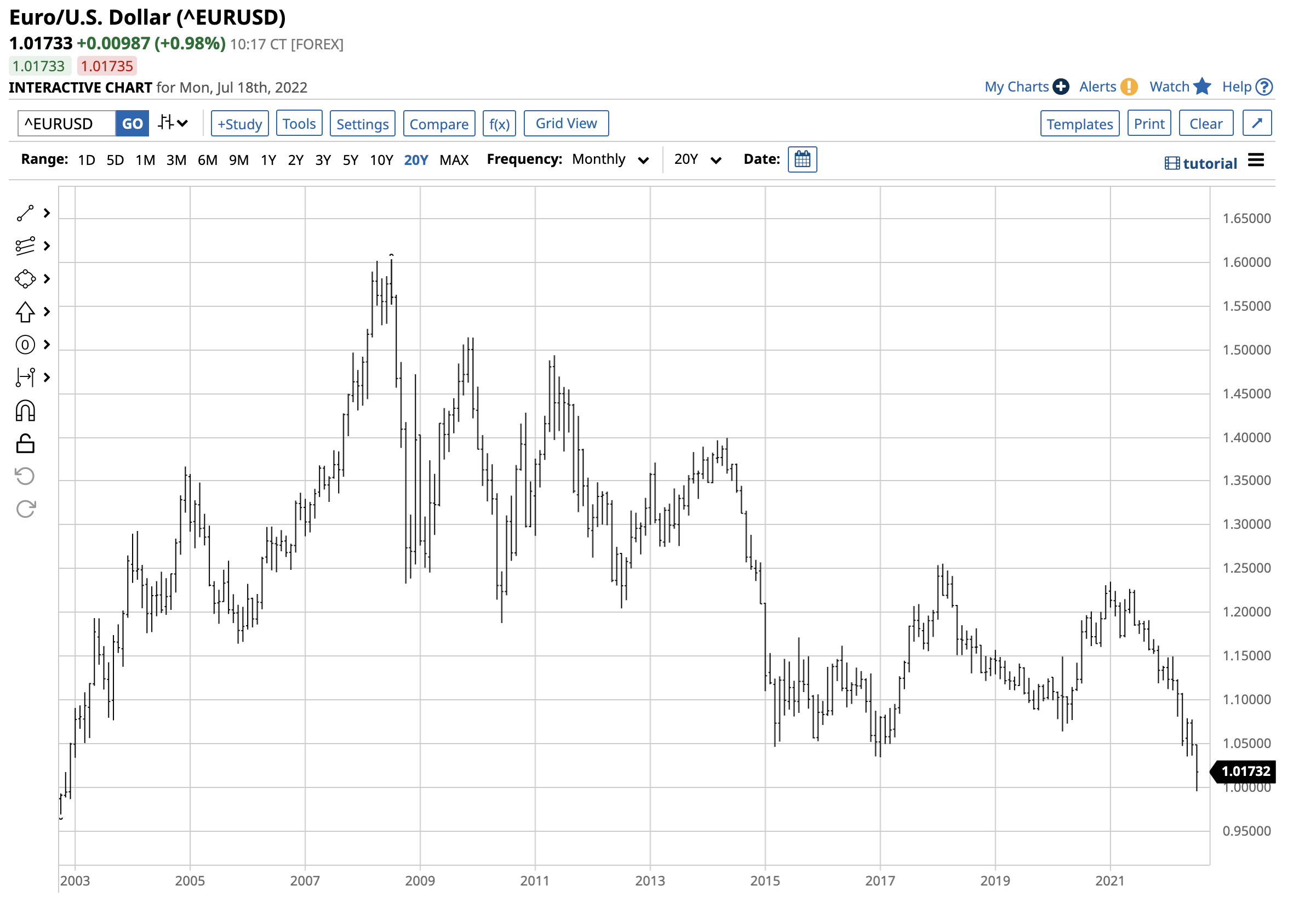
The chart shows that the last time the euro traded at parity against the US dollar was in December 2002. Last week, the price briefly probed below parity and was just above that level on Monday, July 18.
A bullish trend in the index since 2021
The dollar index spiked to a marginal two-decade high in March 2020 as the volatility in markets across all asset classes pushed the index to a 103.960 high. After correcting to 89.165 in January 2021, the index began making higher lows and higher highs.
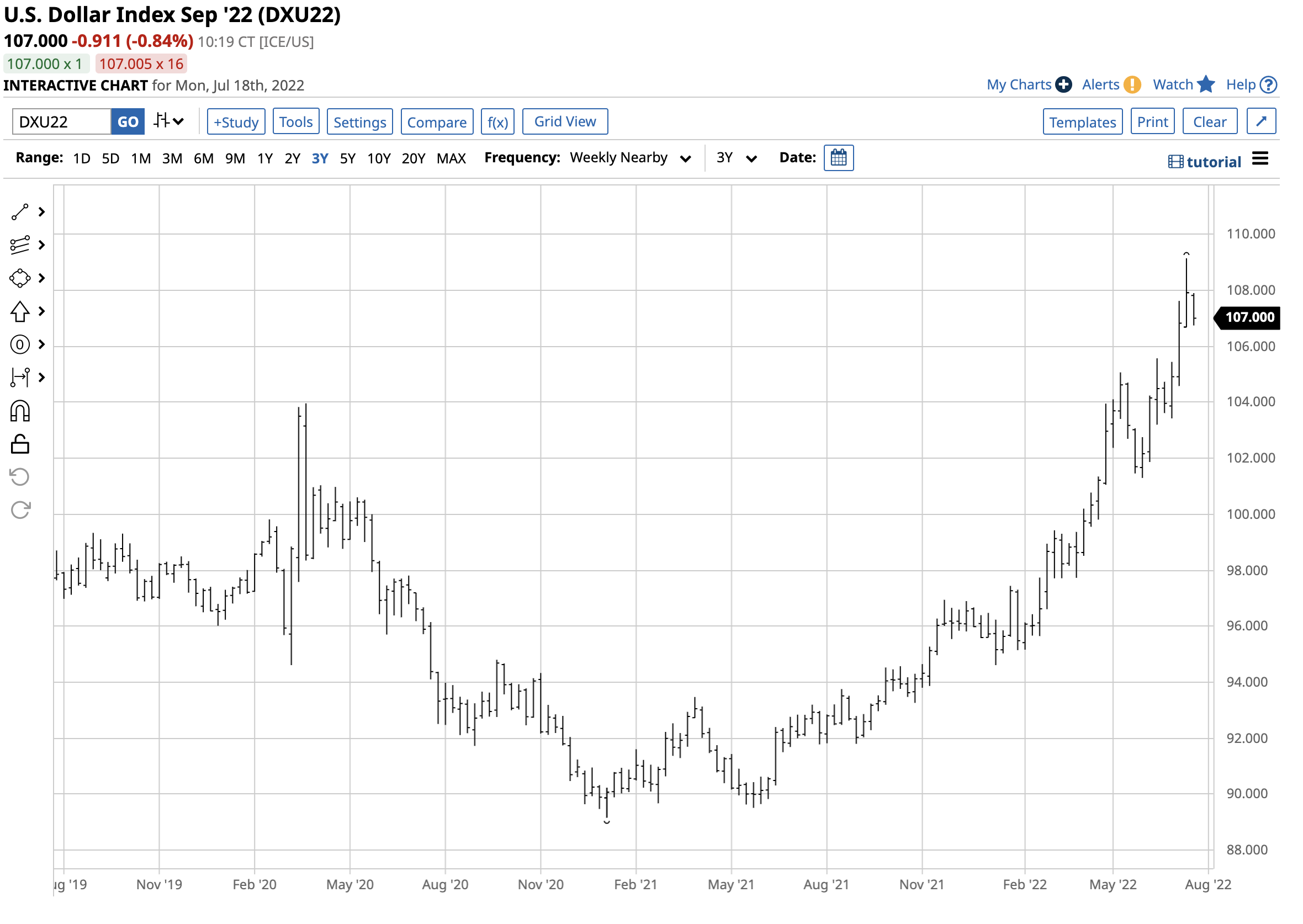
The dollar index made a slightly higher low in May 2021 at 89.515 and took off on the upside over the past fourteen months.
A breakout- Technical resistance is far above the current level
In early May 2022, the index moved above the March 2020 high, signaling a technical breakout in the US currency against the other world reserve currencies.
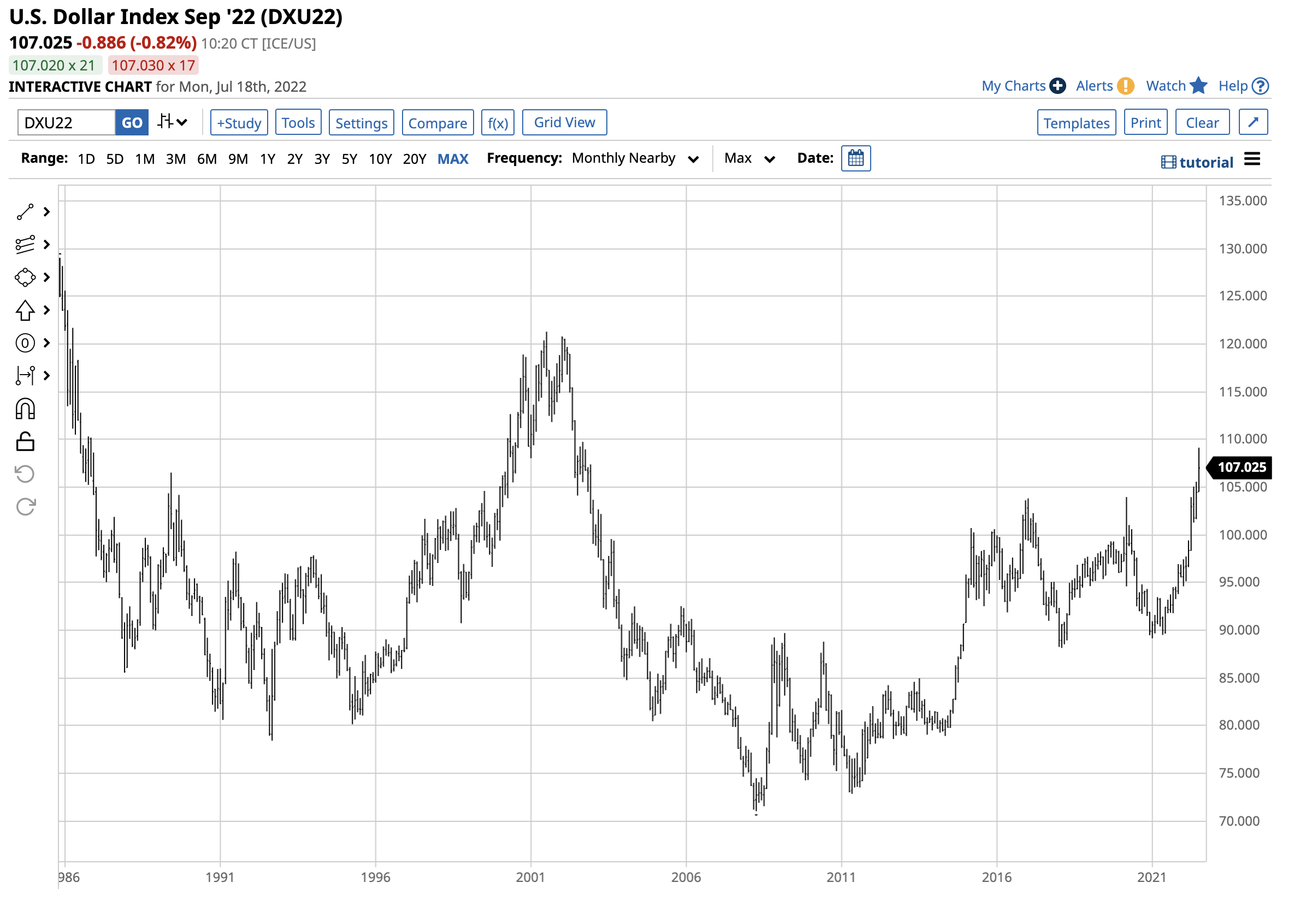
The long-term chart of the dollar index dating back to the beginning of the European Union and the birth of the euro currency highlights the upside target for the index stands at the July 2001 121.290 high, 11.13% above last week’s 109.140 high. The index settled at the 107.911 on July 15 after rising to the 109.140 peak on July 14. It was around the 107 level on Monday, July 18.
Currency moves tend to take time- The dollar index has already made great upside strides
Bull and bear markets in all asset classes rarely move in straight lines, and corrections or recoveries can be significant. Currencies tend to experience less volatility than other asset classes as governments intervene in the foreign exchange markets to provide stability, protecting cross-border transactions. Intervention tends to occur when currency markets extend on the up or downside. Therefore, moves in currency markets are often slow and steady, with trends lasting for months and years.
The dollar index has already moved 22.4% higher from the January 2021 low to the July 2022 peak. Interest rate differentials, the war in Europe, rising inflation at the highest level in four decades, and a bifurcation of trade and geopolitical policies between the world’s nuclear powers have pushed the dollar index to a two-decade high. While the trend remains higher in mid-July 2022, the potential for a significant correction is rising with the dollar. The over 22% is a reason for governments to slow the ascent of the US currency via periodic intervention.
The dollar’s path of least resistance against the euro and the other currencies in the dollar index remains higher. However, the highest inflation levels in almost a half-century mean that all fiat currencies are losing purchasing power. Even though the dollar is the strongest world currency, it continues to lose value as the prices of goods and services are much higher than in early 2021 when the dollar index made its most recent low.
The bull market in the dollar index continued to charge higher to a new high last week. Still, the index remains nothing more than a mirage as inflation erodes the purchasing power of all fiat currencies, and the US dollar is no exception.
More Forex News from Barchart

/Advanced%20Micro%20Devices%20Inc_%20office%20sign-by%20Poetra_RH%20via%20Shutterstock.jpg)

/CPU%20Chip.jpg)