“Why Does the Pro Farmer Crop Tour Keep Underestimating Corn Production?”
by Jim Roemer - Meteorologist - Commodity Trading Advisor - Principal, Best Weather Inc. & Climate Predict - Publisher, Weather Wealth Newsletter and Co-Producer of Climatelligence
Scott Mathews - Editor and Co-Producer of Climatelligence
August 24, 2026
Every August, the Pro Farmer Crop Tour becomes something of an agricultural road trip, treasure hunt and crop detective story rolled into one.
More than 100 scouts fan out across seven major Corn Belt states, stop at randomly selected fields, march into the crop and start counting ears, kernels and soybean pods. The seven Tour states represent roughly 70% of U.S. corn and soybean production.
The resulting numbers can move markets.
But there is an interesting historical wrinkle that Barchart.com readers—and commodity traders—should understand:
Pro Farmer has had a persistent tendency to underestimate the final U.S. corn yield. Its soybean estimates, while certainly not perfect, have generally been closer.
🌽 Corn: Beware the August Pessimism
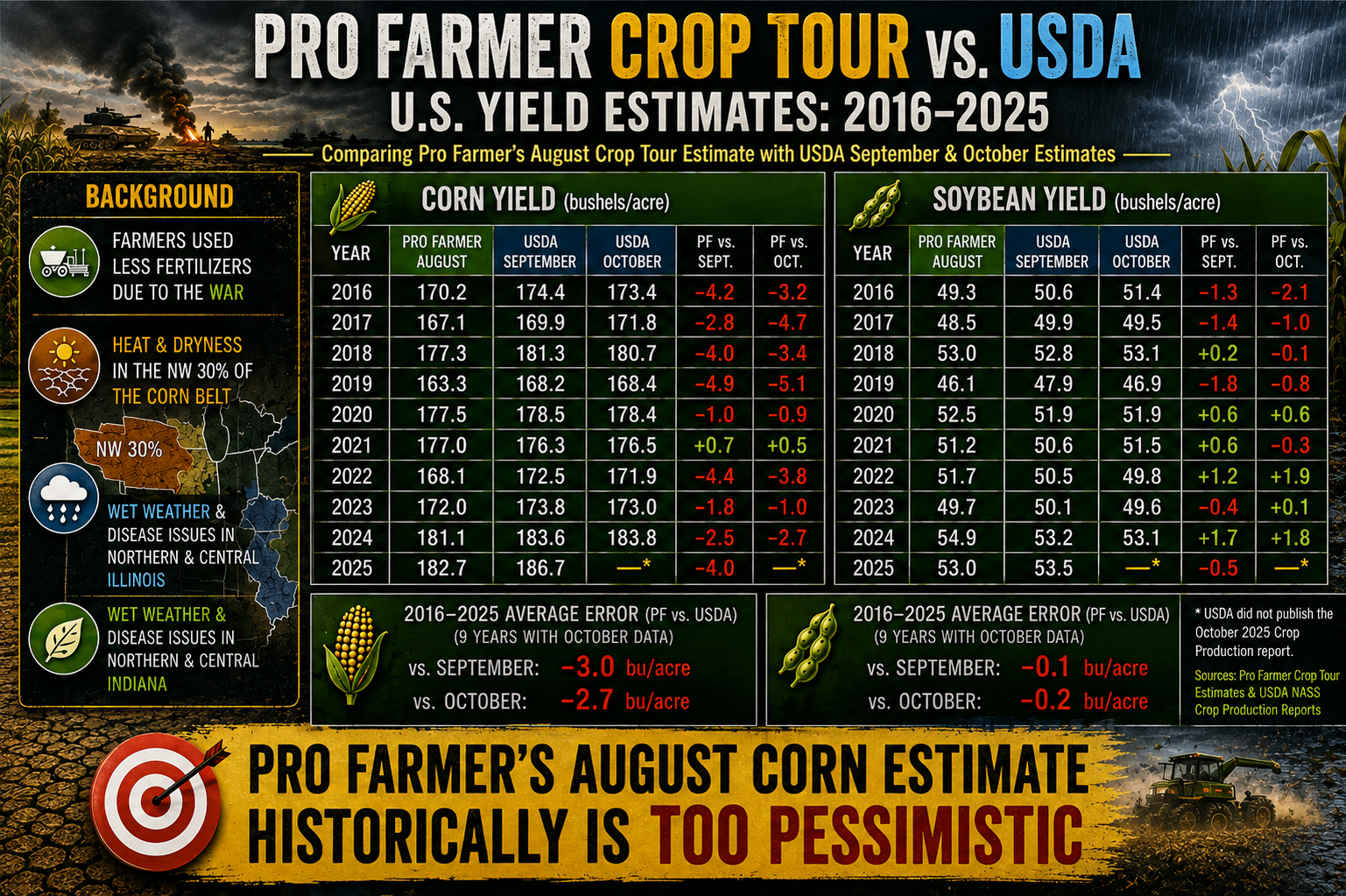
Looking at the last decade, the pattern is striking.From 2016 through 2025, Pro Farmer's national corn yield estimate came in below USDA's eventual final yield in nine of ten years. The lone exception was 2024.
Several misses weren't small:
2017: roughly 9 bushels/acre too low
2020: nearly 6 bushels too low
2022: 5.3 bushels too low
2023: 5.3 bushels too low
2025: 3.8 bushels too low
That doesn't mean we should simply add four or five bushels to Pro Farmer's tally every August. But it does mean traders should be careful about treating the Tour estimate as the final word on crop size. The historical record suggests it has often been better at telling us whether USDA may be too high or too low than telling us precisely where the final yield will land.
Why the corn bias?
(There are several good explanations.)
First, Pro Farmer is looking at corn before Mother Nature has finished making it.
Scouts estimate corn using ear population, grain length, kernel rows and row spacing. That's an excellent snapshot of the crop in the third week of August—but it's still a snapshot. Kernel depth and final grain weight aren't completely known yet. Think of it this way: Pro Farmer is trying to guess the final score while the game is still in the fourth quarter. In favorable late summers, corn can finish surprisingly well. Good soil moisture, moderate temperatures, sunshine and a healthy plant can add kernel weight that wasn't obvious when scouts walked through the field.
Second, the Tour doesn't sample the entire Corn Belt.
The routes are deliberately consistent so this year's observations can be compared with previous Tours. That's one of the Tour's greatest strengths—but it also means the sample isn't identical to USDA's eventual nationwide measurement. Pro Farmer itself emphasizes this point. The organization says the most useful way to interpret Crop Tour is to compare this year's Tour with previous Tours, rather than simply comparing its raw numbers with USDA. Pro Farmer has even developed historical adjustments because it knows certain states and routes tend to measure systematically high or low. In Nebraska, for example, roughly 60% of corn is irrigated, while historically only about 40% of the Tour's Nebraska samples have been irrigated. That's exactly the kind of sampling difference that can create a persistent statistical bias.
🌱 So Why Are Soybeans Different?
(Here's where things get interesting).
The Crop Tour doesn't actually estimate soybean yields in the field.
Instead, scouts count pods in a 3-by-3-foot square.
Why?
Because in August, two enormously important soybean yield variables remain unknown: seeds per pod and final seed weight. Pro Farmer therefore describes its pod count as measuring the size of the soybean crop's "yield factory."
That may actually prevent some false precision. Rather than pretending that 1,400 pods automatically equals X bushels per acre, Pro Farmer can combine those pod counts with historical relationships, crop maturity, weather and other information when producing its national estimate.In addition, recent results illustrate the difference. From 2022–2025, Pro Farmer's soybean estimate had an average absolute error of about 1.8 bushels per acre, versus roughly 4.1 bushels for corn. Its 2025 soybean estimate of 53.0 bu./acre landed exactly on USDA's final 53.0.
Soybeans also have another characteristic that makes August forecasting fascinating:
August weather really matters!
A soybean plant can look spectacular in mid-August and still disappoint if hot, dry weather shrinks seed size or causes pods to abort. Conversely, timely late-August rains can turn an average-looking field into an excellent crop. However, earlier this August, very wet weather from central and northern Illinois through Ohio has caused concerns about disease issues. Usually, “rain makes grain”, so the recent flooding rains in the central and eastern U.S. corn/soybean belt was highly unusual.
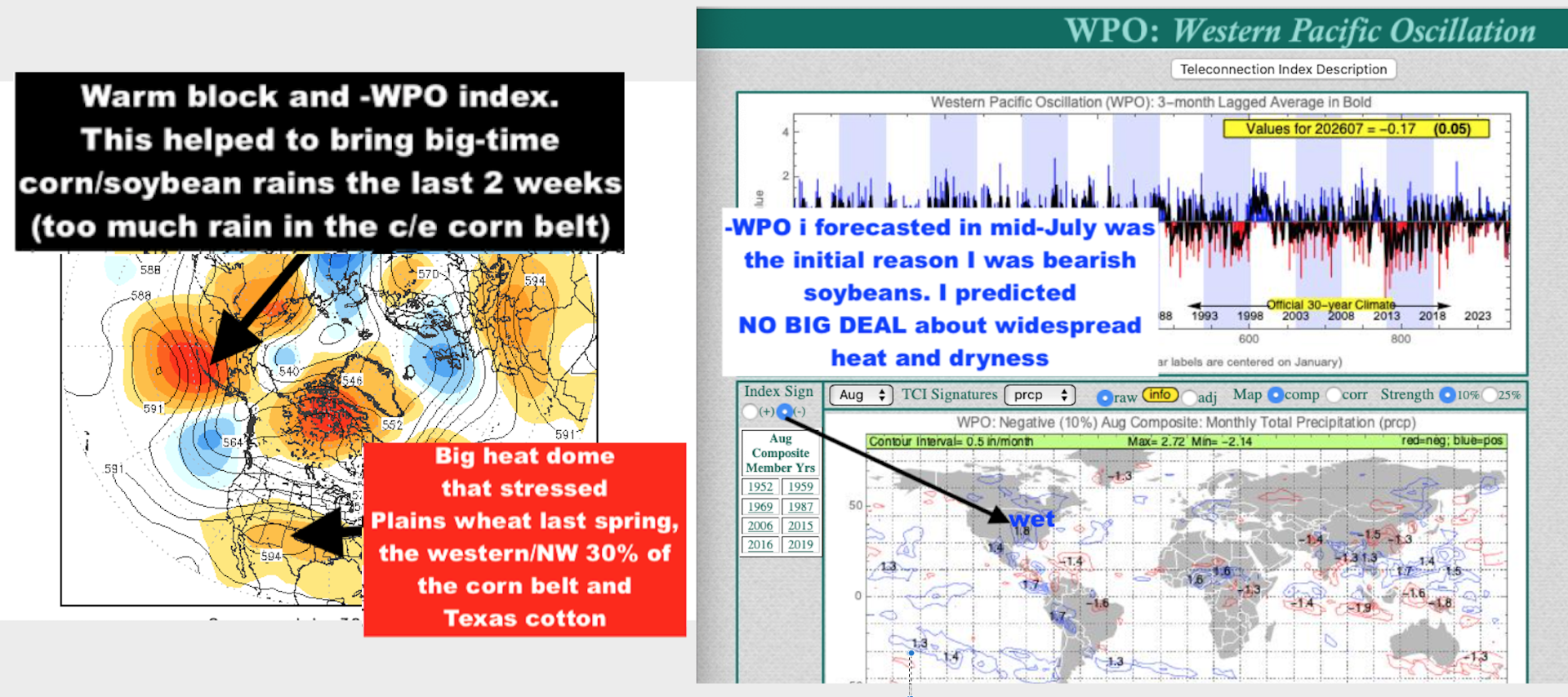
Notice, how (about a month ago), when many meteoroloigists and grain analysts were calling for Midwest heat and dryness, My ClimatePredict program predicted great August rains due to the combination of a teleconnection we call a negative Western Pacific Oscillation Index (-WPO), combined with El Niño. The good news for this week, a drier, cooler weather pattern will develop for 75% of the Midwest. This should still make for a large U.S. soybean crop and potentially is NOT bullish.
Image Sources: Left - StormVistaWxModels.com (used with permission); Right - Climate Predict LLC (a Bestweather, Inc. company)
That's why we have always emphasized that August weather is often more important to soybeans than all the excitement surrounding July weather.
🌽 The Lesson for 2026
This history is particularly relevant this year.
The 2026 crop has some legitimate problems. Dryness and heat affected portions of the western and northwestern Corn Belt, while excessive rainfall and flooding across parts of Illinois, Indiana and the eastern Midwest created concerns about nitrogen loss, disease and crop health. Remember too that many farmers may have not applied enough fertilizers last spring to their corn crop due to a hike in prices attributed to the Iran-U.S. war. Soybeans, on the other hand, do not need fertilization. Hence, their yields were not as adversely affected.
Those problems shouldn't be dismissed.
But neither should history.
The Pro Farmer Tour is extremely valuable—but its greatest value may be as a crop thermometer rather than a crystal ball.
It tells us what scouts are seeing right now, along consistent routes, using consistent procedures. It can identify regional trouble that broad national statistics may overlook.
But when Pro Farmer produces a surprisingly low corn number in August, history tells us to resist immediately burying the crop.
Corn has repeatedly found a few extra bushels between the Tour and the combines.
So…
What is our overall view about the corn and soybean market?
What does El Niño suggest for South American production later this year and in 2027?
What about the autumn harvests of corn and soybeans... Will it be wet or dry?
Find out about Climatelligence, our new, lower-priced newsletter for weather enthusiasts, farmers and commodity traders. Our premium newsletter WeatherWealth has been updated at least three times a week with frequent trading ideas. See here. https://climatelligence.substack.com
We greatly appreciate your interest in Commodity Weather Intelligence!
Mr. Roemer owns Best Weather Inc., offering weather-related blogs for commodity traders and farmers. He is also a co-founder of Climate Predict, a detailed long-range global weather forecast tool. As one of the first meteorologists to become an NFA-registered Commodity Trading Advisor, he has worked with major hedge funds, Midwest farmers, and individual traders for over 35 years. With a special emphasis on interpreting market psychology, coupled with his short-term and long-term trend forecasting in grains, softs, and energy markets, he holds a unique standing among advisors in the commodity risk management industry.
This article contains syndicated content. We have not reviewed, approved, or endorsed the content, and may receive compensation for placement of the content on this site. For more information please view the Barchart Disclosure Policy here.





/Micron%20Technology%20Inc_%20logo%20on%20building-by%20vzphotos%20vis%20iStock.jpg)


/People%20shopping%20at%20a%20Walmart%20store%20by%20Photography%20via%20Shutterstock.jpg)
