



Live cattle, feeder cattle, and lean hog prices are trading at multi-year highs in October 2022. Each year, the peak season for demand runs from late May through early September during the grilling season. While carnivores enjoy animal proteins throughout the year, the demand during the summer months tends to push prices to annual highs.
Meats are seasonal commodities that typically fall to lows in October after the end of the grilling season. However, 2022 is anything but an ordinary year in markets, and animal proteins are no exception.
Live and feeder cattle and lean hog futures trade on the Chicago Mercantile Exchange (CME). The iPath Series B Livestock TR ETN product (COW) moves higher and lower with meat prices and was higher than the level at the end of October 2021 on October 31, 2022.
Live cattle are in a bullish trend
After reaching a low of 81.45 cents in April 2020, live cattle futures have made higher lows and higher highs.
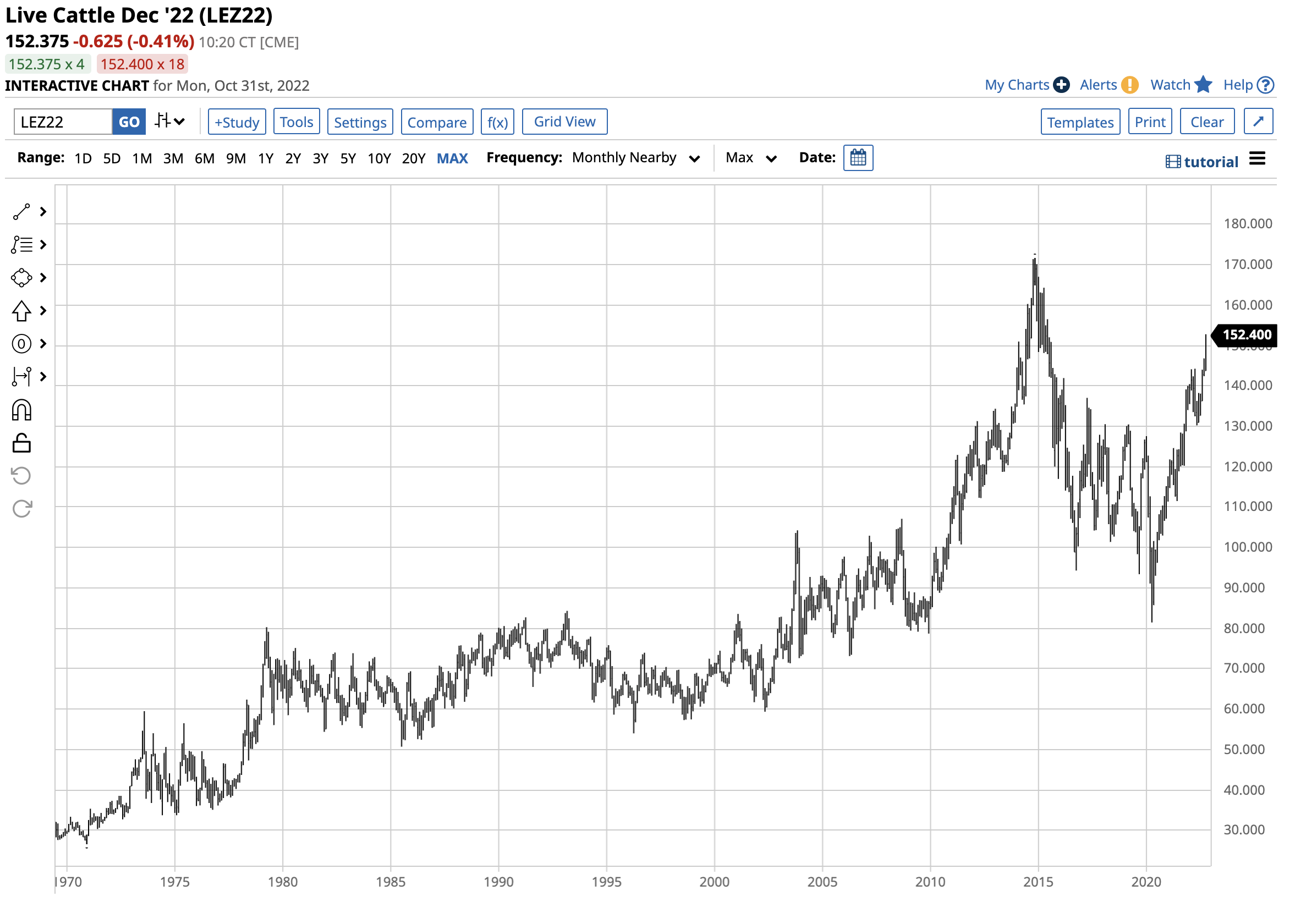
The chart highlights the nearby live cattle futures on the CME rose to the most recent peak of $1.52775 per pound in October 2022. The December contract was near that level at $1.52375 on October 31. The upside target is the November 2014 $1.7165 record high.
Even though the meat sector is in the offseason, live cattle continue to rise in a bullish trend.
The path of least resistance in feeder cattle has been higher
Feeder cattle’s April 2020 low was $1.0395 per pound, and it has followed the live cattle, making higher lows and higher highs since the pandemic-inspired bottom.
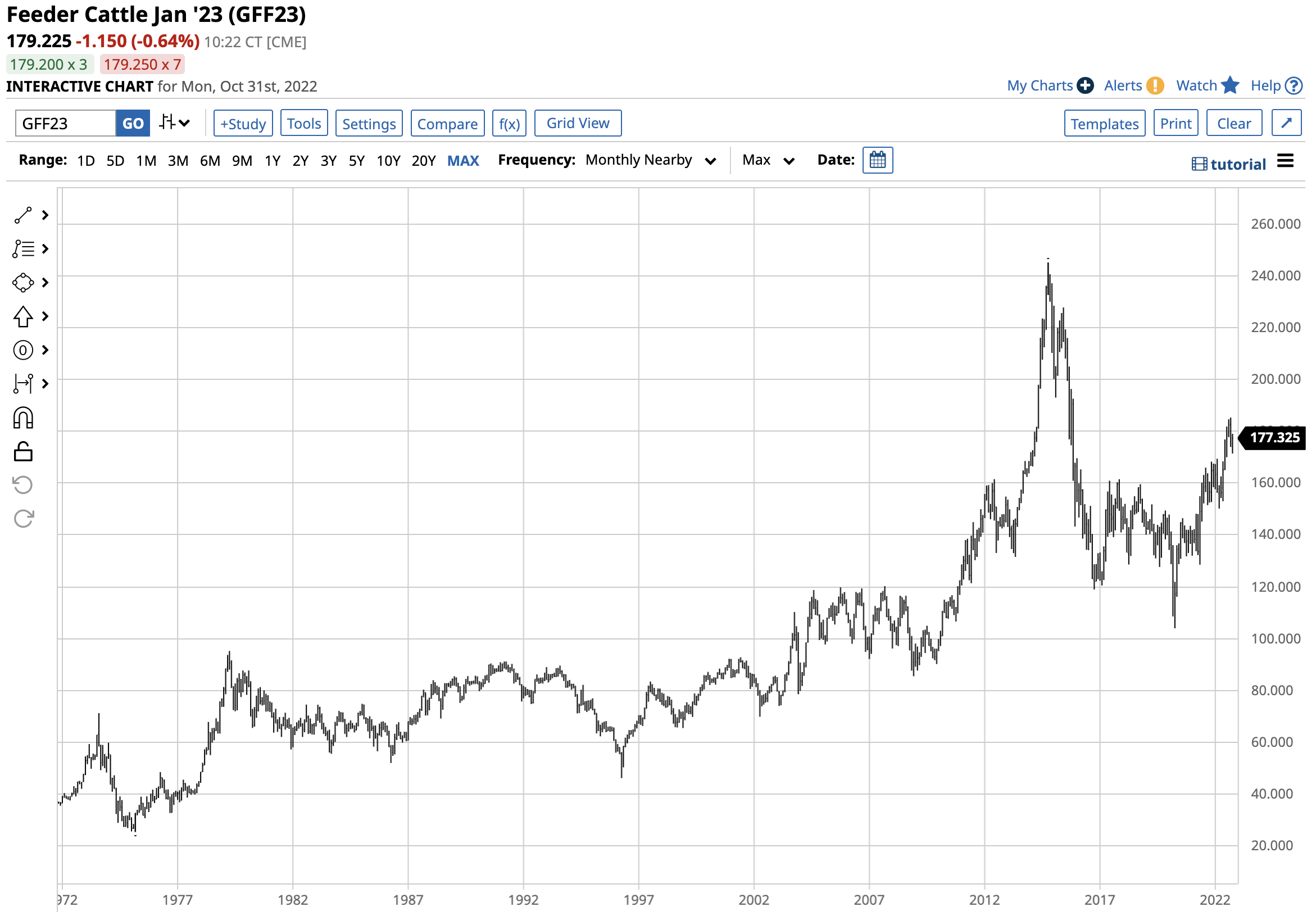
The chart illustrates feeder cattle’s most recent peak came in September 2022 at $1.8530 per pound. The nearby feeders were above the $1.77 level on October 31, with feeder cattle for January delivery above $1.79. The record peak was in October 2014 at $2.4520 per pound.
Feeder cattle are highly sensitive to feed costs, and elevated corn and soybean prices continue to put upside pressure on beef prices. In the latest October World Agricultural Supply and Demand Estimates Report, the USDA raised its 2022 beef price forecasts on “strength in packer demand.” However, it left the 2023 price forecast unchanged from the September report.
Hogs reflect seasonal patterns but remain at an elevated price
The volatile lean hog futures plunged to the lowest level since 2002 when the nearby futures fell to 37.0 cents per pound in April 2020. Since then, hog futures have exploded higher.
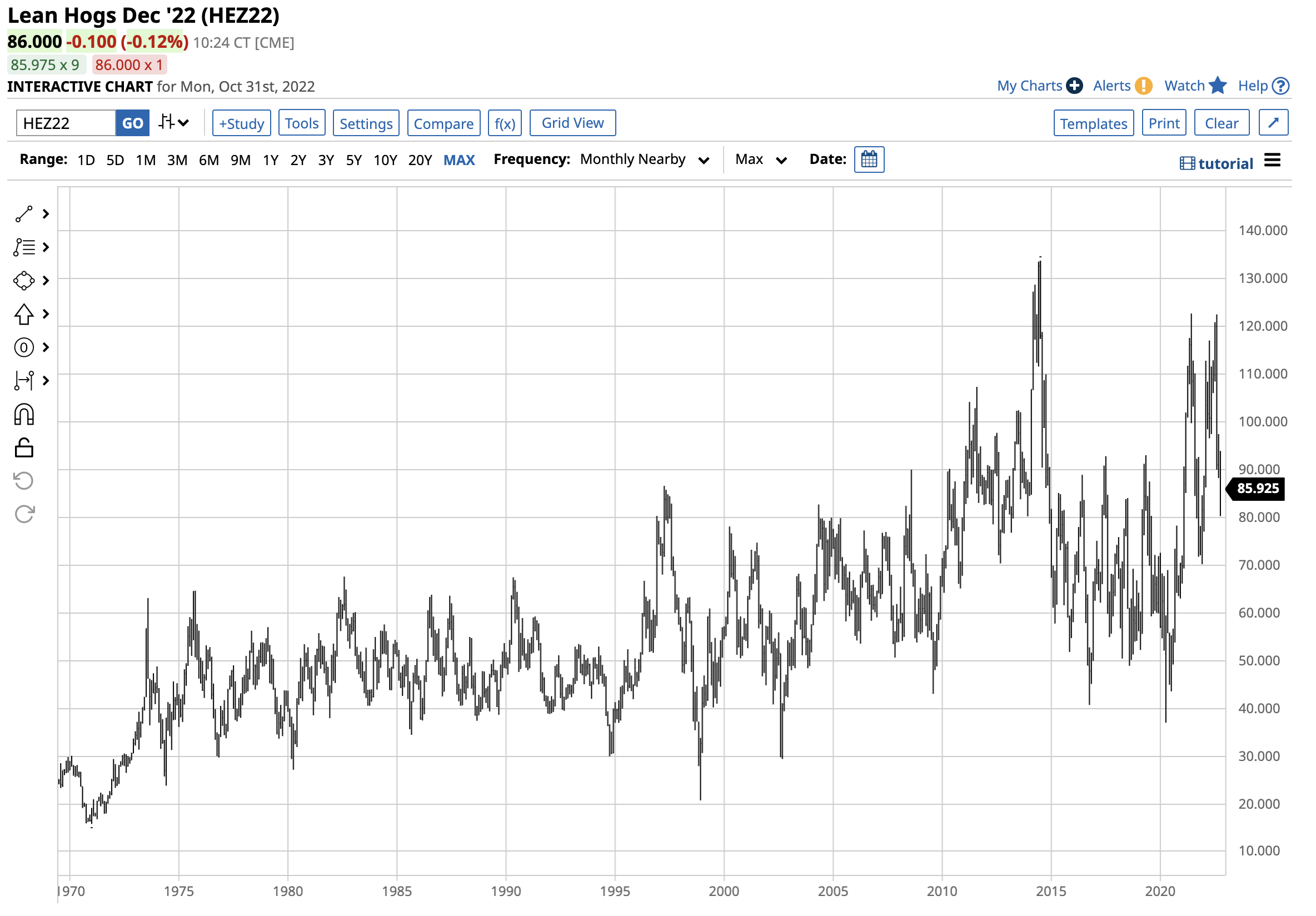
The long-term chart shows the bullish bias in the hog futures arena since the late 1990s. Nearby hog futures traded over $1.22 per pound in June 2021 and August 2022. Seasonality pushed the hogs for December 2022 delivery to the 86.00 cents level on October 31, but they remain elevated compared to the past years during the offseason for demand.
The October WASDE lowered the price forecasts for 2022 and 2023, but nearby hog futures bounced off the 80 cents per pound level in October.
The bullish case for meats in 2023
Given the seasonality in the meat futures markets, declines over the coming weeks and months and into early 2023 are possible. However, the following factors point to higher prices in 2023 as the next grilling season starts in late May:
- The highest inflation in four decades is causing commodity production costs to increase, and meats are no exception.
- Feed prices, the critical ingredient in raising meat-yielding animals, are elevated because of the war in Ukraine. Ukraine and Russia are leading grain-producing countries. If the war continues, the fertile soils in Europe’s breadbasket will remain battlefields. Moreover, the Black Sea Ports, a crucial logistical hub, is a war zone, creating agricultural product shortages and increasing prices. Higher grains are bullish for meat prices.
- The nearby soybean crush spread reached a new record high in October 2022. The margin for crushing beans into soybean meal and oil pushes animal feed prices higher, as soybean meal is a critical ingredient.
- The paths of least resistance in meat futures are higher, and the trend is always your best friend in markets.
I view any significant price corrections in the beef and pork futures are buying opportunities for 2023. However, I would leave plenty of room to add on further declines as meats are volatile commodities, and picking bottoms is risky. A scale-down buying approach will likely be optimal over the coming months.
COW is the livestock ETN product
The most direct route for a risk position in the cattle and hog arenas is via the futures and futures options on the Chicago Mercantile Exchange (CME). The iPath Series B Livestock TR ETN product (COW) provides an alternative to the futures arena.
At $39.60 per share, COW had $28.244 million in assets under management. The ETN trades an average of 7,602 shares daily and charges a 0.45% management fee. COW is not the most liquid ETN product, but it does an excellent job following the meat futures.
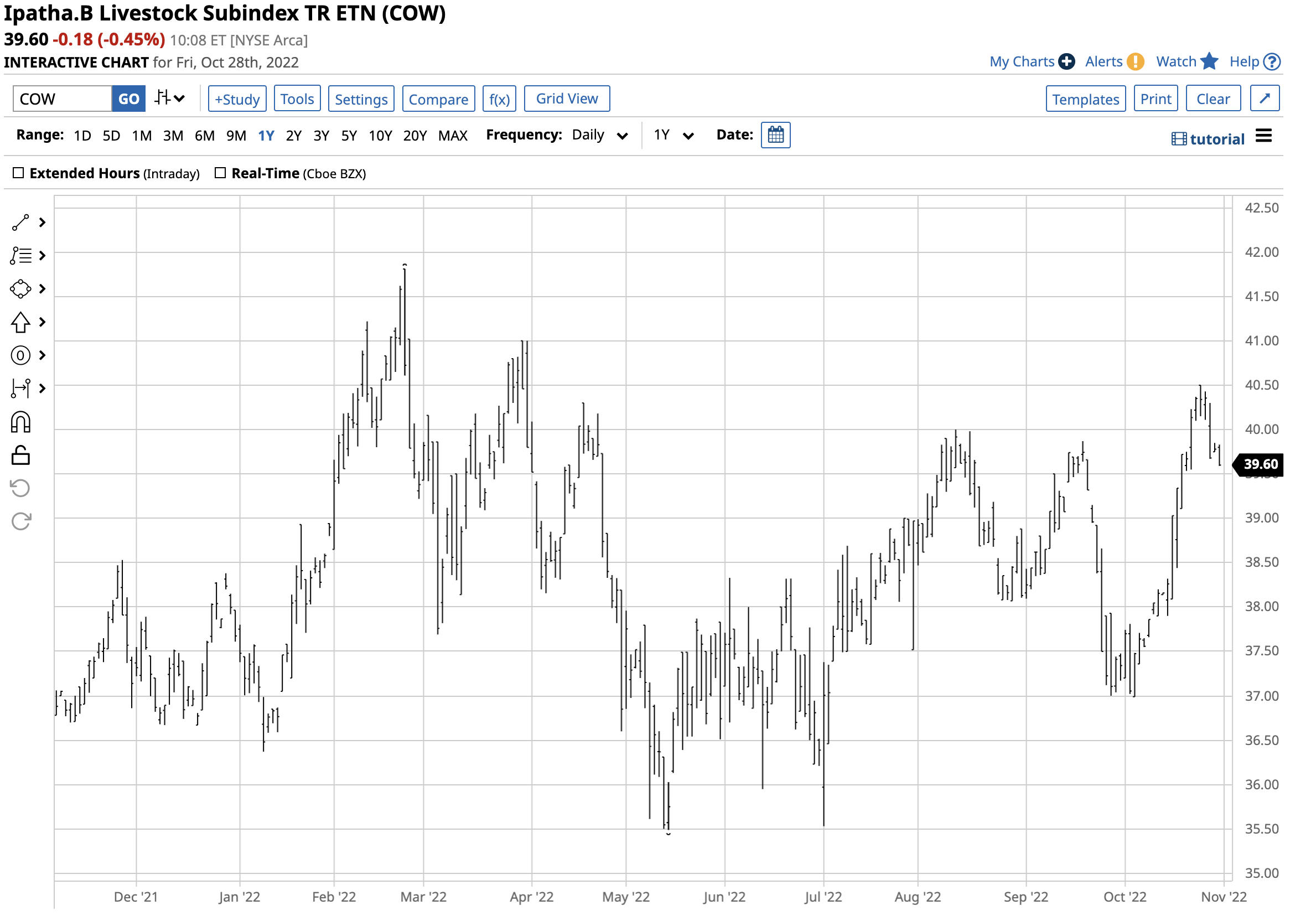
The chart shows that COW closed at $37.67 on December 31, 2021. At the $39.60 level on October 31, 2022, COW was 5.12% higher in 2022.
Since the ETN can be an illiquid product, I suggest avoiding stops and executing buy orders at predetermined levels without chasing the ETN higher or lower. Over the coming months, a wide scale-down buying program could lead to a scale-up profit-taking opportunity in 2023 when the peak demand season approaches and meat futures experience seasonal rallies.
More Livestock News from Barchart
- New Week In Hogs Market
- Cattle Head into New Week
- "Pass More Steak, Please"
- Hogs Rebound into Weekend


/AI%20(artificial%20intelligence)/Ai%20chip%20by%20Quality%20Stock%20Arts%20via%20Shutterstock.jpg)


/Seagate%20sign%20on%20the%20building%20atits%20operational%20headquarters%20By%20JHVEPhoto.jpeg)