


Pick and shovel investment vehicles support an underlying market or asset class. In metals, the PICK ETF that holds shares the leading metals mining companies that extract ores from the earth’s crust and process them into metals. In energy, The OIH ETF product owns shares in companies that provide services to the oil and gas industry. Fertilizer and farm equipment companies are agricultural pick and shovel investments as they provide the inputs and equipment necessary to grow crops.
On April 14, 2021, the NASDAQ listed Coinbase Global Inc (COIN) shares, which I view as a pick and shovel play on the burgeoning cryptocurrency asset class. COIN is a crypto exchange, and its fortunes will rise and fall with the future of the growing market. COIN is a platform that supports buying and selling of the leading and most well-capitalized cryptocurrencies.
COIN shares exploded higher on the listing day before halving in value
COIN did not go on the traditional IPO route when it listed shares on the tech-heavy NASDAQ exchange on April 14, 2021. The company opted to save the excessive investment banking and marketing fees and avoided a lock-up period for founders and early investors with substantial shareholdings. The pre-listing reference price was $250 per share, but COIN shares traded at over $400 on its first trading day.

The chart shows COIN traded to a high of $429.54 on April 14, giving the company a market cap of around $100 billion, above the two leading US exchange platforms, the Chicago Mercantile Exchange (CME) and the Intercontinental Exchange (ICE).
The April 14 listing pushed Bitcoin, the leading cryptocurrency, to a new all-time high. The crypto and COIN shares corrected from the highs. COIN fell on the back of weakness in Bitcoin and likely suffered from insider selling in the first session. On April 14, the stocks closed at the $328 level, a little over $100 below the session’s high. By May 19, the shares fell to $208, which remains the low and critical technical support level.
COIN has followed the asset class since the mid-April listing
Since mid-April, COIN shares have followed Bitcoin prices, but a new high in the crypto did not push COIN to a higher level than on April 14.
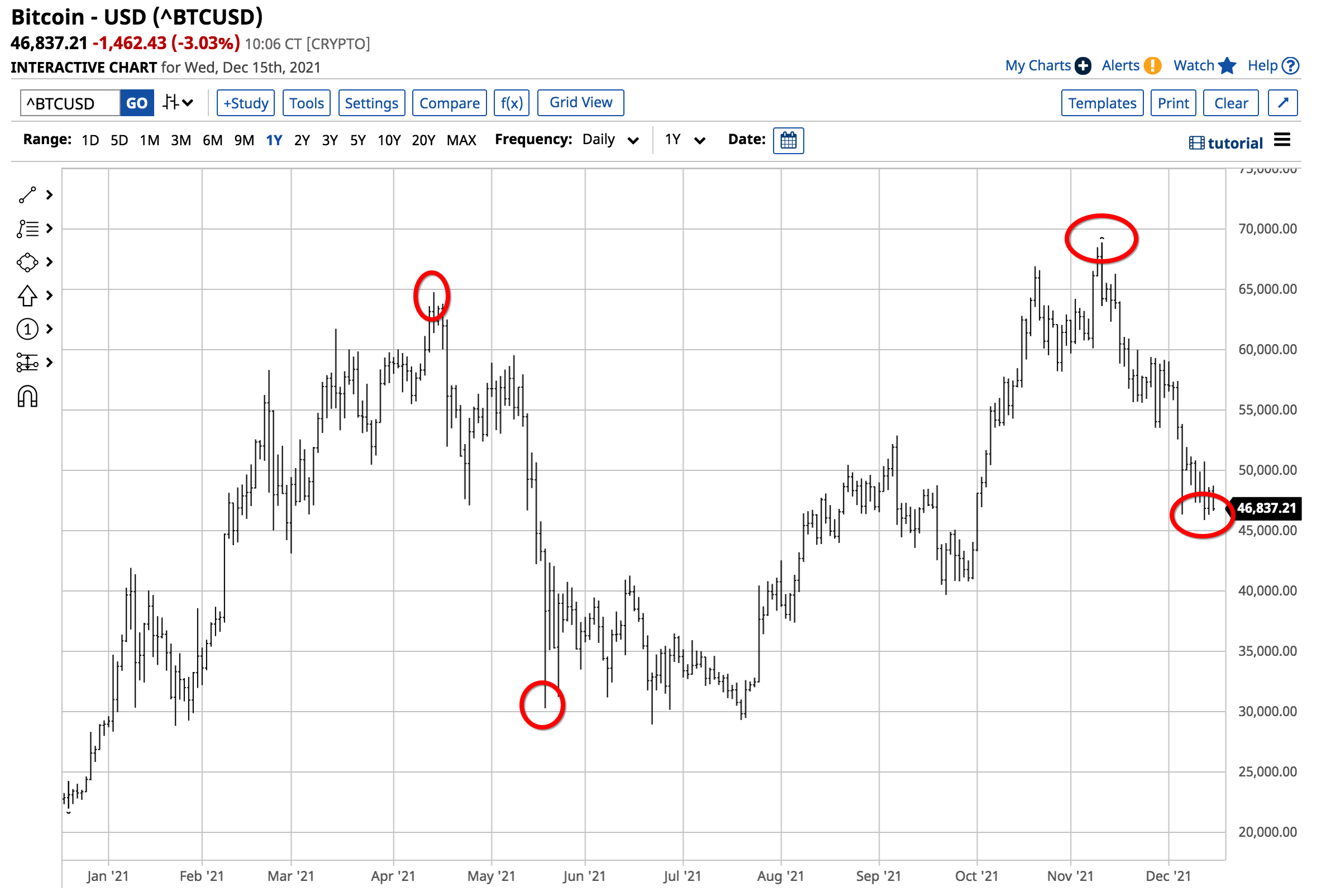
The chart shows the move in Bitcoin from a high of $64,789.27 on April 14 to a low of $30,321.04 on May 19, a 53.2% decline. Over the same period, COIN’s decline from $429.54 to $208 was a 51.6% drop. Bitcoin rose to a new high on November 10 at 68,906.48, a 127.4% rally from the May low. COIN shares moved to a high at $368.90 on November 9, 77.4% above the high. Meanwhile, at the $250 level on December 15, COIN shares were 32.2% lower than the lower high, while Bitcoin at $46,911 was 31.9% lower.
Trading around the $250 reference price
COIN shares have kept pace with percentage moves in Bitcoin, but the exchange business earns profits based on volume instead of price. While a bull market tends to cause increasing volumes, exchanges like COIN make money on each transaction.
In a growing asset class with over 15,650 different cryptocurrencies as of December 15, COIN offers trading services in a select group of cryptos with substantial market caps that create the critical mass necessary for liquidity. Traders and investors depend on liquidity that makes for tight bid-offer spreads. COIN’s description states:

Fifty cryptos is under one-half of one percent of the number of tokens trading in the asset class, so COIN has plenty of room for growth. Meanwhile, the shares were trading around the $250 reference price on December 15, which was the level the market considered “fair value” before the listing. Any selling by founders or early investors likely occurred around the listing date.
Comparing market caps with the two other leading exchanges- Volatility encourages volume
At $250 per share, COIN’s market cap stood at the $55.062 billion level. It briefly rose to over the $100 billion level on the listing day. An average of 4.26 million shares change hands each day.
The Chicago Mercantile Exchange (CME) is the world’s leading futures market. At $227.56 per share, the CME’s market cap stood at $81.781 billion. An average of 1.25 million CME shares are traded each day.
The Intercontinental Exchange, which owns worldwide exchanges across all asset classes, at $134.50, had a market cap of $75.389 billion. An average of 2.234 million ICE shares trade on an average session.
CME and ICE shares were close to all-time highs on December 15. The market caps of each have not yet reached the $100 billion level, a feat COIN achieved on April 14. The bottom line is that all three exchanges make money on volume. They are pick-and-shovel plays on the underlying assets they list. Bull markets attract more market participants and tend to push volumes higher.
COIN makes profits on volume- A crypto investment that does not require a wallet
I do not own any cryptocurrencies. Like many old-school investors and traders, I missed the boat because I cannot wrap my head around computer wallets. Moreover, trusting other custodians in cyberspace is a challenge. When the crypto markets address the custody and security issues, I will be far more comfortable trading and investing in the burgeoning asset class. There are several tokens I would love to own, but I have enough problems using word and excel. For me, a computer wallet with a key is a frightening concept.
Meanwhile, I own Coinbase (COIN) shares as I believe it is a way to participate in the growth of the asset class without all of the risks of computer wallets or custodial issues. I would add to my long position below the $220 level as the growing number of cryptos offers lots of opportunities for the exchange with a leadership role. I believe that we will see the share price move to a new high above the April 14, 2021 peak over the coming years.

/A%20Palantir%20sign%20displayed%20on%20an%20office%20building%20by%20Poetra_RH%20via%20Shutterstock.jpg)

/Chipset%20held%20over%20rush%20hour%20traffic%20by%20Jae%20Young%20Ju%20via%20iStock.jpg)
/Meta%20by%20creativeneko%20via%20Shutterstock.jpg)
/Tesla%20charging%20station%20black%20background%20by%20Blomst%20via%20Pixabay.jpg)