/Berskshire%20Hathaway%20Warren%20Buffett%20image%20by%20QubixStudio%20via%20Shutterstock.jpg)
Berkshire Hathaway (BRK.A) (BRK.B) made some news over the weekend when the company dropped its second-quarter earnings report. Since it was a Saturday, Berkshire pretty much had the financial media to itself, and there was plenty of discussion about CEO Greg Abel beginning to spend the conglomerate’s vast cash hoard.
I was focused on another number, however: $4.5 billion. Berkshire greatly accelerated the company's share buyback efforts during the quarter, spending $4.5 billion to repurchase shares after spending only $235 million in Q1.
This repurchasing sends a clear signal — Abel and his predecessor, board chairman Warren Buffett, believe that Berkshire Hathaway’s value exceeds the market price of Berkshire Hathaway stock. The company does not hold earnings calls with analysts — a practice followed by most companies — but Berkshire did note in its 10-Q filing that it repurchased 65 shares of Class A stock and 1.45 million shares of Class B stock in May, followed by 413 Class A shares and 7.13 million Class B shares in June.
“Berkshire’s common stock repurchase program currently permits Berkshire to repurchase its Class A and Class B shares any time that Berkshire’s Chief Executive Officer, after consultation with the Chairman of the Board, believes that the repurchase price is below Berkshire’s intrinsic value, conservatively determined,” the company wrote in the filing.
Share repurchases benefit current shareholders because they incrementally increase the value of their stake. But I also consider the repurchases to be a signal to prospective shareholders that Berkshire Hathaway is undervalued right now, and worth a closer look.
About Berkshire Hathaway
It’s possible that you do business with Berkshire Hathaway every day without realizing it. The conglomerate owns dozens of companies, including battery-maker Duracell, Pampered Chef, Fruit of the Loom, Geico, and the BNSF Railway. On top of that, Berkshire Hathaway has a vast investment portfolio valued at $263 billion, with some of its greatest holdings being in Apple (AAPL), American Express (AXP), Coca-Cola (KO), Alphabet (GOOGL), and Bank of America (BAC).
Overall, Berkshire Hathaway is one of the biggest publicly traded companies in the world with a market capitalization of $1.1 trillion. Shares are up nearly 10% in the last year, which is a solid return but not as good as the S&P 500’s ($SPX) gain of 21%. Over the last five years, Berkshire has narrowly beaten the larger index, gaining 80% versus the 75% gain of the S&P 500.
Still, the stock has a higher price-to-earnings (P/E) ratio than the broader index at roughly 25 times versus the 21 times of the S&P 500.
Berkshire Beats on Earnings
Berkshire’s earnings report showed revenue of $101.81 billion, up 10% from a year ago and beating the analyst consensus estimate of $96.52 billion. Operating earnings were $12.98 billion, up 16% year-over-year (YOY), and net profit was $25.67 billion. The company posted earnings of $6.02 per share, beating estimates of $5.13 per share.
Although insurance net earnings fell from $1.99 billion in the prior-year period to $1.73 billion, and insurance investment income fell to $3.06 billion, Berkshire saw stronger earnings from manufacturing, service, and retailing, which increased 24% YOY to $4.47 billion. Berkshire Hathaway Energy's profit also came in at $891 million, up 27% YOY, while BNSF Railway profits were $1.56 billion, up 6% YOY.
Berkshire also notably reversed a 14-quarter trend of stock sales, with its massive cash pile shrinking from $397.4 billion to $365.5 billion — still enough to purchase most S&P 500 companies outright.
Should You Buy Berkshire Stock Now?
I think Berkshire Hathaway is a great investment. But at the same time, the valuation is higher than it has been in several years. With that in mind, let’s turn to Abel and Buffett and use their rule of thumb.
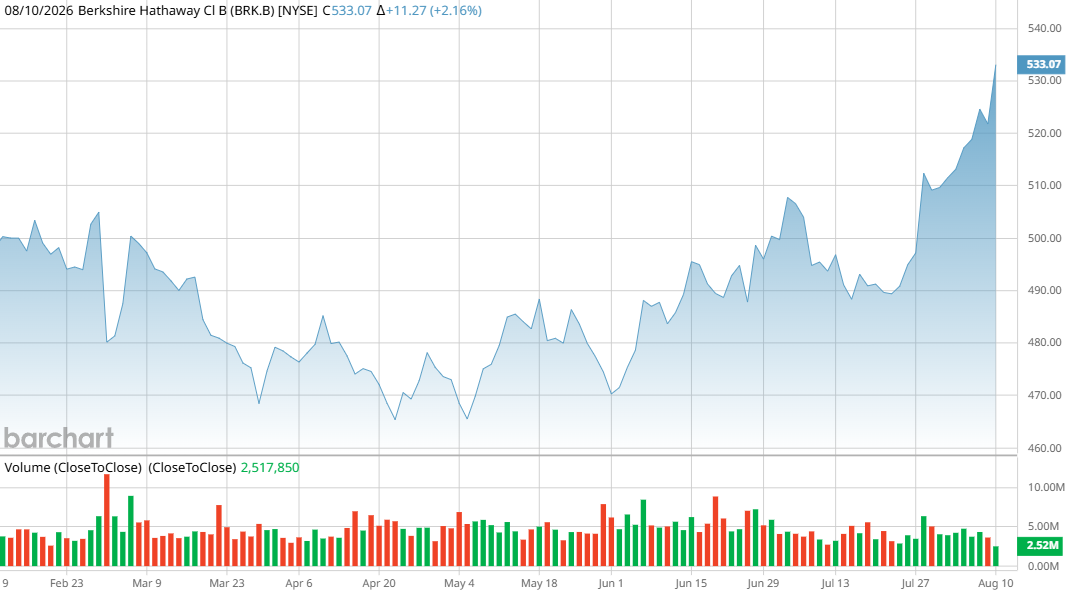
Class A shares of Berkshire are worth more than $700,000 apiece, so we'll focus specifically on the more affordable Class B shares. According to Berkshire’s filing, the company repurchased shares in May at an average price of $476.01 per share, then repurchased shares in June at an average price of $487.98 per share.
Berkshire’s Class B shares currently trade at around $511, so the stock price would need to drop about 5% for you to buy shares at the same average price as Berkshire’s June purchase. The $487.98 price point is not necessarily a ceiling or a floor, but it is a data point investors can use to help determine whether the stock is a good price.
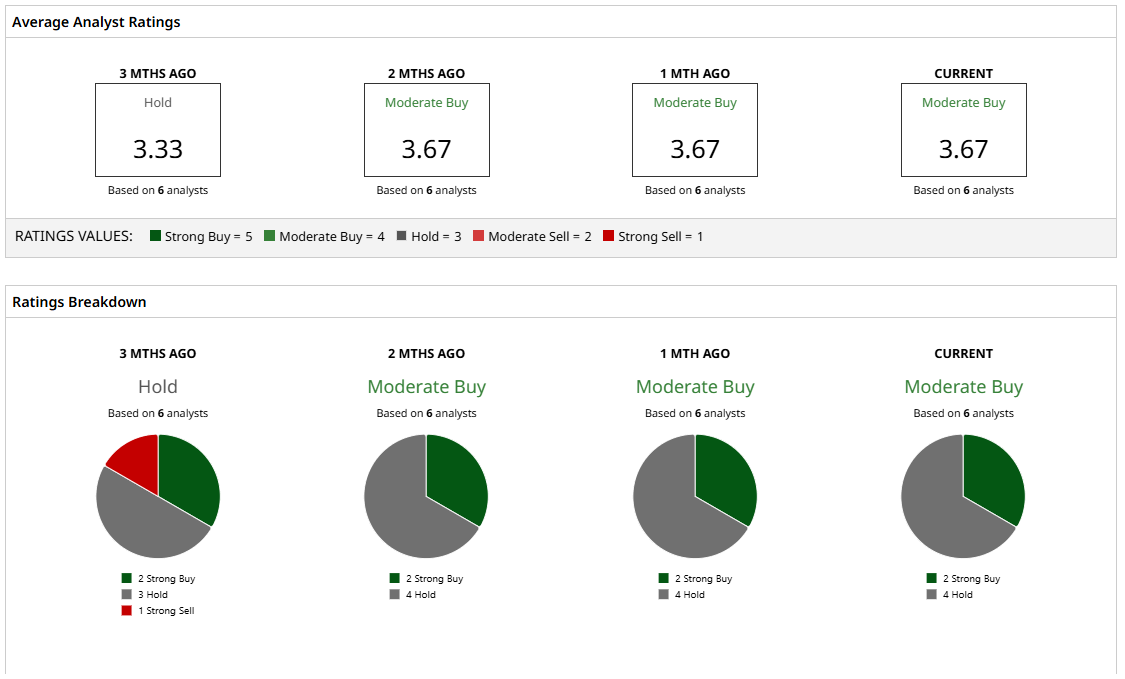
If shares reach that level, you could be getting great value for Berkshire Hathaway stock, just like Abel and Buffett. Shares are currently trading about 4% below the mean price target of $531.60 set by analysts. Overall, Berkshire stock has a consensus “Moderate Buy” rating on Wall Street.
On the date of publication, Patrick Sanders did not have (either directly or indirectly) positions in any of the securities mentioned in this article. All information and data in this article is solely for informational purposes. For more information please view the Barchart Disclosure Policy here.

/Sign%20of%20Intel%20at%20entrance%20%20by%20michaelmond.jpeg)

/NVIDIA%20Corp%20logo%20outside%20building-by%20BING-JHEN_HONG%20via%20iStock.jpg)