/Apple%20Inc%20logo%20on%20Apple%20store-by%20PhillDanze%20via%20iStock.jpg)
Bank of America recently asserted that Apple (AAPL) on June 22 had unveiled “a material positive reset of its AI strategy.” While Apple's new strategy does appear to be superior to its previous approach to AI, it's difficult to see how the change will significantly boost the company's top or bottom lines.
Meanwhile, the huge, recent increases in flash-memory prices could cause the company's growth to meaningfully decelerate going forward.
In light of these points, along with Apple's valuation that is not especially attractive and the performance of AAPL stock over the last few years, I do not expect the name to meaningfully outperform the Nasdaq ($NASX) in the next 12 months.
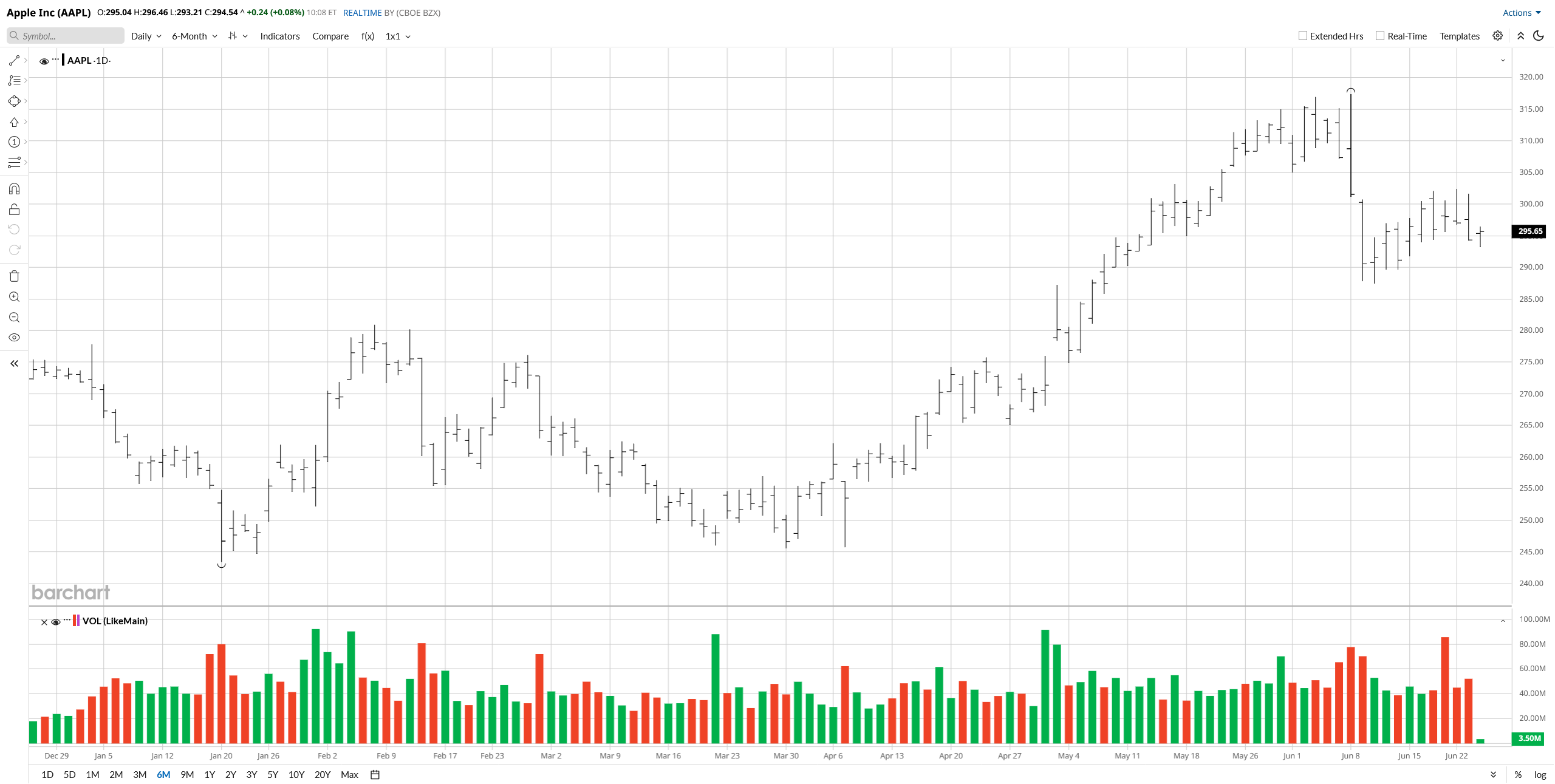
About AAPL Stock
Primarily due to the iPhone’s popularity and its high gross margins, Apple is one of the most profitable companies in the world. In the 12 months that ended in September, it generated income of $112 billion. Consequently, its market capitalization, which stands at about $4.36 trillion, is huge.
The tech giant's trailing price-earnings ratio of 36 is somewhat elevated, given the challenges that it faces.
Bank of America's Take
According to Bank of America, Siri has been “repositioned as a context-aware, multimodal, cross-app assistant embedded across the Apple ecosystem.” Additionally, the assistant "combines personal context understanding, onscreen awareness, broad world knowledge, and systemwide app actions," potentially making it superior to “generic assistants,” the bank contended.
It kept a $380 price target and a “Buy” rating on the shares.
Why Siri Probably Won't Move the Needle for AAPL Stock
The principal way that AI could positively move the needle for AAPL is if its technology spurred more consumers to buy iPhones. But in all probability, the latter phenomenon will not occur. That's because the new Siri is actually powered by Alphabet's (GOOG) (GOOGL) Google Gemini models. Since Android smartphones also use Google's technology, it's almost definitely providing the same or better AI capabilities to high-end Android models. Therefore, iPhones' market share is unlikely to meaningfully increase as a result of Siri's upgrades.
Meanwhile, in terms of obtaining revenue by charging fees for Siri, Apple has a major disadvantage because Google's Gemini, Microsoft's (MSFT) Copilot, and OpenAI's ChatGPT have been in the market for years, giving them a big first-mover advantage over AAPL. Consequently, I don't expect the iPhone maker to obtain needle-moving revenue through that route.
Further, most people conduct research for work on laptops or PCs, and MSFT's installed base is much bigger when it comes to those types of devices than Apple's. Therefore, any investor looking to benefit from the use of AI for research should buy MSFT stock, not Apple's shares. Alternatively, Android, which holds almost two-thirds of the mobile devices OS market share, makes GOOG another, better alternative than AAPL for such investors.
Apple's Flash-Memory Issue
Flash-memory and storage are widely used in Apple's devices, and flash-memory and storage prices “have quadrupled over the past year,” Wall Street Journal reporter Rolfe Winkler recently told Yahoo Finance. Winkler suggested that Apple could raise the price of its entry-level iPhone 18 by $200 to $1,299 in order to prevent its margins on the device from dropping.
If Apple raises its prices by similar percentage levels on all of its offerings, the demand for its products could meaningfully decline, causing its top-and-bottom-line growth to significantly decelerate.
AAPL Stock Has Not Performed Very Well in Recent Years
In the last three years, AAPL's shares have advanced slightly above 50%. Amazon (AMZN), Alphabet, Nvidia (NVDA), and Netflix (NFLX) have all risen meaningfully more during the same period. Given Apple's flash-memory challenge and its likely lack of a boost from AI, along with its valuation that is not especially low, I expect it to continue to underperform many if not most of its large-cap tech peers for the next year.
On the date of publication, Larry Ramer had a position in: AMZN . All information and data in this article is solely for informational purposes. For more information please view the Barchart Disclosure Policy here.


/A%20Palantir%20office%20building%20in%20Tokyo_%20Image%20by%20Hiroshi-Mori-Stock%20via%20Shutterstock_.jpg)
/Elon%20Musk%2C%20founder%2C%20CEO%2C%20and%20chief%20engineer%20of%20SpaceX%2C%20CEO%20of%20Tesla%20by%20Frederic%20Legrand%20-%20COMEO%20via%20Shutterstock.jpg)
/Microsoft%20sign%20at%20the%20headquarters%20by%20VDB%20Photos%20via%20Shutterstock.jpg)