
Covered calls are a great strategy to add to any portfolio, particularly in this era of low yields. Covered calls can offer enhanced yield from stock holdings, in some case, that can be a significant increase.
To trade a covered call we need to own (or buy) 100 shares of a stock and then sell a call option against that stock position.
The goal is to generate income from the stock holding in addition to any dividends. The premium received from selling the call also covers a small decline in the stock price. However, the trade off is that stock gains are limited above the call option strike price.
High volatility stocks have the highest return potential with covered calls, but they also have the highest risk of an adverse price movement. It’s all about finding a strategy that fits the investors risk tolerance.
Let’s look at a few examples using Barchart’s Covered Call Screener.
This first example shows the results of the screener with the default parameters selected.
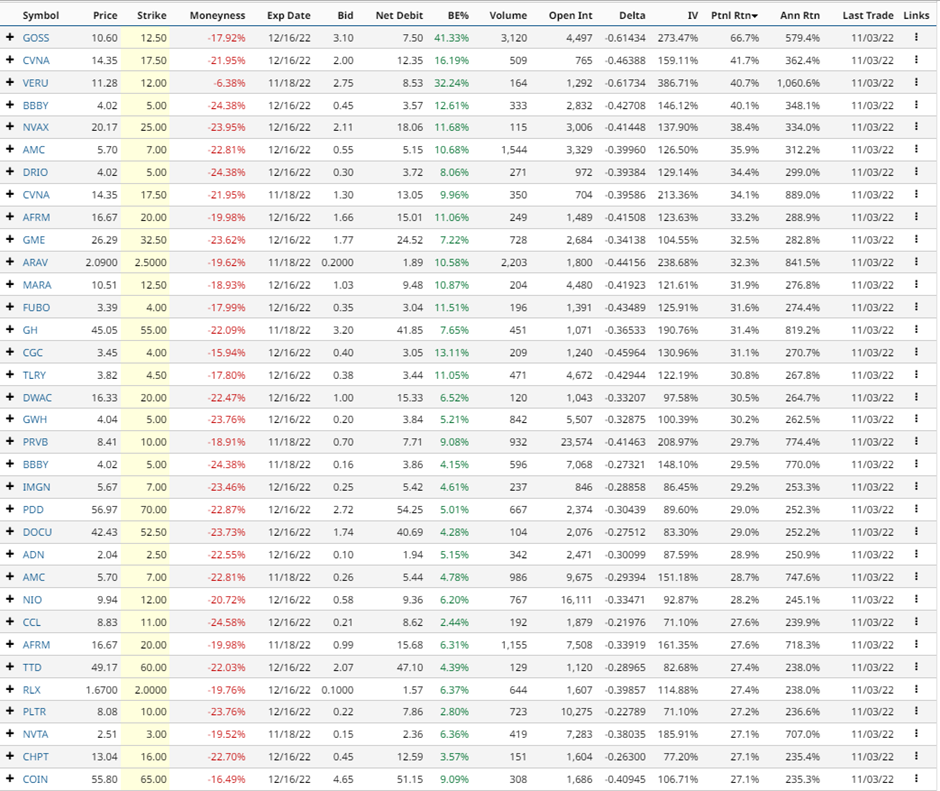
This result returns some stocks with very low market capitalization and, while the returns look great, the risks can also be very high.
Let’s add a filter for Market Cap over 40 billion and 60-month Beta below 1.00. We’ll also change the Moneyness filter from -25% to 0% and add a 50% Buy rating criteria.
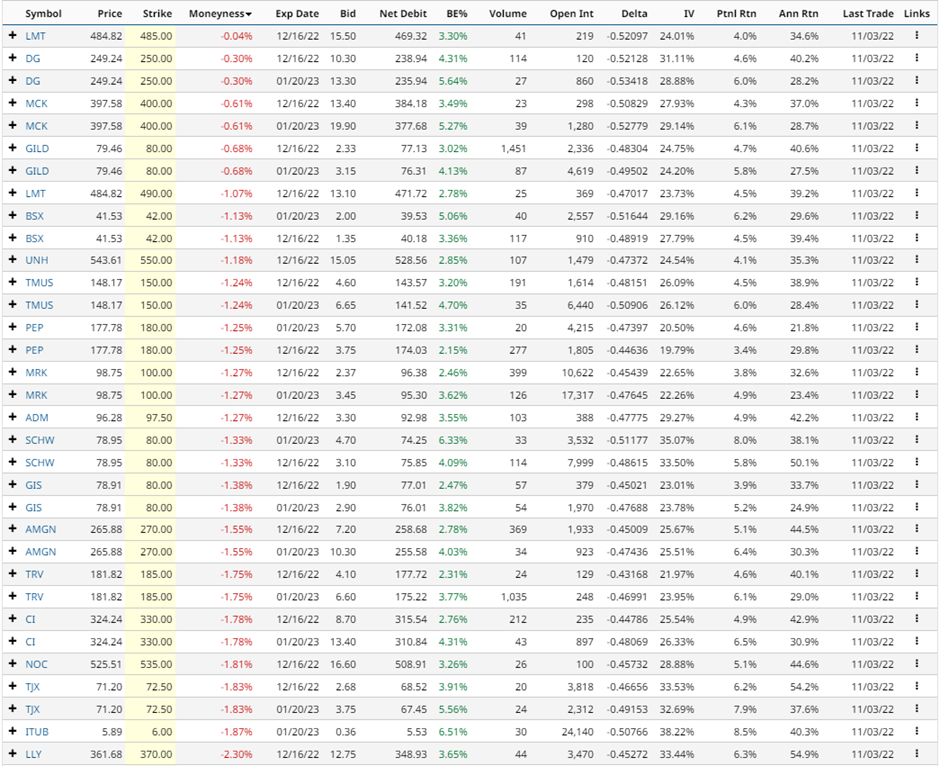
Now, we’re seeing some more mainstream names such as LMT, DG, GILD, UNH, PEP, MRK, ADM, SCHW, AMGN, TRV and LLY.
GILD Covered Call Example
Let’s evaluate the sixth line item, a covered call on GILD. Buying 100 shares of GILD would cost $7,946.
The January 80 strike call option was trading yesterday around $3.15, generating $315 in premium per contract for covered call sellers.
Selling the call option generates an income of 4.13% in 77 days, equalling around 19.32% annualized. That assumes the stock stays exactly where it is. What if the stock rises above the strike price of 80?
If GILD closes above 80 on the expiration date, the shares will be called away at 80 leaving the trader with a total profit of $369 (gain on the shares plus the $315 option premium received).
That equates to a 5.8% return, which is 27.5% on an annualized basis.
GILD is currently followed by 18 analysts with 8 Strong Buy ratings, 1 Moderate Buy rating and 9 Hold ratings.
The Barchart Technical Opinion rating is a 100% Buy with a strongest short term outlook on maintaining the current direction.
The current IV Percentile is 41% which means that the current level of implied volatility is higher than 41% of all occurrences in the last 12 months.
MRK Covered Call Example
Let’s look at another example, this time using Merck.
Buying 100 shares of MRK would cost $9,875. The December 100 strike call option was trading yesterday around $2.37, generating $237 in premium per contract for covered call sellers.
Selling the call option generates an income of 2.46% in 42 days, equalling around 20.87% annualized.
That assumes the stock stays exactly where it is. What if the stock rises above the strike price of 100?
If MRK closes above 100 on the expiration date, the shares will be called away at 100 leaving the trader with a total profit of $362 (gain on the shares plus the $237 option premium received).
That equates to a 3.8% return, which is 432.6% on an annualized basis.
MRK is currently followed by 18 analysts with 12 Strong Buy ratings and 6 Hold ratings.
The Barchart Technical Opinion rating is an 88% Buy with a strengthening short term outlook on maintaining the current direction.
The current IV Percentile is 31% which means that the current level of implied volatility is higher than 31% of all occurrences in the last 12 months.
Please remember that options are risky, and investors can lose 100% of their investment. This article is for education purposes only and not a trade recommendation. Remember to always do your own due diligence and consult your financial advisor before making any investment decisions.
More Stock Market News from Barchart
- Stocks Fall on the Outlook for Tighter Fed Policy
- Markets Boost Rate-Hike Expectations after FOMC Meeting Outcome
- Stocks Fall on Hawkish Fed Policy Outlook
- Markets Today: Stocks Slump on Hawkish Fed and Weakness in Tech Stocks

/AI%20(artificial%20intelligence)/Ai%20chip%20by%20Quality%20Stock%20Arts%20via%20Shutterstock.jpg)

/A%20close-up%20of%20the%20Broadcom%20logo%20on%20a%20smartphone%20by%20Timon%20via%20Adobe%20Stock.jpeg)