




What will oil stocks do if crude oil REALLY goes vertical? As in toward its all-time high...or even (gulp) $200 a barrel? Surprisingly, one example from the not-too-distant past suggests energy stock investors might be a little disappointed.
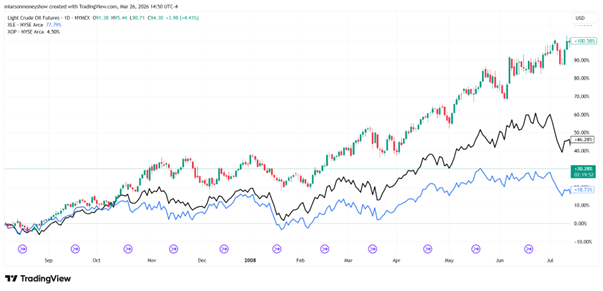
Take a look at the MoneyShow Chart of the Day. It shows the incredible run in WTI crude oil futures during the infamous 2007-2008 bull market – and compares it to the move in two leading energy ETFs, the State Street Energy Select Sector SPDR Fund (XLE) in black and the State Street SPDR S&P Oil & Gas Exploration & Production ETF (XOP) in blue.
(To get more articles and podcasts from MoneyShow, subscribe to our Top Pros’ Top Picks newsletter here.)
WTI Crude Oil Futures, XLE, and XOP (August 2007 – July 2008, % Change)
Source: TradingView
You can see that WTI went bonkers – up roughly 100% between August 2007 and July 2008. But XOP rose just 46.2%, while XLE gained only 18.7%. Sure, those gains aren’t bad. But they don’t represent a “double,” either.
How does the 2007-2008 experience compare with what we’ve seen (so far) in 2026? Take a look…
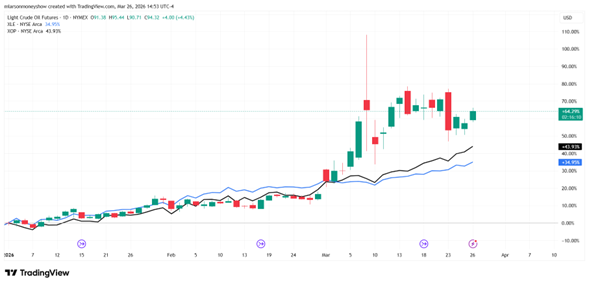
WTI Crude Oil Futures, XLE, and XOP (YTD % Change)
Source: TradingView
WTI was up 64% year-to-date as of yesterday afternoon. But once again, XOP was up just 43.9% and XLE was up only 34.9%. That sure beats the 5.2% loss for the SPDR S&P 500 ETF Trust (SPY). But it shows that when oil prices go ballistic, you won’t necessarily capture it ALL as an investor in energy stocks.
And it makes sense when you think about it. If prices really surge in the shorter term, it crushes longer-term demand by kneecapping economic growth.
The economy and markets collapsed in 2008 – and even though that was PREDOMINATELY because of the mortgage and housing market crisis, $150-a-barrel oil didn’t help. That fear of demand destruction down the road is why energy stock investors won’t pay through the nose up front.
In this case, sector investors are also worried about damage to Persian Gulf infrastructure and other facilities owned in part by large energy sector players. Plus, they’re concerned about the increased operational costs that energy companies could be stuck with for months or years. That could include higher security, insurance, transportation, personnel, and other expenses.
Bottom line? Yes, higher oil prices are bullish for oil stocks…to a point. But if oil truly goes vertical, your stocks might get left (partially) behind.


/A%20close-up%20of%20a%20SpaceX%20sign%20by%20Sundry%20Photography%20via%20Adobe%20Stock.jpeg)

/AI%20(artificial%20intelligence)/AI%20chip%20by%203Dsss%20via%20Shutterstock.jpg)
/Data%20codes%20through%20eyeglasses%20by%20Kevin%20Ku%20via%20Pexels.jpg)