




Earnings season is well and truly upon us again and we’ve seen some big name already report Q1 numbers this week. Netflix (NFLX) dropped 35% today after announcing a loss of 200,00 subscribers.
Earlier in the week we had Bank of America (BAC), Charles Schwab (SCHW), Haliburton (HAL), Johnson & Johnson (JNJ), Lockheed Martin (LMT) and International Business Machines (IBM) all report.
Today, it was all about Tesla (TSLA) with the company reporting after the close. The stock was down 4.96% during regular trading and is currently +5.57% in the after-hours market. That should bode well for these three option ideas discussed yesterday.
In today’s article, we will look at how to use Barchart’s Screener’s to find option trade ideas for this earnings seasons.
Stock Screener
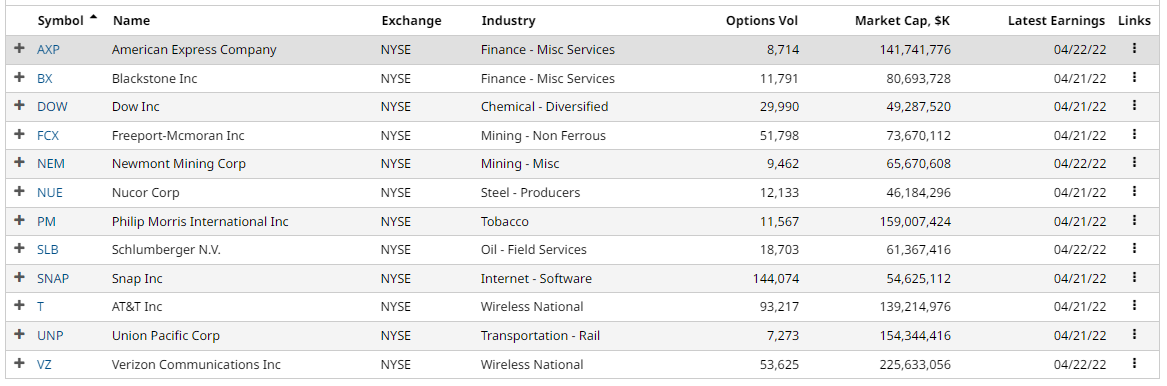
The first step is to use the Stock Screener to find companies with good option volume and upcoming earnings. Here’s a good scan that you might like to use:
- Total Options Volums greater than 5,000
- Market Cap greater than 40 billion
- Latest Earnings Date Between April 21 – April 22
This will give us companies with earnings releases this week that have good option volume. Trading stocks with good option volume is important because it will mean it is easier to get filled on trades and the bid-ask spread is likely to be lower.
The above screener gives us these results:
You may like to change the View to “Technical” which will give the Overall Buy / Sell Rating for each Company.
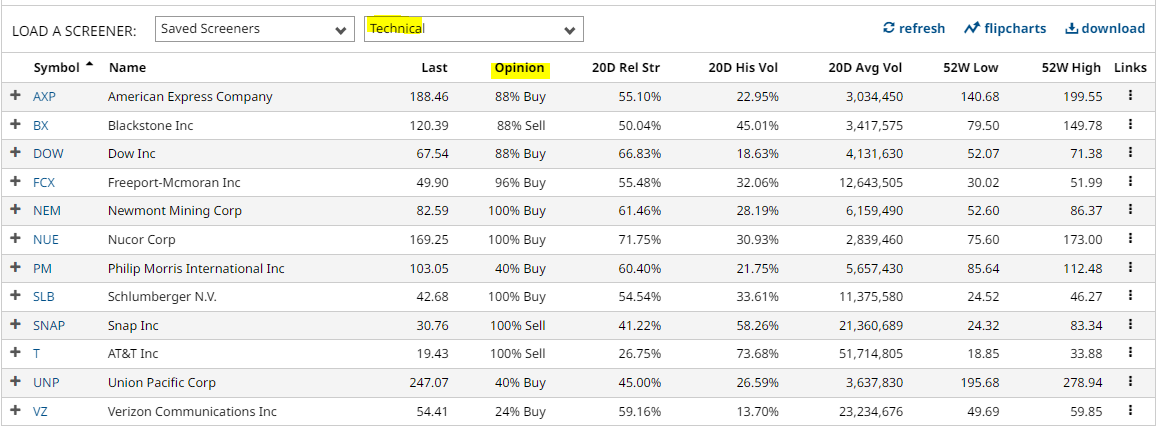
Now we can pick the company or companies we want to trade and decide on a strategy. Let’s look at a couple of examples.
AXP Bull Put Spread
Let’s start with American Express (AXP) and run that through the Bull Put Spread Screener.
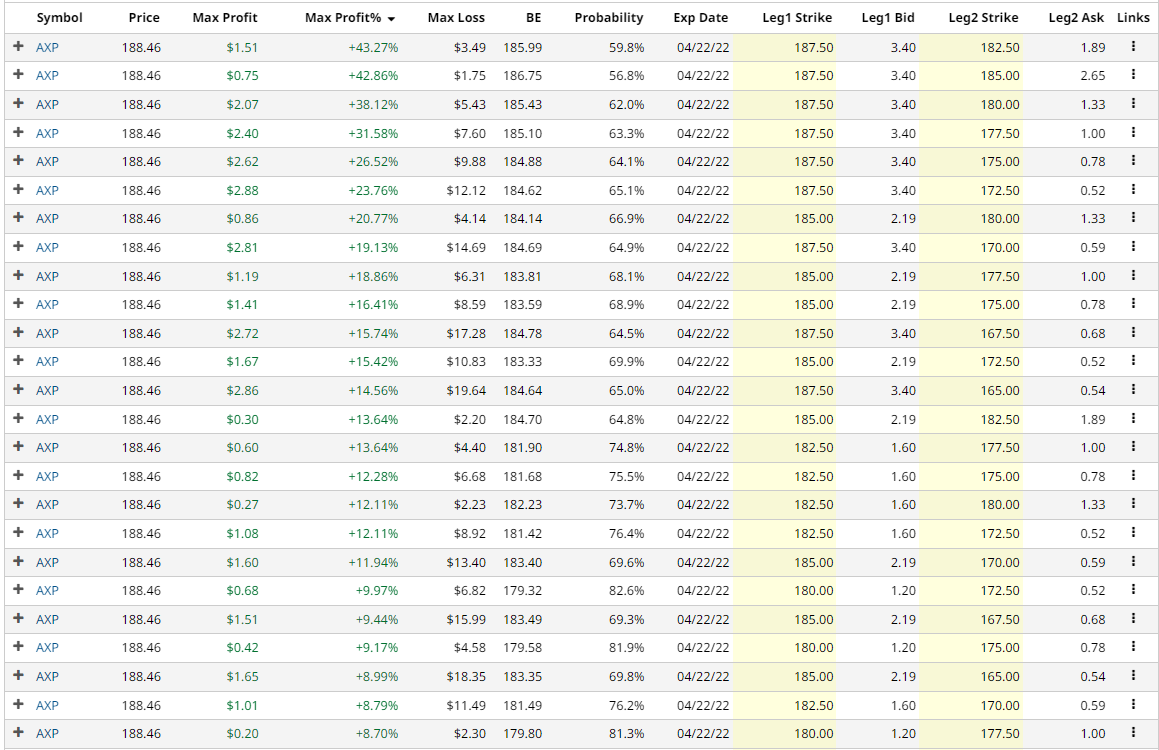
Let’s use the first line item as an example. This bull put spread trade involves selling the April 22 expiry 187.50 strike put and buying the 182.50 strike put.
Selling this spread results in a credit of around $1.51 or $151 per contract. That is also the maximum possible gain on the trade. The maximum potential loss can be calculated by taking the spread width, less the premium received and multiplying by 100. That give us:
5 – 1.51 x 100 = $349.
If we take the maximum gain divided by the maximum loss, we see the trade has a return potential of 43.27%.
The probability of the trade being successful is 59.80%, although this is just an estimate.
The spread will achieve the maximum profit if AXP closes above 187.50 on April 22, in which case the entire spread would expire worthless allowing the premium seller to keep the $151 option premium.
The maximum loss will occur if AXP closes below 182.50 on April 22, which would see the premium seller lose $349 on the trade.
The breakeven point for the Bull Put Spread is 185.99 which is calculated as 187.50 less the $1.51 option premium per contract.
Moving down towards the bottom of the table, we see that the trades have a lower Max Profit Percentage, but a higher Probability of success. There is always a trade off with options.
Traders can also use the Iron Condor Screener if they believe the stock will stay flat, or the Bear Call Spread Screener if they have a bearish outlook.
Conclusion And Risk Management
Trading options over earnings can be risky and is not recommended for beginners. Short-term trades over earnings such as these ones are almost impossible to adjust. Either the trade works, or it doesn’t so position sizing is vital. Short strangles involve naked options and should be avoided by beginner traders.
Short-term trades also have assignment risk, so traders need to be aware of that possibility.
Please remember that options are risky, and investors can lose 100% of their investment.
This article is for education purposes only and not a trade recommendation. Remember to always do your own due diligence and consult your financial advisor before making any investment decisions.
*Disclaimer: On the date of publication, Steven Baster did not have (either directly or indirectly) any positions in any of the securities mentioned in this article. All information and data in this article is solely for informational purposes. Data as of after-hours, April 20, 2022.



/Micron%20Technology%20Inc_logo%20and%20website-by%20Mojahid%20Mottakin%20via%20Shutterstock.jpg)
/Super%20Micro%20Computer%20Inc%20HQ%20photo-by%20Tada%20Images%20via%20Shutterstock.jpg)