



Tyson Foods, Inc. (TSN) is one of the world’s largest food companies and protein producers, specializing in the processing and distribution of chicken, beef, pork, and prepared foods. Headquartered in Springdale, Arkansas, the company plays a central role in the global food supply chain, serving retailers, restaurants, and foodservice providers.
Companies worth $10 billion or more are generally described as “large-cap stocks,” and Tyson, with a market capitalization of around $21.8 billion, fits the criteria perfectly.
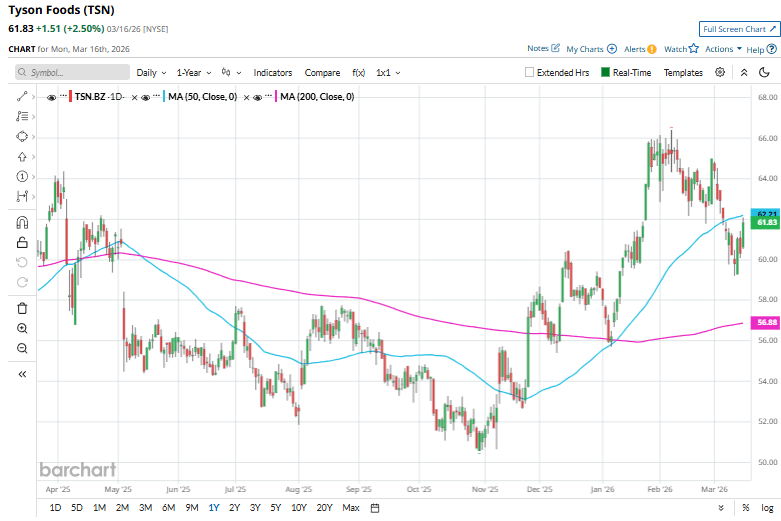
Tyson's shares have retreated 6.9% from their 52-week high of $66.41, met on Feb. 6. Moreover, the stock has gained nearly 6.3% over the past three months, trailing the Invesco Food & Beverage ETF (PBJ), which has surged 7.5% over the same time frame.
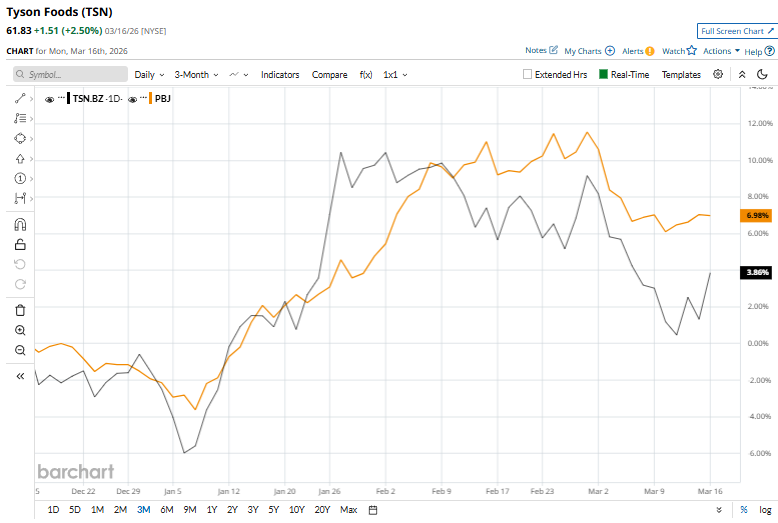
TSN stock has surged 13.8% over the past six months and 3.3% over the past 52 weeks. In contrast, PBJ has rallied 4.4% and 9.4% over the same time periods, respectively.
Since early December, the stock has been trading above its 200-day moving average. However, it has recently dipped below the 50-day moving average.
On Feb. 4, Tyson Foods announced a quarterly dividend of $0.51 per share for Class A and $0.459 per share for Class B common stock, payable on June 15, 2026. This declaration highlights Tyson’s consistent cash flow generation and shareholder-friendly capital allocation strategy, even amid the cyclical nature of the protein industry.
TSN’s rival, Archer-Daniels-Midland Company (ADM), has surpassed TSN over the past year, gaining 50%, but its 13.5% surge over the past six months has trailed Tyson.
TSN has a “Moderate Buy” consensus rating from 11 analysts, and the mean price target of $68.44 signals a premium of 10.7% to current levels.
On the date of publication, Kritika Sarmah did not have (either directly or indirectly) positions in any of the securities mentioned in this article. All information and data in this article is solely for informational purposes. For more information please view the Barchart Disclosure Policy here.




/AI%20(artificial%20intelligence)/Ai%20chip%20by%20Quality%20Stock%20Arts%20via%20Shutterstock.jpg)
/Microsoft%20headquarters%20By%20Peter.jpeg)