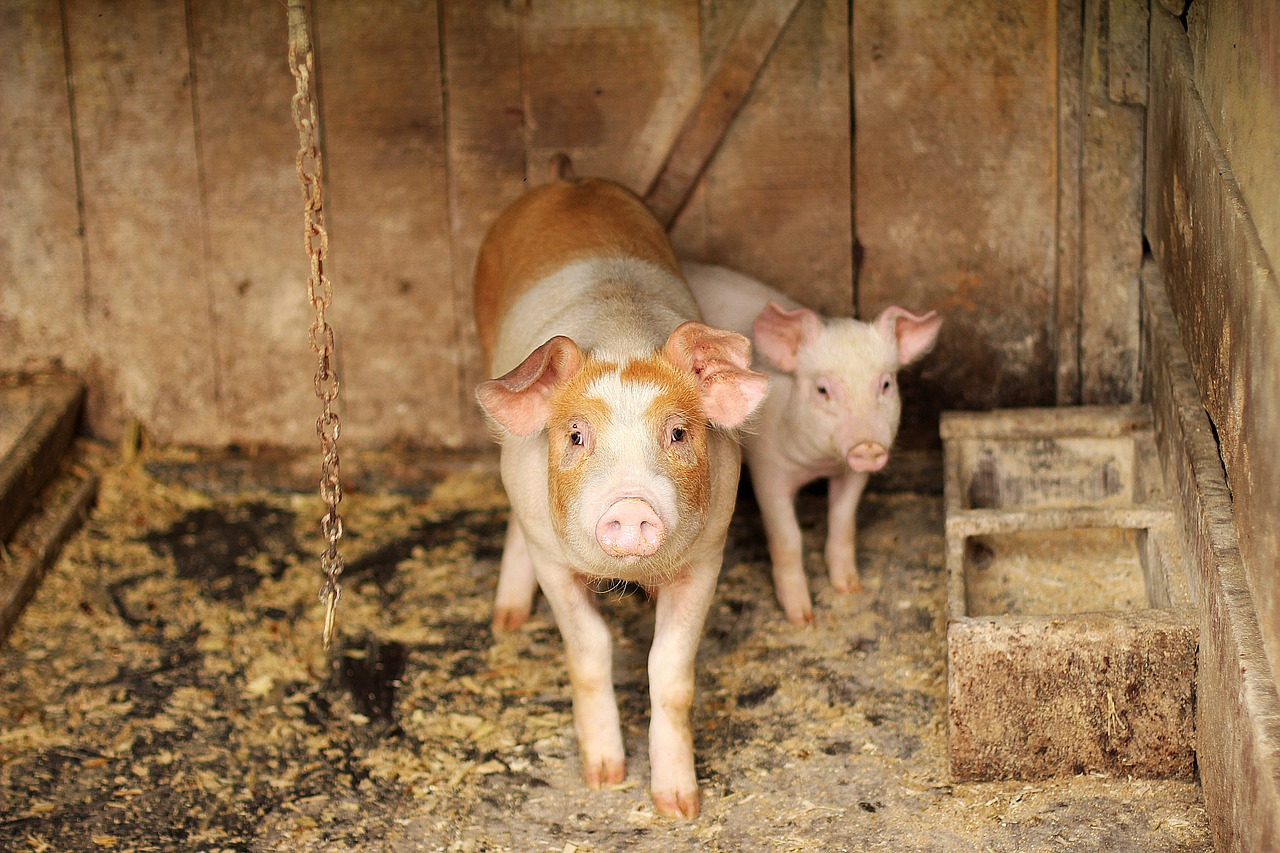
Pork supply is highest in late autumn and early winter, specifically in November and December, due to seasonal farrowing trends. During this period, the market sees an abundance of hogs, which often leads to lower wholesale prices than during the rest of the year.
Key Details on Pork Supply:
- Peak Supply Timing: October through December is generally considered the peak period for hog marketing.
- Production Cycle: Increased slaughter takes place in late autumn/early winter, partly due to historical and practical reasons.
- Consumer Impact: While supply is high at year-end, demand for specific cuts like hams and bacon also peaks, often keeping prices elevated despite the high volume.
- Alternative Timing: Some cuts, such as pork butts, may hit peak supply in late summer.
February often marks the end of high pork wholesale prices, driven by seasonal demand shifts, the end of holiday-driven purchasing, and shifts in supply dynamics. Historically, February marks a transition period when high-value winter demand fades before the onset of spring and summer, leading to a stabilization or decline in wholesale prices.
Key Reasons Why February Acts as the End of High Pork Wholesale Prices Include:
- Weakening Seasonal Demand: High demand for holiday hams and winter comfort foods (like sausages and bacon) typically fades in February. Retailers often reduce featured promotions, leading to a dip in wholesale demand.
- Post-Holiday Stock Reduction: The increased demand for pork during the November/December holiday season is met with increased slaughter, and by February, the market shifts away from these high-demand products, reducing upward pressure on the overall pork cutout.
- Rise in Production/Slaughter: Seasonal trends often see large, consistent slaughter levels through winter, which, combined with cooler weather allowing for higher carcass weights, can increase the supply of pork, putting downward pressure on prices.
- Rangebound Pricing Behavior: Historically, key pork components like loin markets are rangebound during February. While winter often brings high prices, the market begins to take premiums off as the initial winter demand spike passes.
- Belly/Bacon Demand Shift: Although bacon demand can be high, the market for pork bellies, which often drives up the overall cutout value in winter, frequently starts to see gains slow down as the market moves toward February.
While some years may see localized volatility, February is historically a month where market corrections begin following the price rally from early winter.
Technical Picture
Source: Barchart
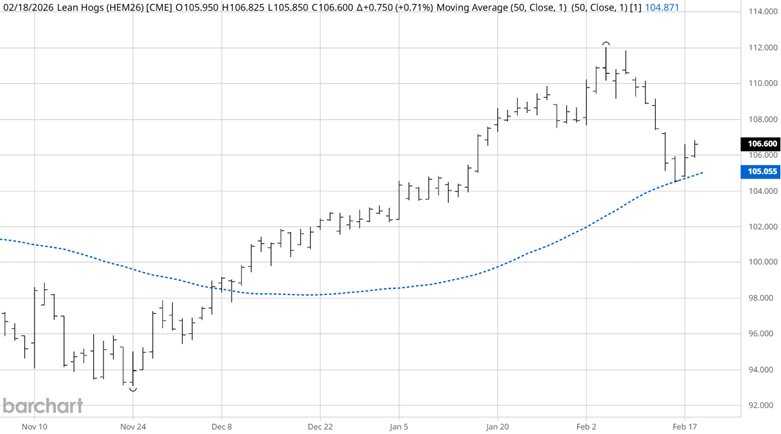
The June lean hog daily chart shows the early-winter seasonal low, which occurs during the peak pork marketing period. Once the price traded above the 50-day simple moving average (SMA), it continued on its seasonal path to February. Since peaking, prices have returned to the SMA and are finding some support. The key at this level is to watch prices and see if they begin closing under and turning down the SMA to confirm a downtrend before attempting to sell. More aggressive traders could find some higher resistance levels to begin selling and possibly build a core position.
Seasonal Pattern
Source: Moore Research Center, Inc. (MRCI)
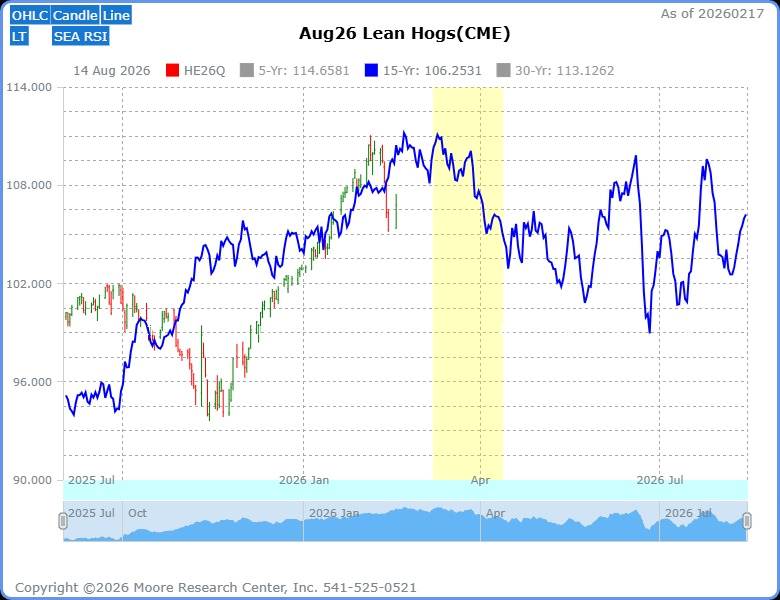
MRCI has researched the August 2026 lean hog futures contract and found an optimized seasonal window (yellow box). Liquidity may be low in the August contract at this time; traders may wish to use the June contract. The 15-year seasonal pattern (blue line) shows the lowest peak-season prices, which persist through the end of the winter season, when demand and prices peak.
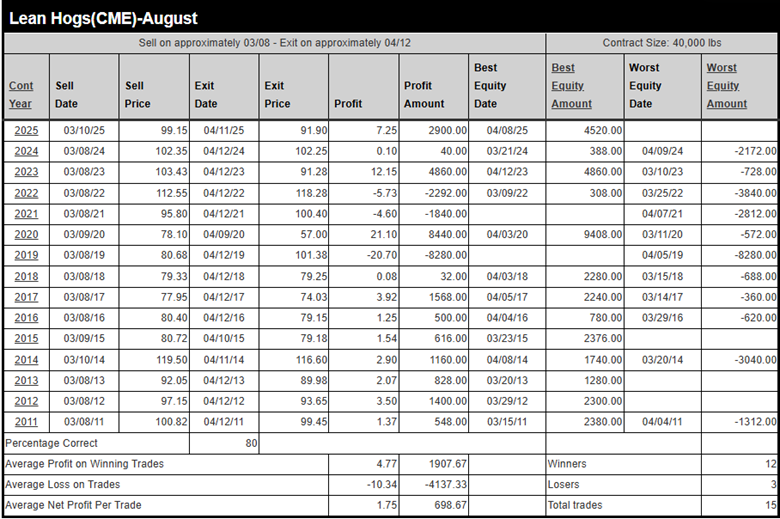
The optimal selling window lasts for approximately 36 calendar days. Allowing traders to scale in and out of bearish positions or trade the length of the seasonal window. In research, MRCI has found that the August lean hog market (June contract for more liquidity) has closed lower on approximately April 12 than on March 08 for 12 of the past 15 years, an 80% occurrence. During this period, hypothetical trading revealed an average profit of $1.75 per contract, or $698.67.
Source: MRCI
Another interesting outcome from the testing was that 4 of the 15 years did not have a daily closing drawdown. Pretty good for a volatile market like lean hogs.
As a crucial reminder, while seasonal patterns can provide valuable insights, they should not be the basis for trading decisions. Traders must consider various technical and fundamental indicators, risk management strategies, and market conditions to make informed, balanced trading decisions.
Products for traders to participate in the lean hog trade:
Futures traders can trade the standard-size 40,000-pound futures contract using the symbol (HE). Options on the futures contract can also be traded. This is a cash-settled contract, so there's no worry about physical delivery. There are no lean hog equity market products to trade. Two exchange-traded funds (ETFs) have lean hog futures contracts, which are considered commodity index funds, not just lean hogs. These products are the Invesco DBA and DBC ETFs.
In Closing…
As we've seen, the pork market follows a well-defined seasonal rhythm, with the heaviest supply hitting from October through December as peak hog marketing and slaughter coincide with holiday demand. While wholesale prices often ease under the weight of that supply, strong seasonal appetite for hams, bacon, and other winter staples can keep values elevated into early winter. By February, however, that demand typically fades, production remains steady, carcass weights stay high, and the market begins to stabilize or correct. The technical picture in June lean hog futures and the historical work from Moore Research Center, Inc., both reinforce the idea of a late-winter transition, with data showing a consistent tendency for prices to soften into spring. Still, seasonals and probabilities are not guarantees—lean hogs remain a volatile market, and disciplined risk management, confirmation from technical signals, and awareness of shifting fundamentals are essential before committing capital.
On the date of publication, Don Dawson did not have (either directly or indirectly) positions in any of the securities mentioned in this article. All information and data in this article is solely for informational purposes. For more information please view the Barchart Disclosure Policy here.

/Microsoft%20headquarters%20By%20Peter.jpeg)

/Amazon%20-%20Image%20by%20bluestork%20via%20Shutterstock.jpg)
/A%20close-up%20of%20the%20Broadcom%20logo%20on%20a%20smartphone%20by%20Timon%20via%20Adobe%20Stock.jpeg)