



/Genuine%20Parts%20Co_%20parts%20by-%20kadmy%20via%20iStock.jpg)
Atlanta, Georgia-based Genuine Parts Company (GPC) distributes automotive and industrial replacement parts. Valued at $14.3 billion by market cap, the company distributes automotive parts, accessories and solutions and replacement parts for hybrid and electric vehicles, trucks, SUVs, buses, motorcycles, farm equipment, and heavy-duty equipment, as well as equipment parts and technologies.
Companies worth $10 billion or more are generally described as “large-cap stocks,” and GPC definitely fits that description, with its market cap exceeding this threshold, reflecting its substantial size, influence, and dominance in the auto parts industry. GPC's strong global presence, with over 10,800 locations, and iconic brands like NAPA drive customer loyalty in a $200 billion+ market.
Despite its notable strength, GPC slipped 31% from its 52-week high of $151.57, achieved on Feb. 12. Over the past three months, GPC stock declined 1%, underperforming the S&P 500 Index’s ($SPX) 13.9% gains during the same time frame.
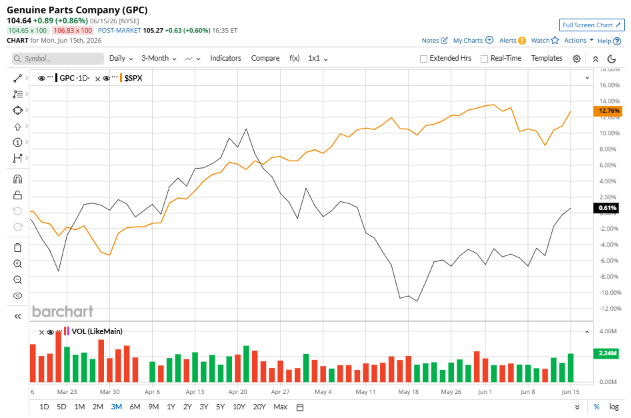
Shares of GPC fell 14.9% this year and dipped 12.6% over the past 52 weeks, notably underperforming SPX’s YTD gains of 10.4% and 26.4% returns over the same time frame.
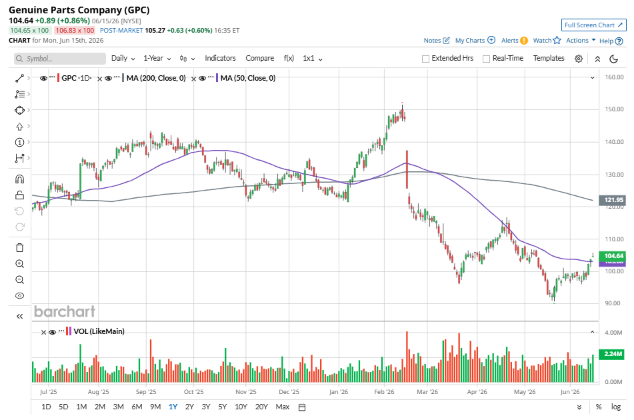
To confirm the bearish trend, GPC has been trading below its 200-day moving average since mid-February. However, the stock is trading above its 50-day moving average recently.
GPC’s underperformance was driven by inflationary pressure across wages, freight, and rent, partially mitigated by restructuring initiatives and disciplined cost management. The company managed supply chain disruptions and Middle East-related inflation with no material impact in Q1, though management has incorporated those risks into its forward planning.
In the competitive arena of auto parts, O'Reilly Automotive, Inc. (ORLY) has taken the lead over GPC, with a marginal uptick over the past 52 weeks and 1% loss on a YTD basis.
Wall Street analysts are reasonably bullish on GPC’s prospects. The stock has a consensus “Moderate Buy” rating from the 11 analysts covering it, and the mean price target of $134.78 suggests a notable potential upside of 28.8% from current price levels.
On the date of publication, Neha Panjwani did not have (either directly or indirectly) positions in any of the securities mentioned in this article. All information and data in this article is solely for informational purposes. For more information please view the Barchart Disclosure Policy here.

/A%20close-up%20of%20a%20SpaceX%20sign%20by%20Sundry%20Photography%20via%20Adobe%20Stock.jpeg)

/A%20close-up%20of%20the%20SpaceX%20sign%20on%20a%20black%20building%20by%20IanDewarPhotography%20via%20Adobe%20Stock.jpeg)
/NVIDIA%20Corp%20video%20chip-by%20Antonio%20Bordunovi%20via%20iStock.jpg)