



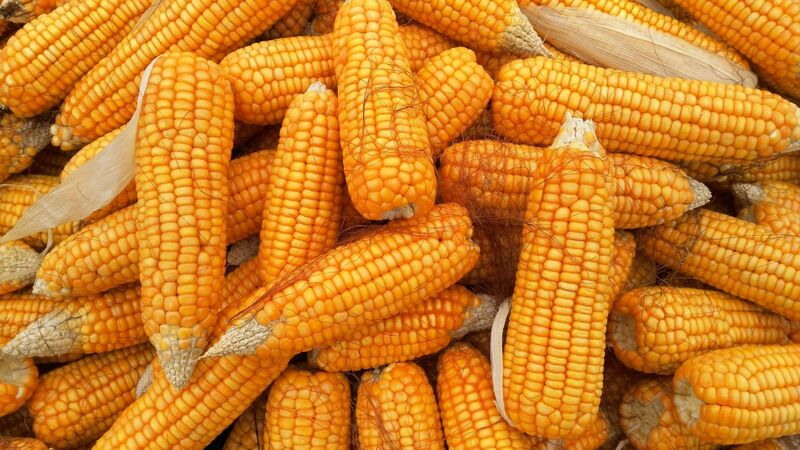
Corn has followed its post-harvest seasonal pattern fairly consistently, considering the many global conditions that could be impacting prices. I wrote an article, "Ah, Shucks, Corn Prices are Looking Higher," discussing some of the factors I believed would be bullish for corn prices.
Specifications, Statistics, and Performance
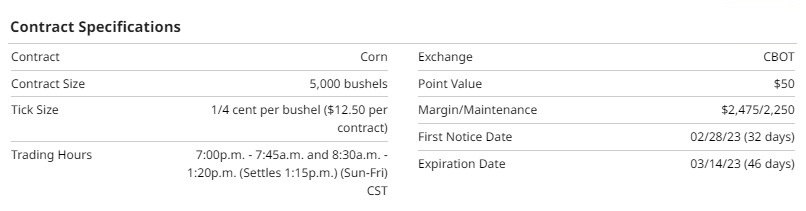
Corn is the largest crop in the US in terms of dollar value and the number of acres planted. Corn is used primarily as livestock feed in the United States and the rest of the world. Other uses for corn are alcohol additives for gasoline, adhesives, corn oil for cooking and margarine, sweeteners, and as food for humans.
The largest futures market for corn is at the CME Group. Both a standard and a mini-size contract are available for trading. The standard size symbol is (ZC), and the mini-size is (XN). For equity traders, there is an Exchange-Traded Fund (ETF) symbol (CORN). Options are available on the standard-size futures contract and the CORN ETF. Before trading options, futures, or equities, seeking training first is recommended.
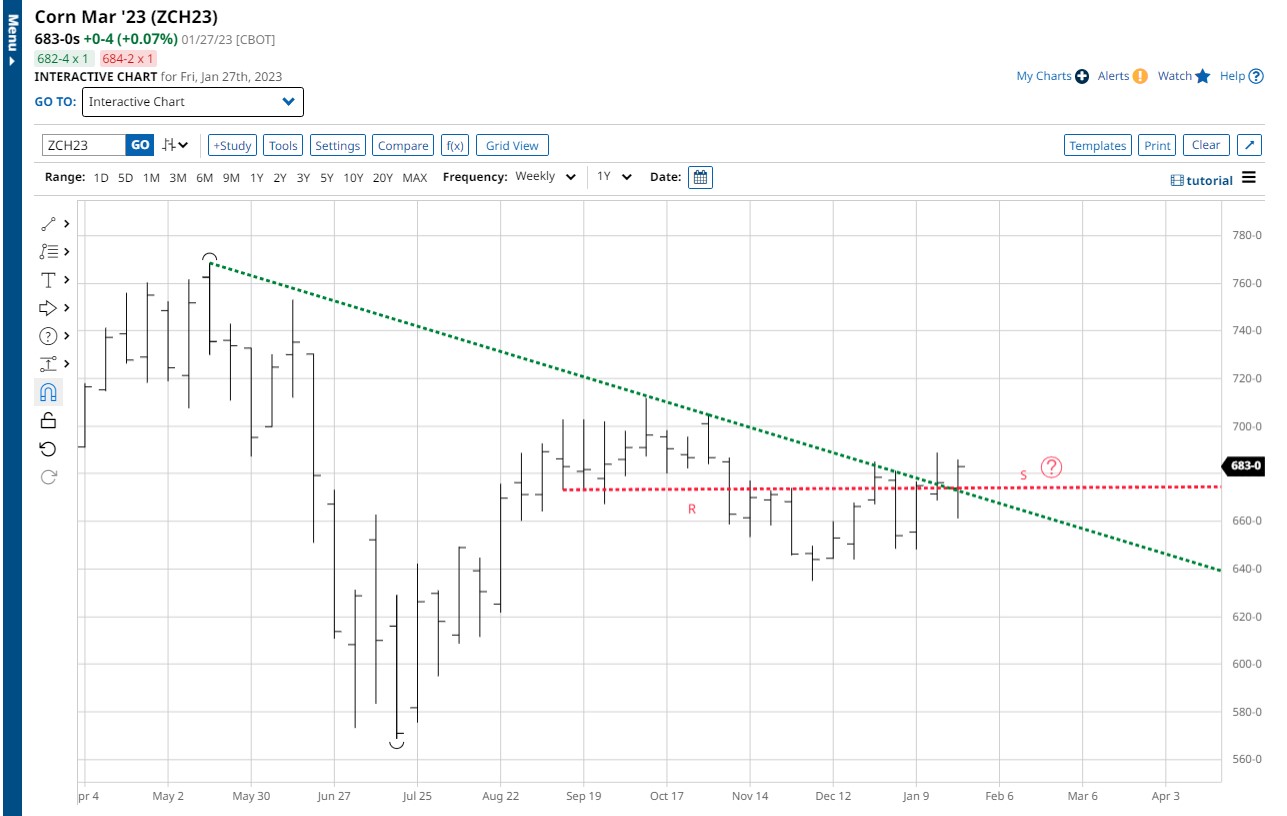
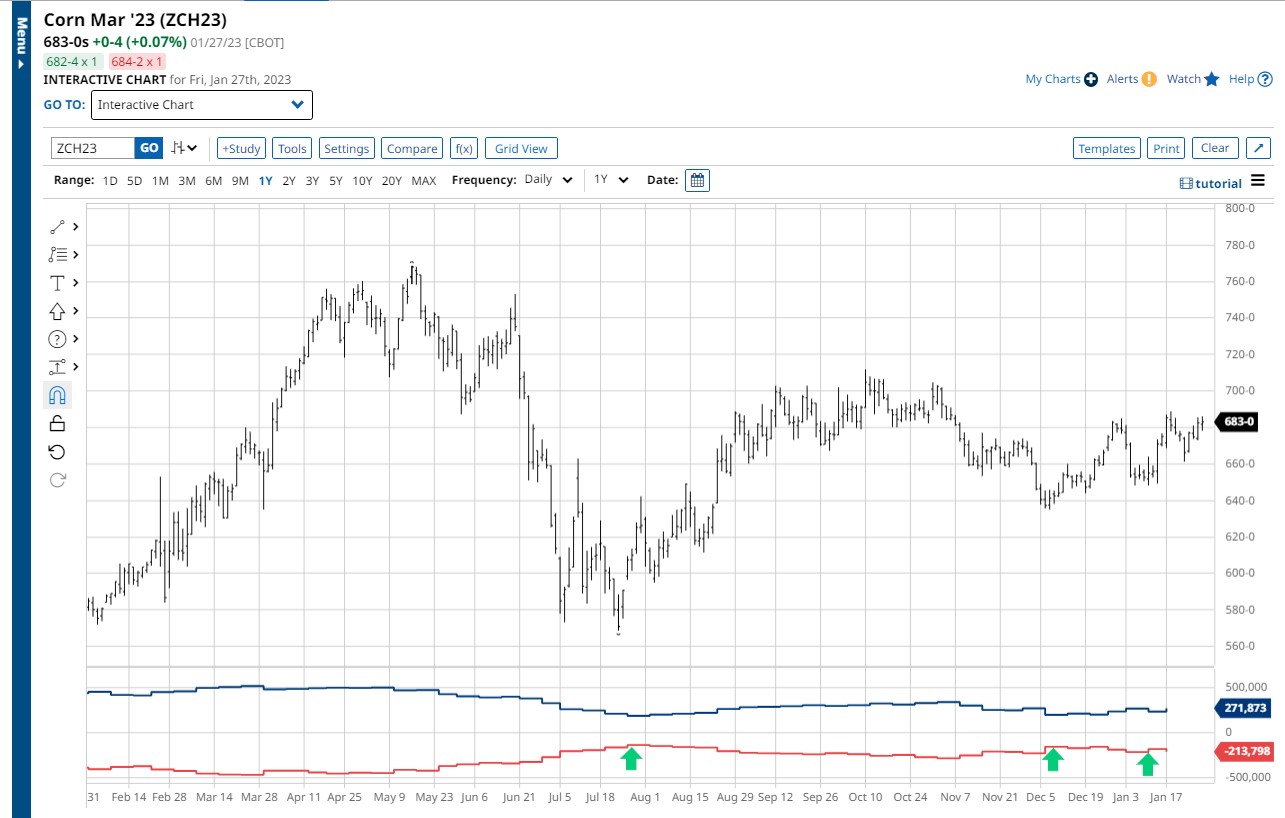
After putting in a seasonal low, 569'0, in August, which was a month earlier than usual and could result in an extended seasonal rally in both time and price, corn has rallied to 712'0 basis March contract. The price corrected back to a low of 635'0 before finding support and rallying to current levels of 683'0.
Corn has performed well over the past six months with a 12% return. During the past 52 weeks, corn has returned 19%. Seasonal post-harvest rallies tend to be significant because corn in the US is not produced during the winter months but only consumed. Commercial users (Processors) know this fact and must hedge their consumption needs by buying futures contracts.
Technicals
Source: Barchart
In early December, I identified this trendline(Green line) and the old support becoming the resistance line (Red line) in my article. Corn's weekly chart had significant resistance as the price returned towards these two lines. It took five weeks to get a close beyond both lines. In the coming weeks, prices will treat both lines as a support area. Corn mustn't have a weekly finish under the week of December 05.
Nearby resistance will be the 712'0 seasonal rally high. A weekly close above this will be positive for the continuation of the post-harvest rally.
Seasonality
Source: Moore Research Center, Inc. (MRCI)
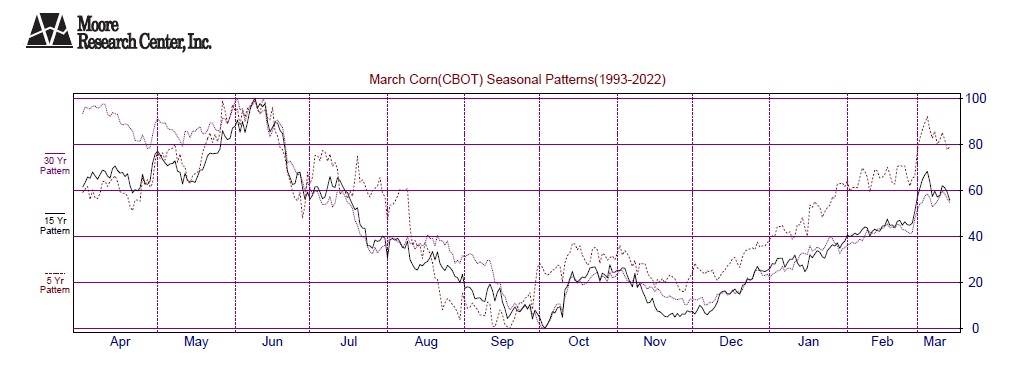
MRCI research confirms the consistency of this post-harvest rally by analyzing the last 5, 15, and 30 years of the price action of the September and October lows. When the commercial traders began building long positions during this period, a trader was getting some valuable information.
The post-harvest rally this season continues its impressive grind higher. Looking ahead, March typically has a price correction. Prices usually fall into support near the end of April (left side of the chart) and then resume the post-harvest rally into the planting season, where commercial (Producers) will begin hedging prices by selling futures. At that point, the seasonal price correction back to the upcoming harvest lows begins.
The Commitment of Traders (COT) Report
Source: Barchart
The COT chart shows where the commercial (Processors) (red line) bullish sentiment started in August by being more bullish than at any time in the past 12 months, creating the post-harvest lows for the season. As the market corrected the initial rally off this low, the December lows were made as the commercials again began buying at even higher prices, very bullish behavior. The third green arrow illustrated that the commercials added to their long positions as prices declined.
During the post-harvest rally, the managed money (blue line) traders bought contracts as the trend began off the august lows. During the correction in December, managed money did not aggressively add to their positions. Since the New Year, managed money has been slowly adding new longs as the bullish trend appears to be gaining momentum.
Summary
Post-harvest corn price rallies result from demand stripping supply that will be replenished in the next harvest season. Since ranchers and feedlots will need corn to feed livestock, international demand for corn and ethanol refiners will need corn for the upcoming driving season. As the world's largest corn producer, the world depends upon the US to fulfill this demand.
Corn continues to be a market to participate in as the New Year begins, and liquidity from the large traders is returning after the holiday period.
More Grain News from Barchart
- Coffee Closes Moderately Higher on Short Covering and Technical Buying
- Sugar Prices Underpinned by Global Supply Woes
- Cocoa Prices Little Changed on Dollar Strength
- Coffee Climbs on Brazilian Real Strength and Technical Buying
On the date of publication, Don Dawson did not have (either directly or indirectly) positions in any of the securities mentioned in this article. All information and data in this article is solely for informational purposes. For more information please view the Barchart Disclosure Policy here.


/Tesla%20dealership%20with%20cars%20in%20lot%20by%20Jetcityimage%20via%20iStock.jpg)
/Jen-Hsun%20Huan%20NVIDIA's%20Founder%2C%20President%20and%20CEO%20by%20jamesonwu1972%20via%20Shutterstock.jpg)

/A%20close-up%20of%20the%20Broadcom%20logo%20on%20a%20smartphone%20by%20Timon%20via%20Adobe%20Stock.jpeg)