




Specifications and Description

Crude oil is petroleum that is acquired directly from the ground. Crude oil was formed millions of years ago from the remains of tiny aquatic plants and animals that lived in ancient seas.
During the 19th century in America, an oil find was often met with dismay. Pioneers dug wells to find water or brine and were disappointed when they struck oil. In 1854, with the invention of the kerosene lamp, the first large-scale demand for petroleum emerged. Crude oil was the world's first trillion-dollar industry and accounts for the single most significant product in world trade. Crude oil is a relatively abundant commodity. The world has produced approximately 650 billion barrels of oil, but another trillion barrels of proven reserves have yet to be extracted.
Source: Barchart CRB Yearbook
In mid-November, I wrote an article for Barchart titled "Crude Oil is Losing its Viscosity as Traders Slip Away From the Asset." The article described how crude oil prices had a seasonal tendency to decline into year-end. The reason is that refiners who produce gasoline and heating oil are taxed at the end of the year for the physical product in their pipelines. To avoid paying taxes for something they have yet to sell, they dump the product on the market, increasing supply and dropping prices. You may have noticed that gasoline prices at the pumps declined into December. The crude oil market also experienced a decline of approximately 1 million contracts in open interest after the rally to $130 per barrel in March 2022.
As the New Year began, you may have noticed that gasoline pump prices are increasing again. Crude oil futures prices have rallied, yet a recession is staring us in the face. Gasoline and crude oil are near the beginning of the year's most robust bullish seasonal pattern. And the open interest has increased from 1.3 million in December to 1.6 million, representing new money returning to the crude oil market.
Another fundamental factor impacting prices was the US Government announcing they would begin buying oil to replenish the Strategic Petroleum Reserves (SPR) that they drained to dangerously low levels. The announcement stated that $70 per barrel was the purchasing price. For now, that has supported higher prices in crude oil.
Technicals
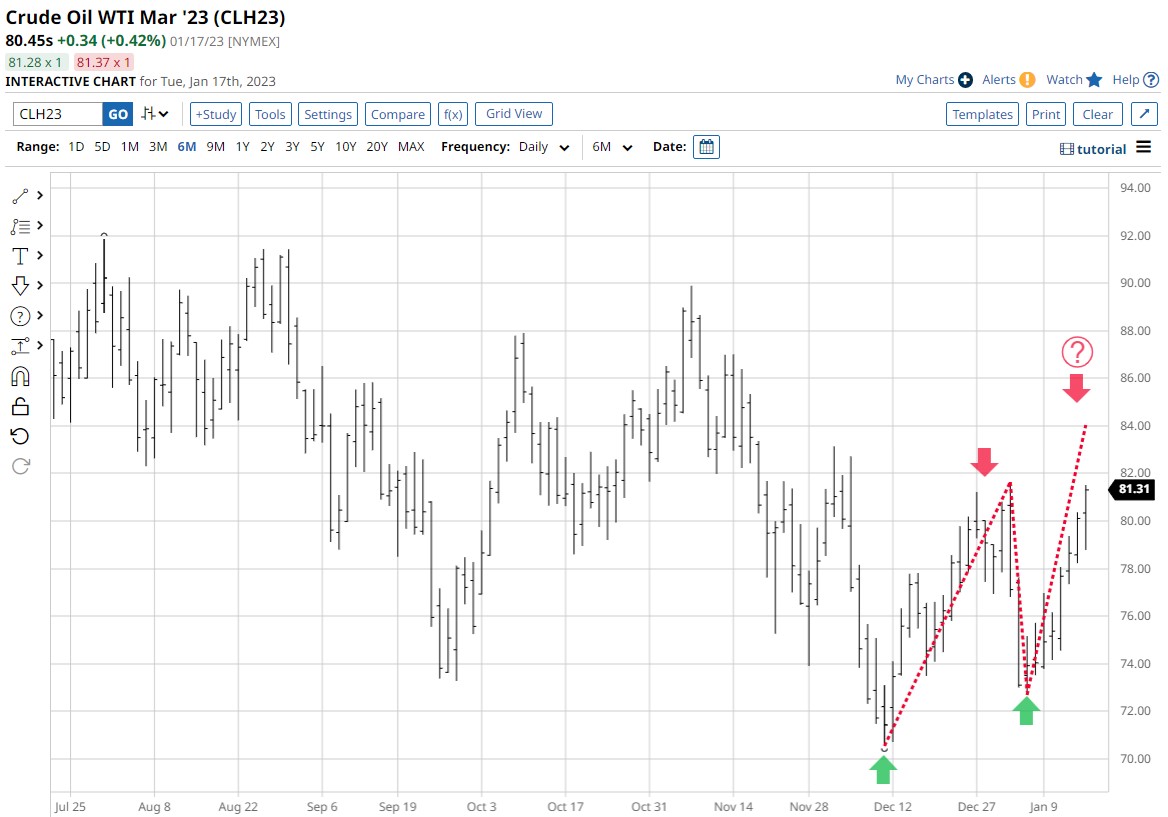
Crude oil prices bottomed in December and appear to have made a seasonal low for now. If the price makes a higher high on the daily chart, we will see more confirmation of a seasonal low.
Seasonality
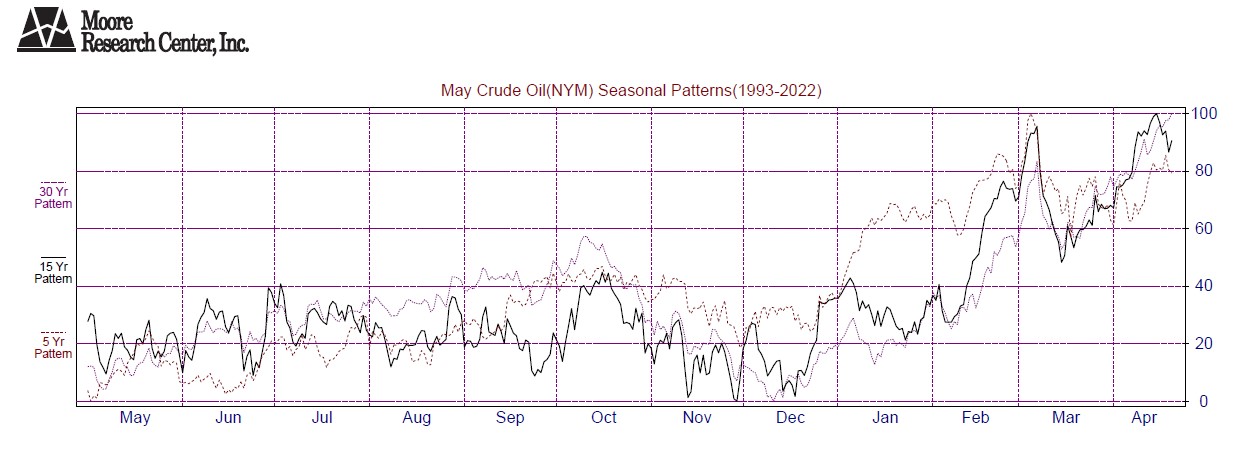
Moore Research Center, Inc. (MRCI) research illustrates this possible robust move we are about to experience in crude oil. Seasonally the rally starts in December and continues until approximately May 1, when the gasoline refiners will have ample supply for the upcoming driving season.
Jerry Toepke is the editor at MRCI and produces a weekly newsletter. His recent article had informative information to support the upcoming seasonal pattern. When we read a report like the one Jerry created, it becomes easier to see why this powerful seasonal pattern occurs each year. It's simply human nature, and as we all know, humans are creatures of habit.
Jerry writes the following:
The primary products of the refining process are gasoline and heating oil. Fortunately, their seasonal bulges in consumption are nearly opposite, and refiners can switch their formulations to maximize the production of one or the other depending on the season. Between the vacation and driving and heating seasons are the so-called shoulder months, during which temperatures are neither too hot nor too cold, and gasoline consumption is in transition. Refiners then take the opportunity to switch over their formulations.
Again, because refiners in certain large-producing states are subject to taxes on year-end inventories of crude oil and products, refiners have every financial incentive to flush products before the end of the year. While doing so, they maintain their runs by depleting their physical inventories of crude and delaying new purchases as much as possible until the new year.
Thus, as the new year begins, refiners must ensure that heating oil supplies last through winter. Further, as winter passes its midpoint, the market slowly turns its attention to spring, its improving driving conditions, the upcoming driving and vacation season --- and the need to begin meeting the demand for building gasoline inventories.
The Commitment of Traders Report (COT Report)
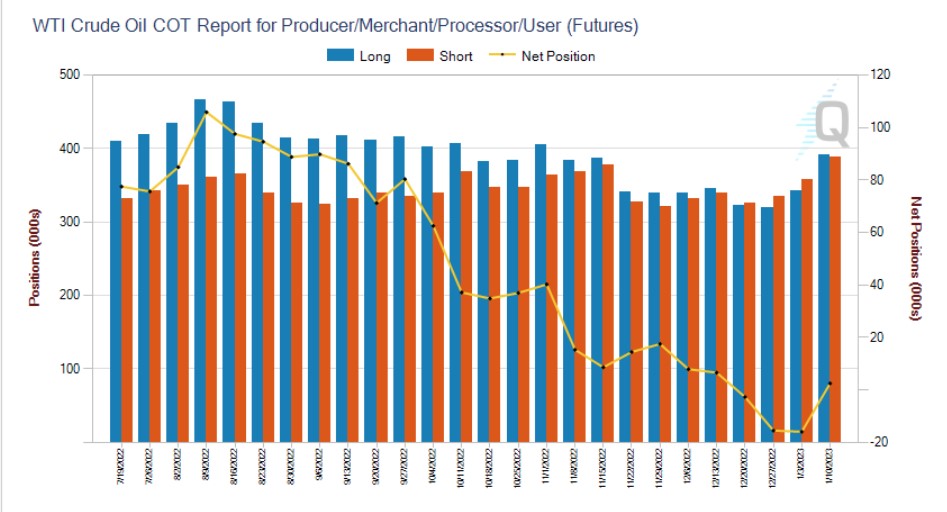
Source: CMEGroup
Confirming the seasonal low with other trading tools is advised regardless of a seasonal pattern's strength. For confirmation, I like to use the COT report.
Commercial traders are well aware of the high-demand periods for the products they produce. Therefore, they are the first to begin buying before the seasonal low by dollar cost averaging their position. Examining the COT report above, the blue bars represent commercial traders' long positions, and each bar represents one week. During the past two weeks, the commercial traders have added 71K new long positions.
Managed money has yet to start accumulating long positions in large quantities. The majority of managed money accounts are trend-following. The reason could be that there has yet to be a solid up trend to trigger a trading signal.
Commercial traders usually create the tops and bottoms in market moves, and later when a trend develops, the managed money joins.
Summary
The seasonal buy for crude oil is starting to build evidence that this year may be consistent with the past. Due to the duration of this trade, from January to May, a trader may decide to trade an exchange-traded fund (ETF) instead of a futures contract, allowing for more staying power during the upcoming trend.
The ETF that tracks actual oil contracts is USO. For those with a more significant risk appetite, you could trade the standard-size crude oil contract (CL) or the micro-futures contract (MCL for CMEGroup and CY for Barchart). Options on futures and the ETF are available as well.
If the crude oil market can produce a daily up trend, that may be when the managed money joins the seasonal oil trade. Be patient, use risk management, and have a trading plan to manage all trades.
More Energy News from Barchart
- Nat-Gas Prices Rebound as U.S. Temps Cool
- Crude Climbs on Stronger-Than-Expected Chinese Economic News
- Crude Climbs on Stronger-Than-Expected Chinese Economic News
- Update on Uranium and CCJ
On the date of publication, Don Dawson did not have (either directly or indirectly) positions in any of the securities mentioned in this article. All information and data in this article is solely for informational purposes. For more information please view the Barchart Disclosure Policy here.


/Space/Rocket%20launching%20into%20space%20by%20BEST%20BACKGROUNDS%20via%20Shutterstock.jpg)
/A%20close-up%20of%20an%20AMD%20office%20by%20gehapromo%20via%20Adobe%20Stock.jpeg)
/Micron%20Technology%20Inc_%20logo%20on%20building-by%20vzphotos%20vis%20iStock.jpg)
/NVIDIA%20Corp%20logo%20outside%20building-by%20BING-JHEN_HONG%20via%20iStock.jpg)