




Arabica coffee beans trade in the futures market on the Intercontinental Exchange (ICE) and are a member of the commodity market’s soft commodity sector. Coffee, sugar, and frozen concentrated orange juice are soft commodities that share something else in common. Brazil is the world’s leading producer of free-market sugarcane, oranges, and Arabica coffee beans.
Soft commodities can be highly volatile as the weather in growing regions is the most influential factor for output each year. Meanwhile, economic conditions and currency differentials can also influence prices.
At over the $2.25 per pound level on the nearby ICE futures contract on August 16, coffee remains well above the technical support level and is consolidating after moving to an eleven-year high at over $2.60 per pound. The iPath Series B Coffee Subindex ETN product (JO) moves higher and lower with the coffee futures price.
Coffee corrected from the 2022 high- The price probed below $2 and recovered
The continuous ICE coffee futures contract reached $2.6045 per pound in early February when it ran out of upside steam.

The chart highlights the September contract turned lower at $2.5690 on February 10, 2022, and made a series of lower lows. On July 14 and 15, coffee futures probed below $2, reaching a low of $1.9460. Coffee was back near the $2.20 level on August 16.
A weather event lit a bullish fuse
Dry conditions in Brazil ignited the coffee futures market in July 2021, pushing the price over a critical technical resistance level.

The longer-term chart shows coffee’s rise over the November 2016 $1.76 high that launched the price to just above the $2.60 level. Weather conditions in the leading growing regions are always the primary factor for the path of least resistance of agricultural commodity prices, but other factors contributed to coffee’s rise.
Economic conditions have kept a bid under coffee futures
Commodity prices reached lows in 2020 as the global pandemic gripped markets, and coffee was no exception. In June 2020, nearby coffee futures found a bottom at 92.70 cents per pound, which was a higher low from the
April 2019 86.35 cents level. Increasing inflationary pressures from artificially low interest rates and government stimulus programs caused the economic condition. Moreover, labor shortages and supply chain bottlenecks created a landscape that pushed raw material prices higher. Inflation erodes money’s purchasing power, causing coffee and other raw materials to move appreciably higher. Coffee reached the highest price since 2011, the last time it traded above the $3 per pound level, in 2021 and 2022. The highest inflation in four decades has kept a bid under the coffee futures market.
The Brazilian real has supported higher coffee prices
While the US dollar is the benchmark pricing mechanism for ICE coffee futures, Brazil is the world’s leading producer and exporter of Arabica beans. Local production costs are in Brazilian real terms. A declining real tends to weigh on coffee prices as labor expenses fall, and a rising real often supports higher prices.
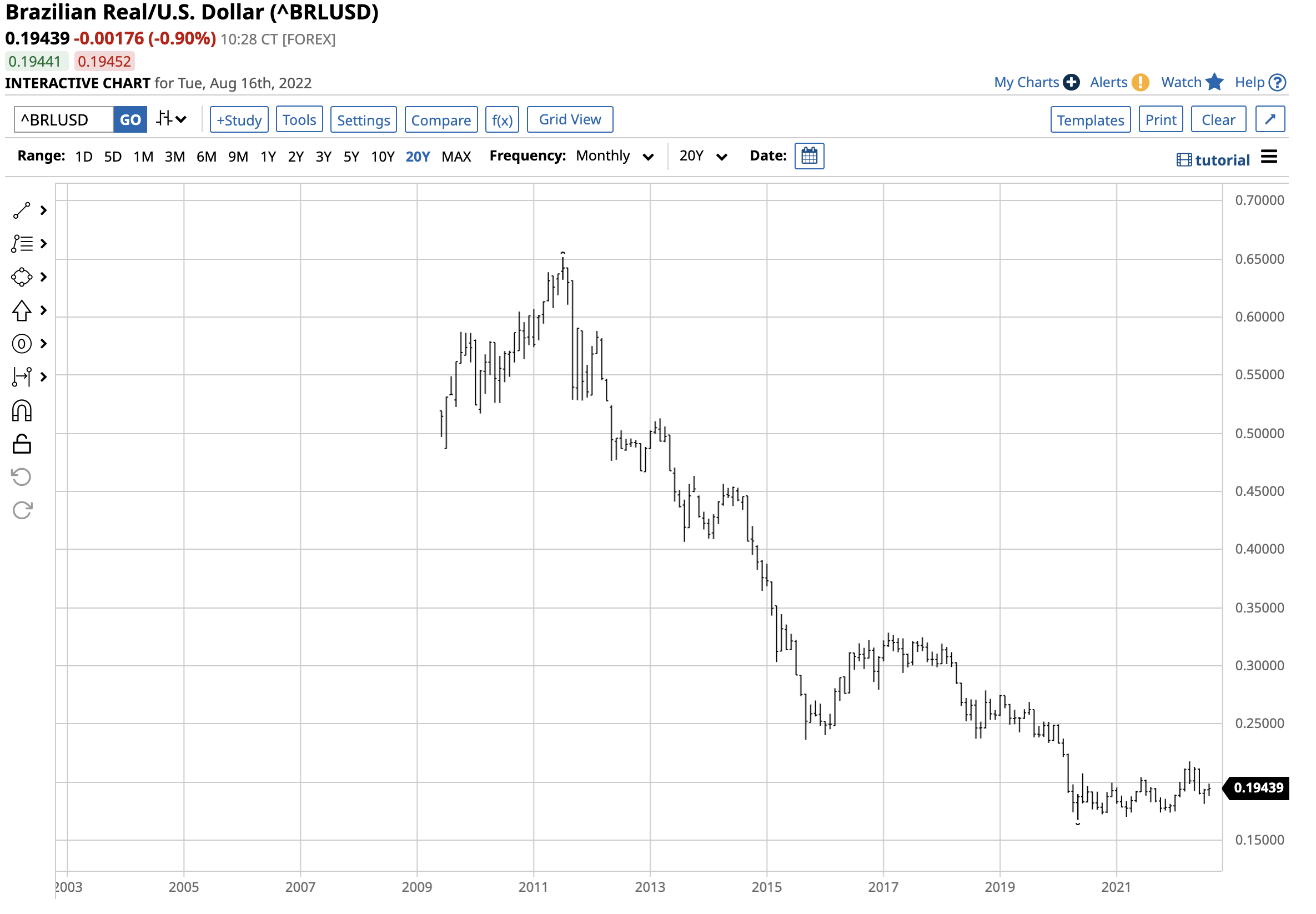
The chart illustrates the decline in the Brazilian dollar versus the US dollar foreign exchange rate, which reached a low of $0.16756 in May 2020, around the time coffee futures last traded below the $1 per pound level. The real has made slightly higher lows and higher highs since May 2020, reaching a peak of over $0.21 in April 2022. The rise of the Brazilian currency against the US dollar supported the coffee futures price.
The $3 level is the upside target- JO follows the coffee futures price
Nearby coffee futures traded above $3 per pound in 1977, 1997, and 2011. The highs came in April and May of those years, a seasonal clue for the coffee market. Inflation, a stabilized Brazilian currency, and the bullish technical trend continue to support the coffee futures price. Technical support remains substantially below the current market price at the $1.76 per pound level. While the $2.6045 2022 high is technical resistance, the long-term target stands at the $3 per pound level. If coffee holds above the $2 level, we could see the fourth challenge of $3 during the first half of 2023.
The most direct route for a risk position in coffee is via the Arabica coffee futures and futures options trading on the Intercontinental Exchange. The iPath Series B Coffee Subindex ETN product (JO) provides an alternative for those looking to participate in the coffee arena without venturing into the leveraged and highly volatile futures market.
At $60.60 on August 16, JO had $152.923 million in assets under management and traded an average of 8,643 shares each day. JO charges a 0.45% management fee. The most recent rally in the September ICE coffee futures contract took the price from $1.9460 on July 15 to $2.2770 on August 12, a 17% increase.

Over the same period, the JO ETN moved from $53.00 to $61.96 per share, or 16.9% higher, as the ETN did an excellent job tracking nearby coffee futures on the upside.
Coffee is a highly volatile agricultural commodity, and we may see wide price swings over the coming months. I favor buying coffee on price weakness, using a scale-down approach that leaves plenty of room to add on further price weakness. My ultimate target is above the $3 per pound level.
More Softs News from Barchart


/A%20corporate%20sign%20for%20SK%20Hynix%20by%20Tada%20Images%20via%20Adobe%20Stock.jpeg)

/2d%20illustration%20of%20Cloud%20computing%20by%20Blackboard%20via%20Shutterstock.jpg)
/Server%20racks%20by%20dotshock%20via%20Shutterstock.jpg)