A long call butterfly is entered when a trader thinks a stock will not rise or fall by much between trade initiation and expiration. When using calls, the trade is constructed by buying an in-the-money call, selling two at-the-money calls and buying an out-of-the-money call. The trade is entered for a net debit meaning the trader pays to enter the trade. This debit is also the maximum possible loss.
The maximum profit is calculated as the difference between the short and long calls less the premium that you paid for the spread.
Let’s take a look at Barchart’s Long Call Calendar Screener for July 21st:
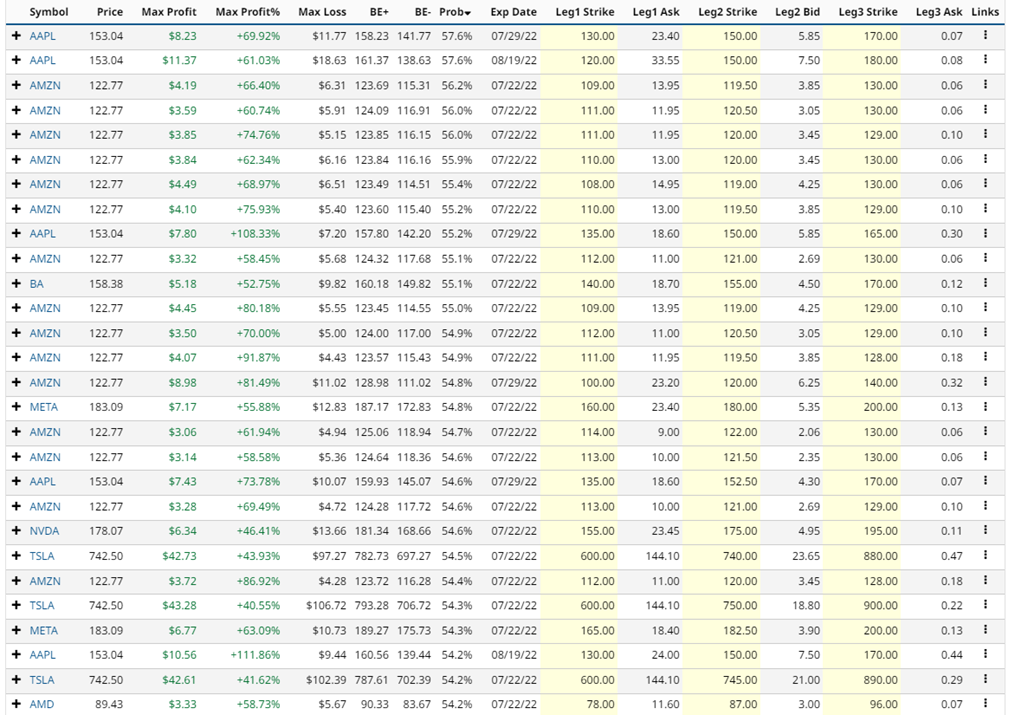
The screener shows some interesting long call butterfly trades on popular stocks such as AAPL, AMZN, BA, META, NVDA and TSLA.
Let’s take a look at the first line item – a Long Call Butterfly on Apple stock.
Using the July 29 expiry, the trade would involve buying the 130 strike call, selling two of the 150 strike calls and buying one of the 170 strike calls. The cost for the trade would be $1,177 which is the most the trade could lose. The maximum potential gain is $823. The lower breakeven price is 141.77 and the upper breakeven price is 158.23. The maximum profit is 69.92% with a probability of success of 57.6%.
The Barchart Technical Opinion rating is a 40% Sell with a weakest short term outlook on maintaining the current direction. Long term indicators fully support a continuation of the trend.
AMZN Long Call Butterfly Example
Let’s take a look at another example, this time on AMZN.
Using the July 22 expiry, the trade would involve buying the 109 strike call, selling two of the 119.50 strike calls and buying one of the 130 strike calls. The cost for the trade would be $631 which is the most the trade could lose. The maximum potential gain is $419. The lower breakeven price is 115.31 and the upper breakeven price is 123.69. The maximum profit is 66.40% with a probability of success of 56.2%.
The Barchart Technical Opinion rating is a 48% Sell with a weakest short term outlook on maintaining the current direction. Long term indicators fully support a continuation of the trend.
Mitigating Risk
Thankfully, Long Call Butterfly Spreads are risk defined trades, so they have some built in risk management. Some trades might like to exit the trade is the upper or lower breakeven price is breached.
Position sizing is important so that a 100% loss does not cause more than a 1-2% loss in total portfolio value.
Long Call Butterfly’s can also contain early assignment risk, so be mindful of that if the short calls are in-the-money and it’s getting close to expiry.
Both of these trades are quite short-term. Some traders may like to extend the date filter to between 14 and 30 days to expiration.
Please remember that options are risky, and investors can lose 100% of their investment.
This article is for education purposes only and not a trade recommendation. Remember to always do your own due diligence and consult your financial advisor before making any investment decisions.
*Disclaimer: On the date of publication, Steven Baster did not have (either directly or indirectly) positions in some of the securities mentioned in this article. All information and data in this article is solely for informational purposes. Data as of after-hours, July 20, 2022.
More Stock Market News from Barchart

/AI%20(artificial%20intelligence)/Ai%20chip%20by%20Quality%20Stock%20Arts%20via%20Shutterstock.jpg)
/A%20Palantir%20office%20building%20in%20Tokyo_%20Image%20by%20Hiroshi-Mori-Stock%20via%20Shutterstock_.jpg)