




A bull call spread is an options strategy that a trader uses when they believe the price of an underlying stock will move higher in the short term.
To execute the strategy, a trader would buy a call option and sell a further out-of-the-money call option with the following conditions:
- Both call options must use the same underlying stock
- Both call options must have the same expiration
- Both call options must have the same number of options
Since the strike price of the sold call is higher than the strike price of the bought call, the initial position will be a net debit.
The bull call spread profits as the price of the underlying stock increases, similar to a regular long call.
The difference between a bull call spread and a regular long call is that the upside potential is capped by the short call.
The purpose of the short call is to mitigate some of the overall costs of the strategy at the expense of putting a ceiling on the profits.
Losses are also capped, in this case by the debit taken when you execute the trade.
Let’s take a look at Barchart’s Bull Call Spread Screener for July 18th:
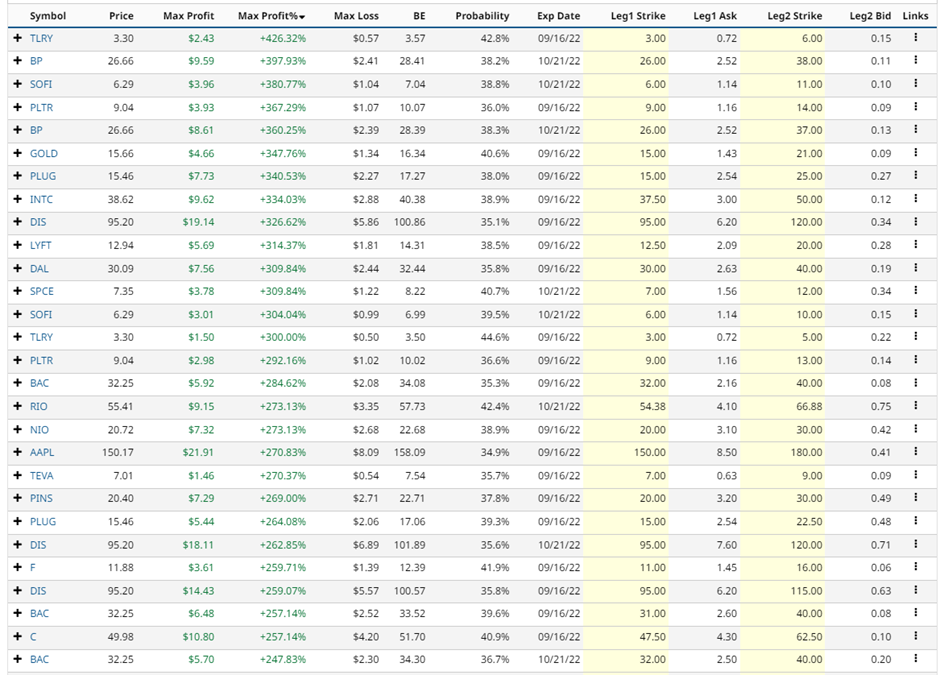
As you can see, the scanner shows some interesting Iron Condor trades on stocks such as TLRY, BP, SOFI, PLTR, GOLD, PLUG, INTC and DIS.
Let’s adjust the scanner to make sure we are only looking for bull call spreads on stock with a Buy rating and Mark Cap above 40 billion.
This scan gives us the following results:
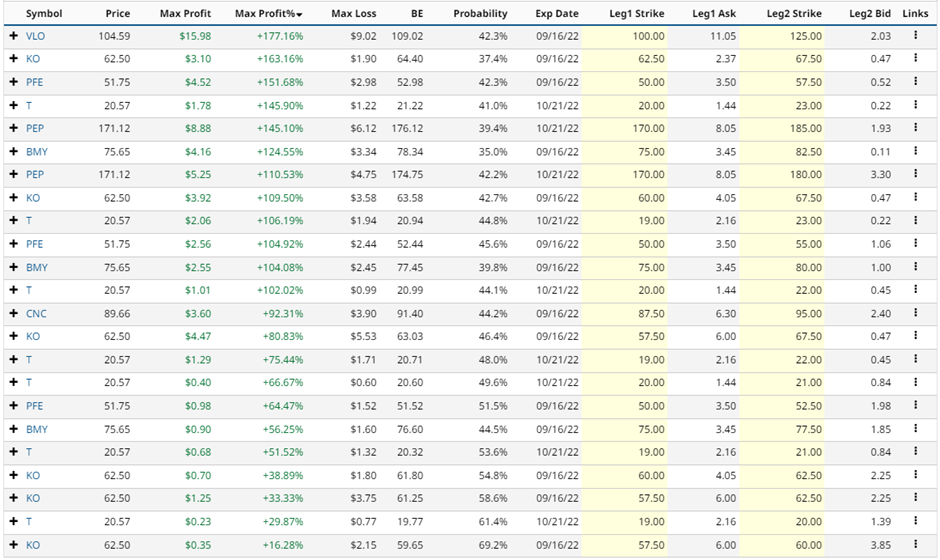
VLO Bull Call Spread Example
Let’s take a look at the first line item – a bull call spread on VLO.
This bull call spread trade involves buying the September expiry 100 strike call and selling the 125 strike call.
Buying this spread costs around $9.02 or $902 per contract. That is also the maximum possible loss on the trade. The maximum potential gain can be calculated by taking the spread width, less the premium paid and multiplying by 100. That give us:
25 – 9.02 x 100 = $1,598.
If we take the maximum gain divided by the maximum loss, we see the trade has a return potential of 177.16%.
The probability of the trade being successful is 42.3%, although this is just an estimate and does not indicate the probability of achieving the maximum profit.
The spread will achieve the maximum profit if VLO closes above 125 on September 16. The maximum loss will occur if VLO closes below 100 on September 16, which would see the trader lose the $902 premium on the trade.
The breakeven point for the Bull Call Spread is 109.02 which is calculated as 100 plus the $9.02 option premium per contract.
The Barchart Technical Opinion rating is an 8% Buy with a weakest short term outlook on maintaining the current direction.
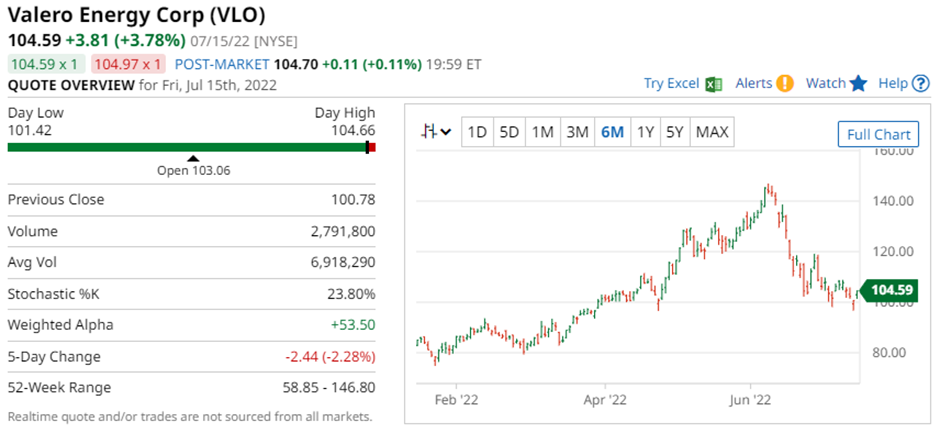
VLO is showing an IV Percentile of 90% and an IV Rank of 72%. The current level of implied volatility is 51.67% compared to a 52-week high of 59.87% and a low of 30.28%.
KO Bull Call Spread Example
Let’s look at another example, this time using Coca-Cola (KO)
This bull call spread also uses the September expiry and involves buying the 62.50 strike call and selling the 67.50 strike call.
This trade would cost $190 and have a maximum potential profit of $310.
The Barchart Technical Opinion rating is a 32% Buy with a weakening short term outlook on maintaining the current direction.

KO is showing an IV Percentile of 83% and an IV Rank of 64%. The current level of implied volatility is 22.90% compared to a 52-week high of 28.56% and a low of 12.66%.
Mitigating Risk
Thankfully, bull call spreads are risk defined trades, so they have some build in risk management. The most the VLO example can lose is $902 while the KO call spread has risk of $190.
For each trade consider setting a stop loss of 25-30% of the max loss.
Also keep an eye on key support levels and moving averages.
Please remember that options are risky, and investors can lose 100% of their investment. This article is for education purposes only and not a trade recommendation. Remember to always do your own due diligence and consult your financial advisor before making any investment decisions.
*Disclaimer: On the date of publication, Steven Baster did not have (either directly or indirectly) positions in any of the securities mentioned in this article. All information and data in this article is solely for informational purposes. Data as of after-hours, July 17, 2022.
More Stock Market News from Barchart



/Johnson%20%26%20Johnson%20location%20sign-by%20JHVEPhoto%20via%20iStock.jpg)
/AI%20(artificial%20intelligence)/AI%20technology%20-%20by%20Wanan%20Yossingkum%20via%20iStock.jpg)
/A%20close-up%20of%20an%20AMD%20office%20by%20gehapromo%20via%20Adobe%20Stock.jpeg)