




Brazil's Cold Front Gamble Keeps Bears and Bulls on Edge
Coffee sentiment over the past month has been shaped almost entirely by Brazil. A cold front moving through Rio Grande do Sul, Santa Catarina, and Parana has raised fresh frost risk concerns just as the 2025/26 harvest winds down, a development that briefly lifted prices toward $2.60 per pound from levels closer to $2.50, which had been the lowest since November 2024. Traders are also watching the developing El Nino pattern, with industry analysis suggesting a stronger event could delay the September to October rains that are critical for the 2026/27 flowering period in Brazil, a risk that extends well beyond the current harvest cycle. At the same time, ICE certified arabica stocks have fallen to 396,171 bags, sharply below the 859,389 bags held a year earlier, reinforcing the view that near term physical supply remains tight even as the broader narrative turns bearish.
That bearish narrative has centered on expectations of a bumper Brazilian crop, with some trade estimates pointing to roughly 75.3 million bags for 2026/27, a year over year increase of more than 20 percent as growers recover from prior weather damage and invest in tree renovation. This supply optimism, combined with a generally negative macro tone and persistent dollar strength weighing on dollar denominated commodities, contributed to one of the largest speculative liquidations across the agricultural complex this year, with funds removing billions of dollars in long exposure. The combination of speculators trimming their long positions, and growing supply confidence pushed futures to their recent multi year low before short covering and the renewed frost headlines sparked the bounce.
What the Market Has Done
- Coffee broke below the 340 daily support level at the end of January, gapping lower and continuing its descent toward 280, which is identified as Daily Level 2.
- Buyers responded at 280 and price rotated back to the upside, but sellers stepped in and capped the advance at 322.4, the gap low from the February 2 and 3 session that also lines up with the yearly VWAP, creating a strong confluence of resistance.
- From that rejection point, sellers steadily compressed price back down toward 280 over the following months.
- In May, sellers finally overwhelmed buyers at 280 and the market extended its decline to 240, the long term support from 2024 (Daily Level 3).
- Responsive buyers emerged at 240 and price has since rotated back up toward the 280 zone, where the market currently sits in a tug of war between origin selling pressure and weather driven short covering.
What to Expect in the Coming Weeks
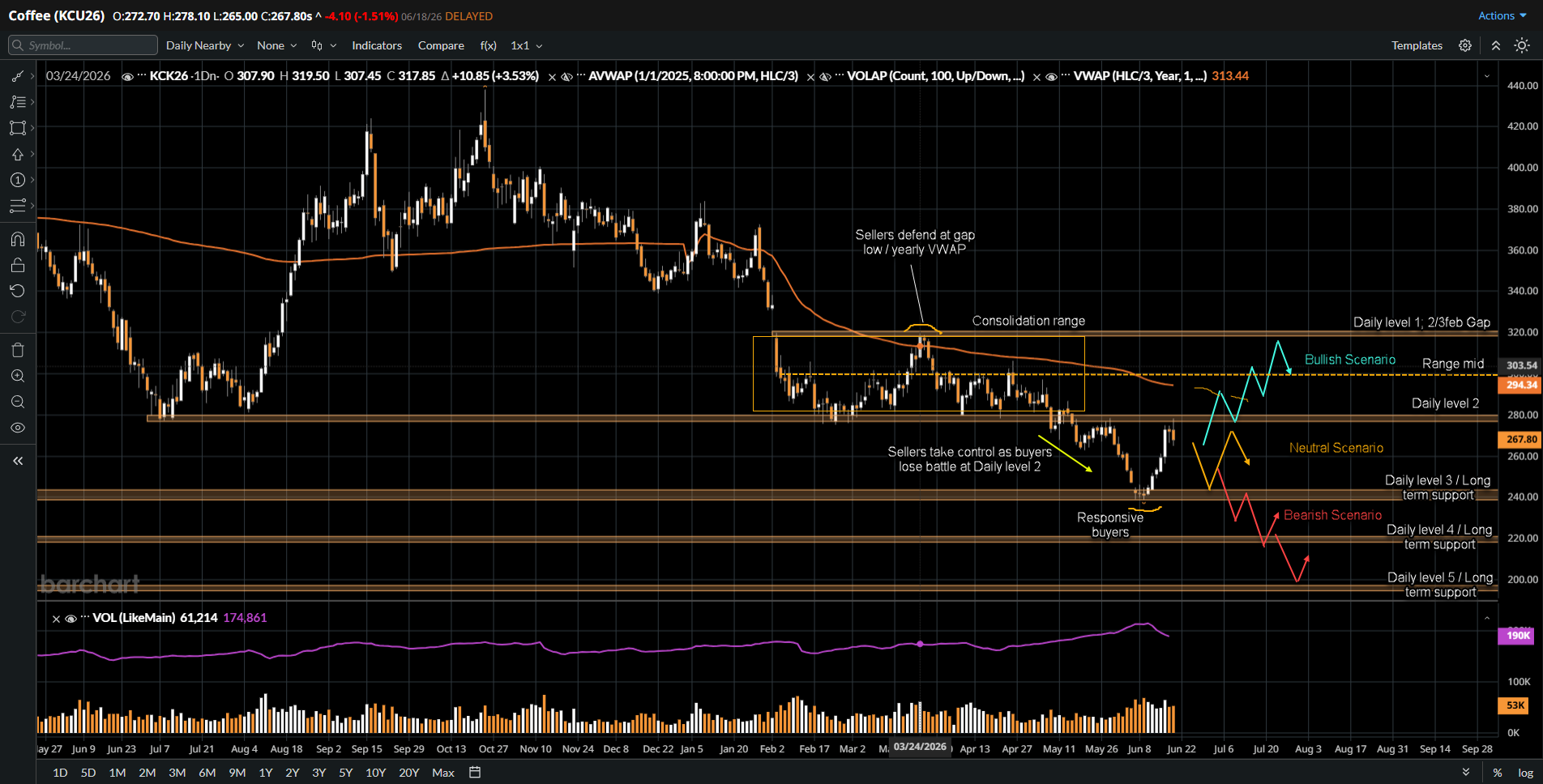
Key levels to watch remain 280 (daily level), and 240, the long term daily level 3 support.
Neutral Scenario
- If sellers manage to hold the market down at 280, expect a rotation lower back toward 240, with the possibility that buyers again defend that level.
- This would likely produce two way rotation and consolidation between 240 and 280.
- This scenario would likely play out if Brazil's weather risk stays ambiguous, meaning the cold front and frost reports remain inconclusive without confirmed crop damage, leaving traders without a clear catalyst in either direction.
Bullish Scenario
- If buyers are able to reclaim and hold above 280, expect possible selling resistance to emerge near the projected VWAP level.
- If that resistance fails to hold sellers, look for continued upside toward 300, the range midpoint, and potentially back up to 322.4, the daily level 1 zone tied to the February 2 and 3 gap.
- This scenario would likely be triggered by confirmed frost or freeze damage across Minas Gerais, Sao Paulo, or Parana that forces analysts to meaningfully cut 2026/27 production estimates.
Bearish Scenario
- If buyers fail to defend 240, expect a move down toward 220, the daily level 4 zone that also represents long term support dating back to 2024.
- A break below that area would open the door to a move toward the 200 region, identified as daily level 5.
- This scenario would likely be triggered by a clean resolution of Brazil's weather risk, such as confirmation that the cold front passed without significant crop damage, combined with continued bumper crop estimates near 75 million bags and a steady or strengthening dollar.
Conclusion
Coffee futures sit at a genuine inflection point where technical structure and fundamental narrative are converging at the same levels. The 240 to 280 range has become the market's battleground, with origin side bumper crop expectations and dollar strength fighting against tightening exchange stocks and fresh Brazilian frost anxiety tied to both the current harvest and the 2026/27 flowering outlook. Until traders get clarity on whether the latest cold front produces real agronomic damage, expect the market to remain headline driven and prone to sharp two way swings within this range. Traders should keep a close eye on Brazilian weather updates and ICE stock reports over the coming weeks, since either could quickly tip this market out of consolidation and into its next directional move.
We provide the infrastructure you need to quantify your discipline and ensure every decision is backed by the confidence of seeing exactly what drives your performance. Start trading with the clarity you deserve. Open an Account today.
Disclaimer:
This article is provided for informational and educational purposes only and does not constitute financial, investment, or trading advice. The analysis presented reflects the author’s market observations and opinions at the time of writing and is not a recommendation to buy or sell any futures contract, security, or financial instrument. Futures trading involves significant risk and is not suitable for all market participants. Losses may exceed initial margin deposits, and market conditions can change rapidly.
Any scenarios, levels, or market expectations discussed are hypothetical in nature and are intended solely to illustrate potential market behavior. They do not represent actual trading results and should not be interpreted as guarantees of future performance. Past performance, market behavior, or historical price action are not indicative of future outcomes.
Readers are solely responsible for their own trading decisions and risk management. Always conduct independent research, consider your financial situation and risk tolerance, and consult with a qualified financial professional, if necessary, before engaging in futures or derivatives trading.


/A%20corporate%20sign%20for%20SK%20Hynix%20by%20Tada%20Images%20via%20Adobe%20Stock.jpeg)

/2d%20illustration%20of%20Cloud%20computing%20by%20Blackboard%20via%20Shutterstock.jpg)
/Server%20racks%20by%20dotshock%20via%20Shutterstock.jpg)