




War, the Fed, and a Market Looking for a Reason to Move
Silver's price action over the past month has been a direct reflection of a macro environment pulling in competing directions. The US-Iran conflict, which erupted on February 28, 2026, remains the dominant geopolitical force. In late May, silver rallied sharply after reports surfaced of a tentative 60-day ceasefire extension between the US and Iran, with futures opening up 4.6% on May 29. Then on June 12, silver jumped another 5.5% at the open after President Trump announced a halt to further airstrikes and declared the war over, though Saxo Bank's head of commodity strategy Ole Hansen cautioned traders against chasing those headlines, noting markets had seen similar premature victory claims before. Simultaneously, the macro pressure from monetary policy has weighed heavily on Silver. The May 2026 CPI print came in at 4.2% year-over-year, the hottest reading since April 2023, driven largely by a 3.9% surge in energy prices tied to the Strait of Hormuz disruption. With core CPI edging up to 2.9%, the Fed held rates steady at 3.50-3.75% for a third consecutive meeting, and CME FedWatch data as of June 9 shows a 97% probability of another hold at the June 16-17 FOMC. The real focus now is the dot plot, the first updated projection since March and the first under incoming Fed Chair Kevin Warsh, whose hawkish inflation stance is well known. A weaker US dollar in recent sessions has offered some support to Silver, with the University of Michigan Consumer Sentiment Index nudging up to 48.9 in June from 44.8 in May, but the overall picture leaves Silver sensitive to any shift in rate path messaging or ceasefire durability.
What has the Market done?
- Silver has been contained within a wide sideways range since February, with 90 (daily level 1) capping the topside and 62 (daily level 2) defining the range low, and this structure has been largely intact as sellers have maintained a steady grip on every swing higher.
- From March through May, sellers progressively stepped down their offers within the range, each rally meeting fresh supply at lower highs, a pattern consistent with a market where the burden of proof sits firmly on the bulls.
- The yearly VWAP has acted as a significant capping level on each swing up, with sellers defending it on multiple tests and preventing any sustained move back toward the range top at 90 (daily level 1).
- Sellers most recently stepped down their offers to 76.9 (range mid), where they took control. The March 18 FOMC-driven selloff confirmed this level when silver fell toward 76.9 following the Fed's hawkish hold and upwardly revised inflation forecasts, which raised the opportunity cost of holding non-yielding assets like Silver.
- From 76.9, Silver has since sold off back to 62 (daily level 2 / range low), completing another leg lower within the established structure. Silver printed a cycle low of 61.59 earlier this week, before recovering modestly to trade around 67-68 heading into the weekend, suggesting some intraday buyer interest at the range low but no clear directional conviction yet.
- The macro backdrop has reinforced the seller narrative throughout this range. The closure of the Strait of Hormuz drove energy-led inflation higher, eliminated near-term rate cut expectations, pushed real yields up, and periodically sent the dollar higher, all of which are structural headwinds for Silver as a non-yielding, dollar-denominated asset.
What to expect in the coming weeks?
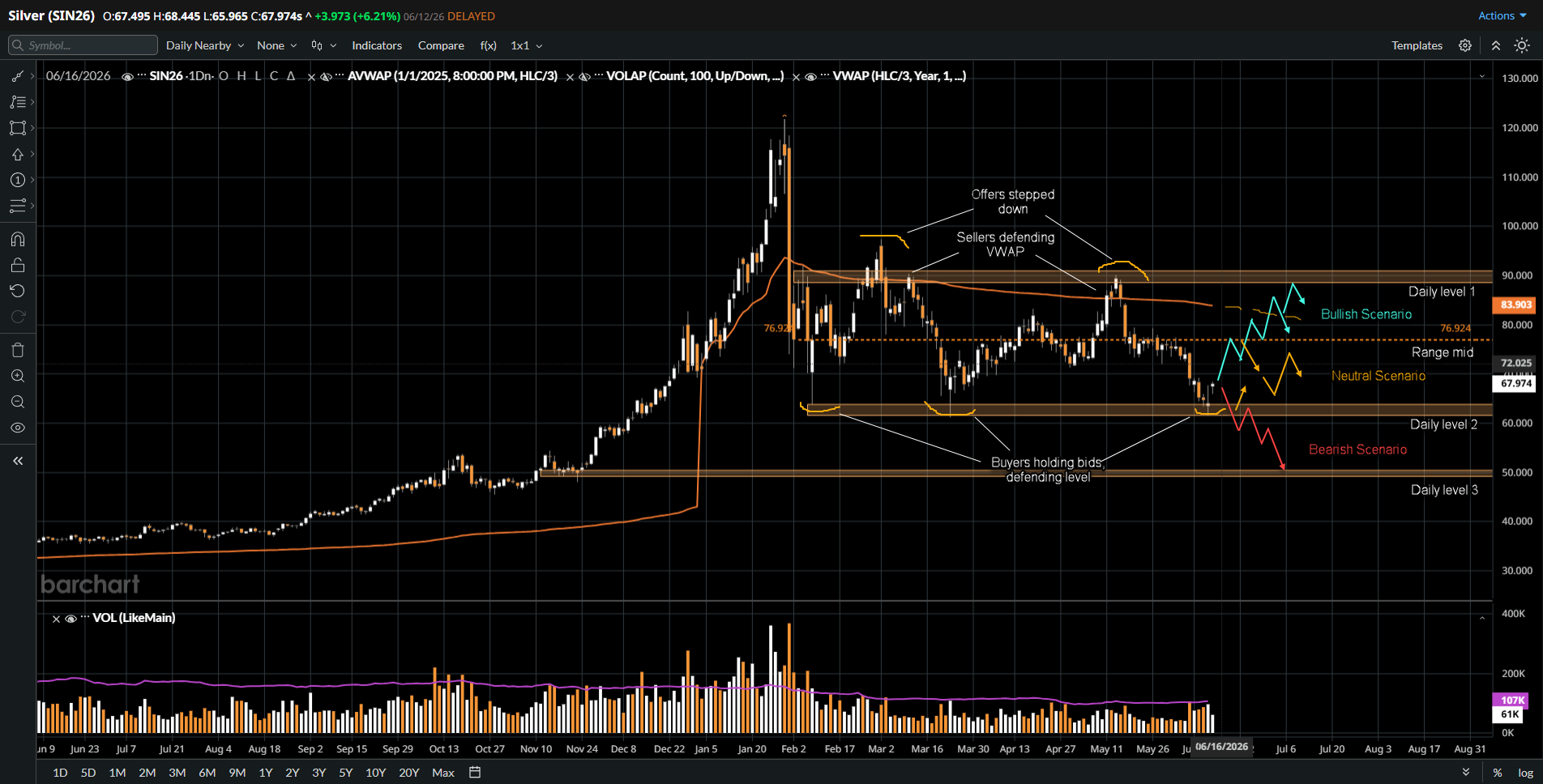
The key level to watch is 62 (daily level 2 / range low). How the market responds at this level in the coming weeks will likely define whether Silver remains range-bound, breaks lower, or begins to build a base for a recovery.
Bullish
- If buyers are able to defend 62, the first target on the recovery is 76.9 (range mid), where sellers have established a clear presence and can be expected to defend again.
- Should Silver push through 76.9 without sellers regaining control, the next upside objective is the yearly VWAP, a level sellers have used as a consistent capping point throughout the range.
- A sustained move above the yearly VWAP would open the path back toward 90 (daily level 1 / range high), which would represent a full-range reclaim.
- The possible macro trigger for this scenario would be confirmation of a durable US-Iran ceasefire or a formal deal that reopens the Strait of Hormuz, which would ease the energy-driven inflation shock, potentially give the Fed room to signal earlier cuts in the June 16-17 dot plot under Kevin Warsh, and weaken the dollar enough to provide Silver with meaningful tailwinds.
Bearish
- If buyers fail to defend 62 (daily level 2 / range low), Silver opens the door to a move toward 50 (daily level 3), where buyers would be expected to respond given the significance of that longer-term structural level.
- The possible macro trigger here would be the June 16-17 dot plot delivering a hawkish surprise, with the median projection penciling in a December 2026 rate hike rather than any easing, combined with a breakdown in ceasefire negotiations or a fresh escalation in the US-Iran conflict that pushes oil and the dollar higher simultaneously.
- Traders should remain cautious of a false break below 62, where Silver briefly dips below range low before recovering back up into the range, a pattern that can trap late sellers and set up a sharp short squeeze reversal.
Neutral
- If sellers continue to defend 76.9 (range mid) and buyers hold their ground at 62 (daily level 2 / range low), the most likely outcome is continued two-way rotations between these two levels, with Silver grinding sideways without a clear directional resolution.
- The possible macro trigger for this scenario is the June 16-17 FOMC producing no surprises in the dot plot while the US-Iran situation remains in a ceasefire-but-unresolved limbo, with neither a full deal nor a fresh escalation providing the catalyst needed to break Silver out of this compressed range.
Conclusion
Silver sits at a genuinely pivotal juncture. The technical picture is clear in its structure but undecided in its direction, with sellers having demonstrated consistent control from the yearly VWAP down through 76.9 and now pushing price back to the range low at 62. What happens at this level matters enormously. The macro backdrop offers both a bull and bear case simultaneously, with the structural supply deficit in Silver and the long-term industrial demand story from solar, EVs, and AI infrastructure sitting underneath the market, while a hawkish Fed, elevated real yields, and ceasefire uncertainty cap the upside. The June 16-17 FOMC dot plot under Kevin Warsh is the near-term macro catalyst that could tip the balance. Watch how Silver behaves at 62 both before and after that decision.
We are a professional-grade futures brokerage engineered by traders to provide the high-performance architecture and futures trading platform required for serious market participation. We serve as a professional technical partner for traders who prioritize data integrity and objective analysis. Take the next step in your professional evolution and Open an Account today.
Disclaimer:
This article is provided for informational and educational purposes only and does not constitute financial, investment, or trading advice. The analysis presented reflects the author’s market observations and opinions at the time of writing and is not a recommendation to buy or sell any futures contract, security, or financial instrument. Futures trading involves significant risk and is not suitable for all market participants. Losses may exceed initial margin deposits, and market conditions can change rapidly.
Any scenarios, levels, or market expectations discussed are hypothetical in nature and are intended solely to illustrate potential market behavior. They do not represent actual trading results and should not be interpreted as guarantees of future performance. Past performance, market behavior, or historical price action are not indicative of future outcomes.
Readers are solely responsible for their own trading decisions and risk management. Always conduct independent research, consider your financial situation and risk tolerance, and consult with a qualified financial professional, if necessary, before engaging in futures or derivatives trading.


/A%20corporate%20sign%20for%20SK%20Hynix%20by%20Tada%20Images%20via%20Adobe%20Stock.jpeg)

/2d%20illustration%20of%20Cloud%20computing%20by%20Blackboard%20via%20Shutterstock.jpg)
/Server%20racks%20by%20dotshock%20via%20Shutterstock.jpg)