




Dual Edge Research publishes two powerful newsletters that work great individually — and even better together. The Bull Strangle Newsletter focuses on stocks and options, combining stock ownership with premium-selling strategies to generate consistent income and market-beating returns. The Smart Spreads Newsletter specializes in seasonal commodity futures spreads, offering a diversified approach with low correlation to equities. Together, they deliver a complete investment perspective — one focused on income, the other on diversification — all under one simple subscription.
Introduction
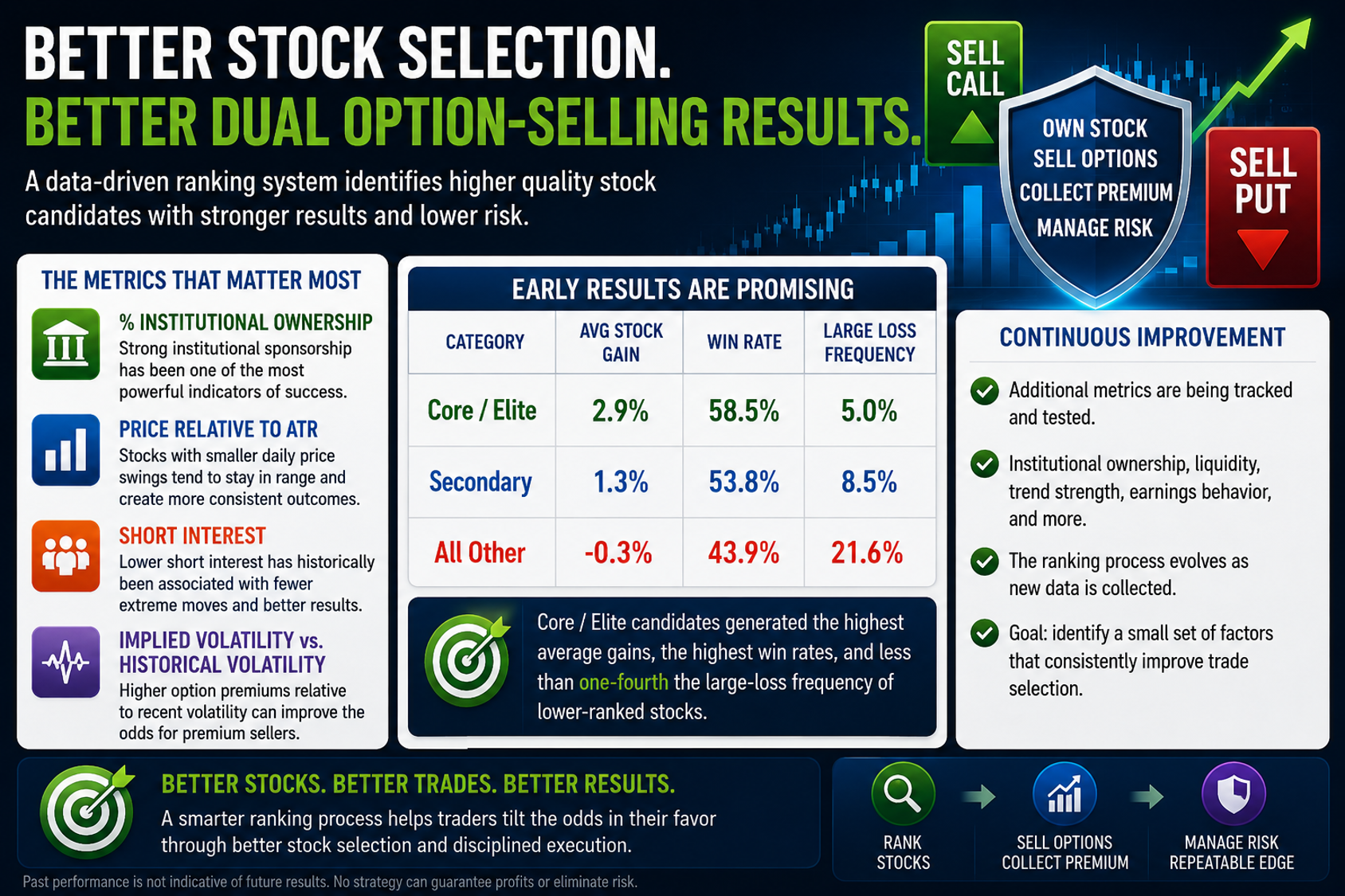
One of the most important decisions in the Bull Strangle strategy occurs before a trade is ever placed: stock selection. While option premiums, strike selection, and position management all contribute to results, the quality of the underlying stock often determines whether a trade begins with the wind at its back or faces unnecessary headwinds from the start.
Over the past year, I have been conducting an ongoing research project to identify the characteristics most commonly found in the strongest Bull Strangle candidates. The objective is not to predict which stocks will produce the highest returns. Instead, the goal is to identify stocks that have historically exhibited a combination of stability, liquidity, institutional sponsorship, and volatility that supports consistent option-selling performance.
Turning Research into a Ranking System
Using hundreds of historical Bull Strangle trades, each stock was evaluated using a series of quantitative metrics and assigned to one of several rating categories. Today, stocks are generally classified into four groups:
- Core / Elite
- Secondary
- All Other
Core and Elite stocks represent the primary candidates for new positions. Secondary candidates are often used to improve sector diversification when sufficient Core opportunities are unavailable. Stocks falling into the All Other category generally do not meet the standards established by the ranking process and are typically excluded from consideration. While the database continues to grow, the initial results have been encouraging.
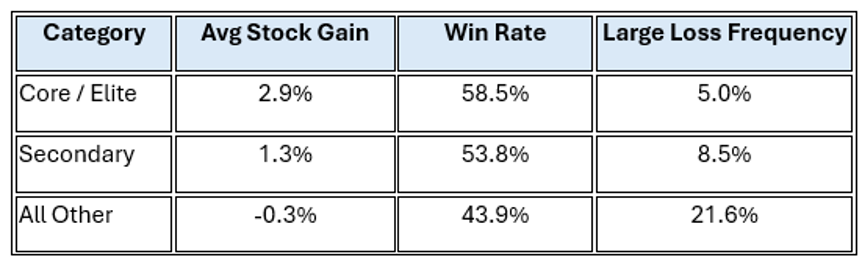
The results reveal a clear progression. As stock quality improves, average returns increase while the frequency of large losses declines dramatically. Perhaps most importantly, the Core and Elite groups produced less than one-fourth the large-loss frequency observed in the All Other category. For a strategy built around consistency and risk management, avoiding large losses can be just as important as capturing gains.
The Metrics Driving Results
Several factors have emerged as particularly useful in identifying stronger candidates.
- Institutional Ownership - One of the strongest findings from the research has been the importance of institutional sponsorship. Stocks with higher levels of institutional ownership have generally produced better outcomes than stocks with limited institutional participation. Institutions often provide liquidity, stability, and a deeper shareholder base that can reduce the likelihood of extreme price swings. While institutional ownership alone is not sufficient, it has become one of the most important components of the ranking process.
- Price Relative to Average True Range (ATR) - Another powerful metric is the relationship between stock price and Average True Range. Stocks with higher price-to-ATR ratios tend to experience smaller percentage price fluctuations. Since the Bull Strangle strategy benefits from stocks remaining within a manageable trading range, this characteristic has proven highly valuable.
- Short Interest - Short interest has also demonstrated meaningful predictive value. Stocks with elevated short interest often exhibit greater volatility and are more susceptible to sudden price shocks. While these stocks occasionally produce explosive gains, they can also generate outsized losses that are less desirable for an income-oriented strategy. The research consistently shows that lower short-interest stocks tend to deliver more favorable risk-adjusted outcomes.
- Implied Volatility Relative to Historical Volatility - The final major component evaluates current option pricing relative to recent realized volatility. This relationship helps identify situations in which option premiums may be attractive without requiring excessive risk of price movement. Since premium collection is a central component of the Bull Strangle strategy, this factor remains an important part of the screening process.
Research Continues
Although the current ranking system has shown promising early results, the work is far from complete. Several additional metrics are now being tracked and evaluated, including relative strength, earnings-related behavior, liquidity measures, moving-average relationships, trend persistence, and other market structure characteristics.
The goal is not to create a complex "black box" model. Instead, the objective is to identify a small number of factors that consistently improve stock selection while keeping the process transparent, repeatable, and practical.
Continuous Improvement
No ranking system can eliminate risk. Markets evolve, leadership changes, and new environments emerge. However, early evidence suggests that focusing on institutional ownership, volatility characteristics, short interest, and option-pricing relationships can significantly improve the quality of stock selection.
The Bull Strangle strategy has always emphasized repeatable processes over predictions. The ranking system follows the same philosophy. By continually collecting data, evaluating outcomes, and refining the selection process, the objective remains simple: improve the quality of each watch list and stack small advantages over hundreds of trades.
Over time, those small advantages can become a meaningful edge.
Want to build a more complete trading toolkit?
The Bull Strangle Newsletter focuses on stocks and options, combining stock ownership with disciplined option-selling techniques designed to generate consistent income while managing risk.
The Smart Spreads Newsletter focuses on seasonal commodity spreads, a historically proven approach that seeks opportunities across agricultural, energy, metal, and financial futures markets.
Each strategy is designed to stand on its own, but together they provide a diversified approach that can perform across a wide range of market environments. For traders looking to deepen their education, The Bull Strangle Strategy and Trading Commodity Spreads, both available on Amazon.
Visit BullStrangle.com to subscribe for just $1 for the first month.
For a video overview of the Bull Strangle Newsletter
For a video overview of the Smart Spreads Newsletter
Darren Carlat
Dual Edge Research
(214) 636-3133
DualEdgeResearch@gamil.com
Disclaimer
This information is for informational purposes only and should not be considered as investment advice. Past performance is not indicative of future results, and all investments carry inherent risk. Consult with a financial advisor before making any investment decisions.


/A%20photo%20of%20a%20Sandisk%20Solid%20State%20Drive%20by%20Top%20Popular%20Vector%20by%20Shutterstock.jpg)

/AI%20(artificial%20intelligence)/Data%20Center%20by%20Caureem%20via%20Shutterstock%20(2).jpg)
/ServiceNow%20Inc%20building%20in%20Silicon%20Valley-by%20Sundry%20Photography%20via%20iStock.jpg)