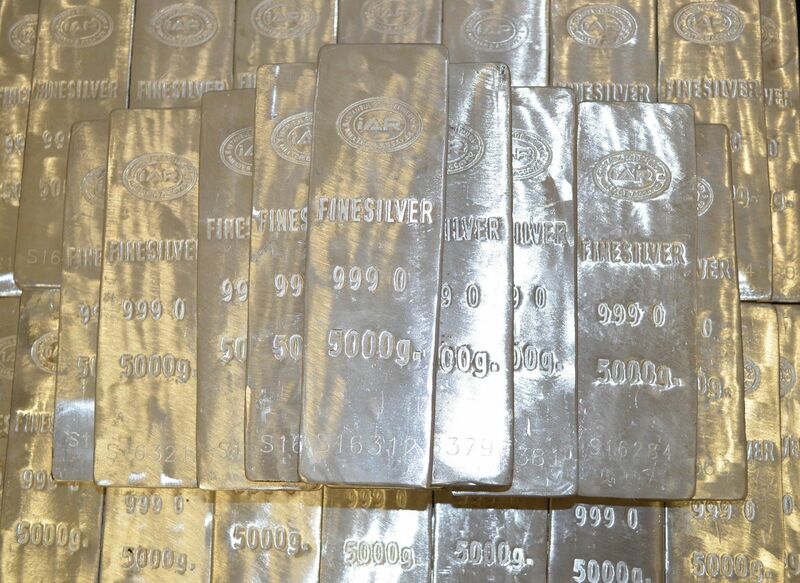
History tends to repeat in markets, and longer accounts provide more data that can validate assumptions improving the odds of success. Few price relationships have as long of a history as the price relationship between silver and gold. In approximately 3200 BCE, the first Egyptian Pharaoh, Menes, declared that two and one-half parts silver equal one part gold. For over 5,200 years, gold and silver have been a means of exchange. Long before there were dollars, euros, yen, pounds, or other fiat currencies in the worldwide financial system, gold and silver were money.
In the 1960s, I was first exposed to silver’s role as currency as my grandfather referred to the change in his pocket as silver. In those days, quarters, dimes, half, and dollar coins contained the metal. For ages, gold has been the bills in our wallets and silver the coins. Menes established the silver-gold ratio. In modern times, since the 1970s, the average has been between sixty and seventy ounces of silver value in each ounce of gold value. Over the past months, the ratio has been declining towards the average, which could be a bullish sign for the precious metals in 2023.
A long-term look at the ratio
Dividing the nearby gold futures price by the nearby silver futures price calculates the silver-gold ratio.

The chart ({GCG23}/{SIH23}) shows the median level for the silver-gold ratio since the 1970s has been between 60 and 70 ounces of silver value in each ounce of gold value, far above the level established by Menes more than 5,200 years ago.
When the ratio is below the median, it tends to be bullish for gold and silver prices. The chart shows the decline to just over the 15:1 level in 1980 when gold and silver reached record highs. In 2011, when gold hit a new all-time peak and silver came within striking range of the 1980 high, the ratio fell to just over 32:1. While not perfect, a declining ratio tends to be a bullish signal for the gold and silver futures markets.
The recent trend is lower
A declining ratio is bullish because speculators tend to flock to the more volatile silver market during upward trends. Silver tends to outperform gold on a percentage basis during bullish periods. Meanwhile, silver’s far lower per-ounce price contributes to its speculative nature.

The short-term chart ({GCG23}/{SIH23}) highlights the ratio’s decline from 96.6:1 on September 1, 2022, to the 75.7:1 on December 20. The ratio has made lower highs and lower lows over the past months, a bullish technical signal for the leading precious metals.
Central bank’s policies have weighed on prices since early 2022
Gold and silver prices tend to move lower when interest rates rise as higher rates increase the cost of carrying the metals. Moreover, gold and silver compete with other assets for capital, and higher rates make fixed-income instruments more attractive.
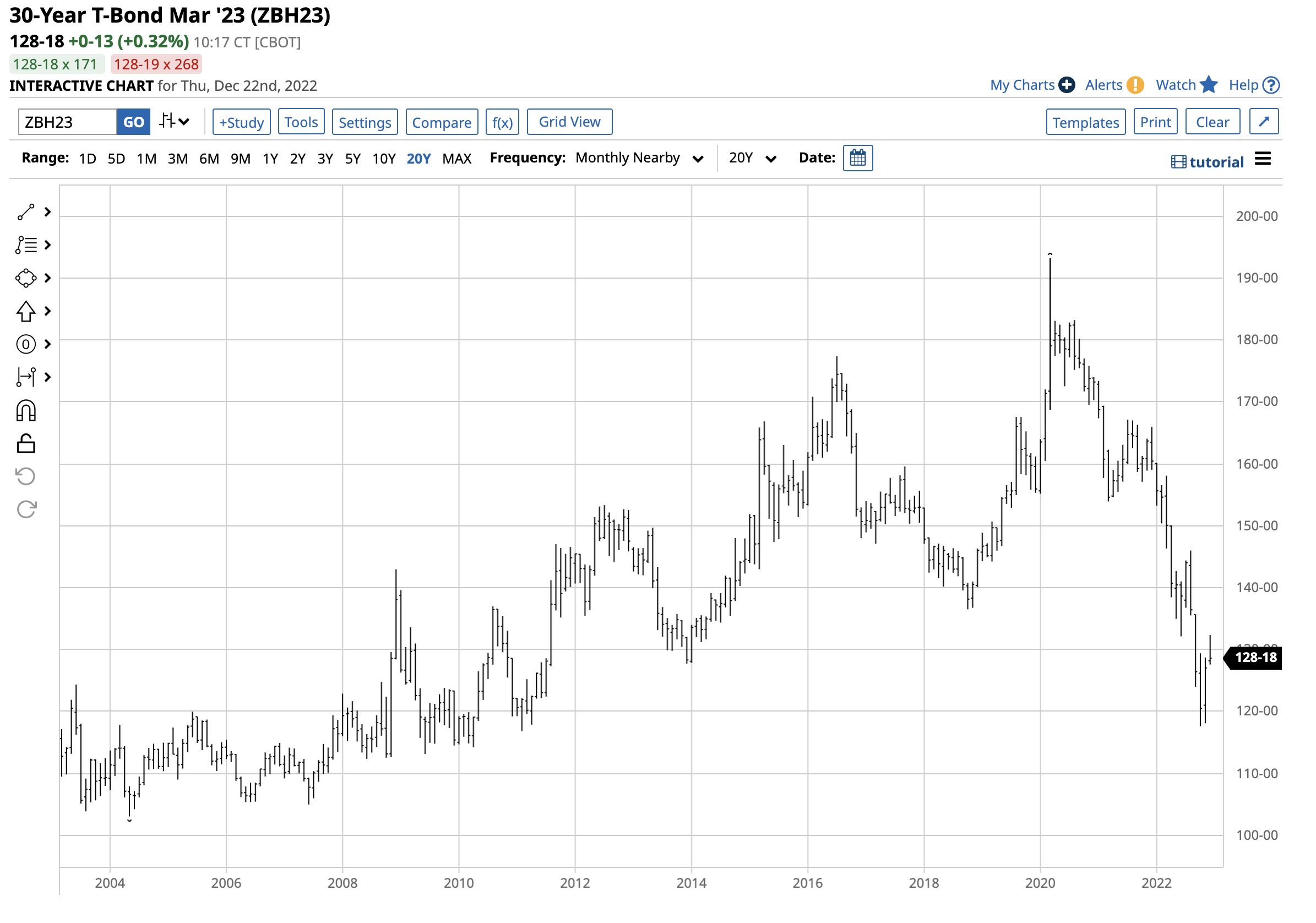
The chart of the U.S. government 30-Year Treasury bond futures shows a steady decline in 2022. The U.S. Federal Reserve increased the short-term Fed Funds Rate from zero percent in March to 4.25% to 4.50% at the final December FOMC meeting. The central bank’s quantitative tightening program to reduce its swollen balance sheet has pushed rates for longer maturities higher.
Higher rates also pushed the U.S. dollar higher, and a rising dollar tends to weigh on precious metals prices.
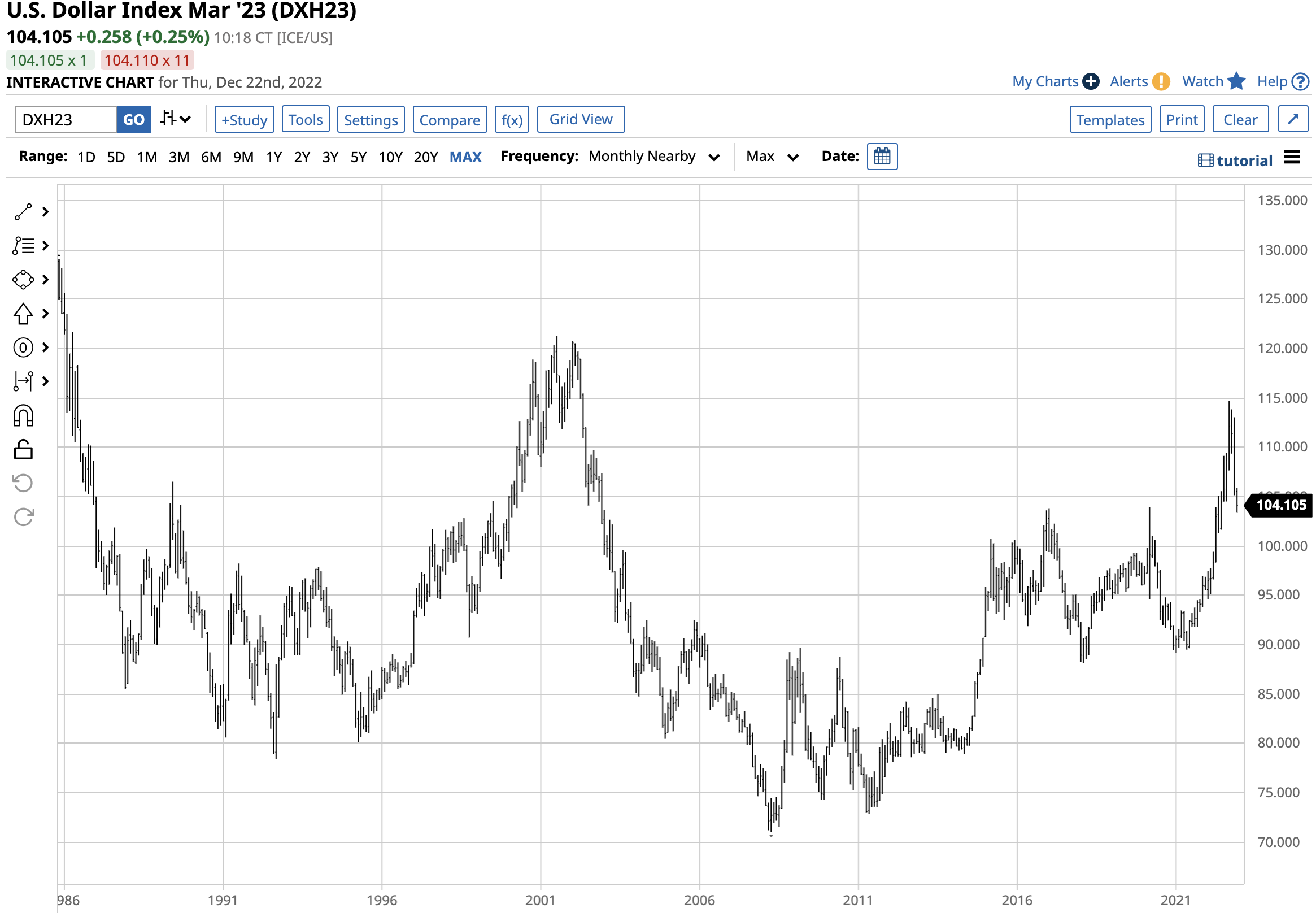
The dollar index futures chart shows the U.S. currency’s explosive rally in 2022, which took the index to 114.785, the highest level since 2002.
Rising rates and a strong U.S. dollar tend to be a double-barrel bearish factor for gold and silver prices.
Central banks validate gold’s role in the financial system
While hawkish central bank monetary policy in the U.S. and worldwide has weighed on precious metals prices, the central banks continue to validate gold’s role in the global financial system. In Q3 2022, central banks bought a record 399.3 metric tons of gold to add to reserves. Central banks, governments, monetary authorities, and supranational institutions hold gold as an integral part of foreign exchange reserves. Gold is hard currency or money.
Meanwhile, as Russia faced mounting sanctions after the Ukraine invasion, Moscow declared that 5,000 rubles are exchangeable for one gram of gold. The move put the Russian currency on a quasi-gold standard. In February 2022, before the invasion, Russian President Putin and Chinese leader Xi shook hands on a “no limits” alliance. If China follows Russia and backs the yuan with gold, it would be a significant event for the international gold market. Meanwhile, gold remains a critical asset for all governments.
Other factors supporting gold and silver in 2023
The factors supporting gold and silver in 2023 include:
- Gold and silver price have displayed strength in 2022 as they outperformed stocks, bonds, and most other assets.
- The bifurcation between the world’s nuclear powers creates geopolitical tensions that support gold and silver, the world’s oldest currencies.
- Inflation has caused production costs to rise, putting upward pressure on prices.
- Fiat currencies depend on the full faith and credit in the governments that issue legal tender. Faith and credit have been declining over the past years.
- Gold has been in a bull market since 1999, when the price reached rock bottom at $252.50 per ounce. Since then, every significant dip in gold has been a buying opportunity, with the latest new record peak in March 2022 at over the $2070 per ounce level.
- Silver prices are far higher than at the turn of this century and have been holding above the $20 per ounce level.
- Demand for silver for solar panels and other industrial applications has been rising.
I expect gold and silver prices to soar in 2023. However, bull markets rarely move in straight lines. Buying on price weakness has been the optimal approach to precious metals for over two decades, and I expect that trend to continue in 2023.
More Metals News from Barchart
- Stocks Slide on Chip Stocks and Hawkish Economic News
- Dollar Moves Higher as Yen Relinquishes Some of Tuesday’s Sharp Gains
- Stocks Higher on Positive Corporate Earnings
- Dollar Retreats as Yen Surges on Hawkish BOJ
On the date of publication, Andrew Hecht did not have (either directly or indirectly) positions in any of the securities mentioned in this article. All information and data in this article is solely for informational purposes.


/AI%20(artificial%20intelligence)/Ai%20chip%20by%20Quality%20Stock%20Arts%20via%20Shutterstock.jpg)
/A%20close-up%20of%20the%20Broadcom%20logo%20on%20a%20smartphone%20by%20Timon%20via%20Adobe%20Stock.jpeg)