




Dual Edge Research publishes two powerful newsletters that work great individually — and even better together. The Bull Strangle Newsletter focuses on stocks and options, combining stock ownership with premium-selling strategies to generate consistent income and market-beating returns. The Smart Spreads Newsletter specializes in seasonal commodity futures spreads, offering a diversified approach with low correlation to equities. Together, they deliver a complete investment perspective — one focused on income, the other on diversification — all under one simple subscription.
Introduction
Seasonal spreads begin with a simple idea: certain price relationships tend to repeat over time. But identifying a seasonal pattern is not the edge. The edge comes from selection.
Across markets, contract months, and structures, the number of possible spread combinations is effectively unlimited. Most exhibit some form of seasonal behavior. Very few produce stable, repeatable outcomes.
The role of filtering is to reduce that universe—removing instability before any comparison or ranking takes place.
Step 1 — Define the Filtering Objective
Filtering is not optimization. It is elimination. The goal is not to find the “best” trades. It is to remove trades that demonstrate inconsistent, unstable, or untradeable behavior. This distinction matters. Optimization seeks improvement. Filtering enforces standards. Only trades that meet those standards are allowed into the selection universe.
Step 2 — The Core Metrics
Filtering requires objective standards. Each spread is evaluated using a consistent set of structural metrics designed to identify stability, not optimize performance.
RIDX (Range Index) measures the strength and consistency of the seasonal pattern across time. Trades driven by isolated outcomes are removed.
Corr5 (5-Year Rolling Correlation) confirms that recent behavior aligns with historical tendencies. Patterns that no longer persist are excluded.
APW (Achieved Profit Window) evaluates how often a trade reaches its expected profit during the seasonal window. This prevents averages from being distorted by infrequent large winners.
Days (Trade Duration) ensures the seasonal window persists long enough to be captured without requiring precise timing.
Volume (Liquidity) confirms that the spread can be executed efficiently, avoiding trades that appear viable in theory but fail in practice.
PL/DD × Win% (Return vs. Drawdown) evaluates whether the expected return justifies the historical adverse movement, incorporating both magnitude and consistency.
These metrics function as eliminators—not optimizers. They are not used to rank trades or fine-tune entries. They are used to remove configurations that fail to meet minimum structural standards. What remains after this step is not a refined version of the full universe. It is an entirely different universe—one defined by stability, consistency, and tradability.
Step 3 — What Filtering Removes
Applying these metrics reveals a critical insight: most trades are not failures—they are inefficient. They may win. They may even win frequently. But they exhibit one or more of the following:
• Returns that are too small relative to risk
• Inconsistent behavior across time
• Excessive drawdowns relative to expected gain
• Limited ability to reach target outcomes
These trades degrade performance quietly. They are not obvious outliers. They are structurally weak. Filtering removes them.
Step 4 — The Impact of Filtering
The effect of filtering is measurable.
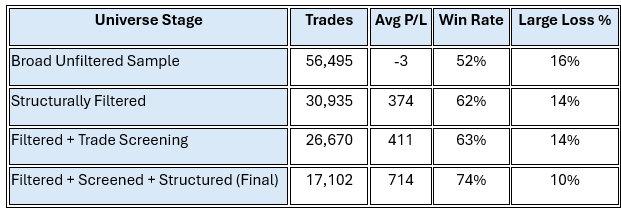
The improvement is not driven by trade management. It is driven by removal. As weaker configurations are eliminated:
• Win rate increases
• Average returns expand
• Large losses decline
This is the function of filtering—not enhancement, but refinement of the opportunity set.
Step 5 — When Ranking Becomes Meaningful
Only after filtering does ranking begin. At this stage, every remaining trade has already demonstrated:
• Consistent behavior
• Structural alignment
• Acceptable risk characteristics
Now, differences between trades reflect relative strength, not hidden instability. Ranking becomes a process of comparison within a qualified universe—not across the entire market.
Step 6 — From Filtering to Portfolio Construction
Filtering defines what is eligible. Ranking defines what is preferred. But portfolio construction determines what is sustainable. Not all surviving trades deserve equal capital. Some offer greater consistency and form the core of the portfolio. Others play supporting roles.
The objective is not to maximize individual trade outcomes. It is to build a portfolio that remains stable across time.
Final Thoughts
Seasonal spreads do not require more ideas. They require fewer—but better—ones. The filtering process provides that constraint. It removes trades that win but do not pay. It removes trades that behave unpredictably. It removes trades that introduce unnecessary risk. What remains is not a larger opportunity set. It is a better one.
Want to See This Applied in Real Time?
Each week, the Smart Spreads Newsletter applies this filtering framework across markets to identify qualified trade candidates. If you’re interested in seeing how seasonal spreads are systematically narrowed, evaluated, and selected, you can learn more in the latest updates.
More Information
Now you can get two powerful newsletters — for one simple price!
- For stocks and options, the Bull Strangle Newsletter shows you how to combine stock ownership with dual option selling — a disciplined strategy that has consistently outperformed the S&P 500.
- For commodity futures, the Smart Spreads Newsletter focuses on seasonal commodity spreads — a proven, low-correlation approach that thrives in all types of markets.
Each newsletter is designed to deliver consistent income on its own — but when used together, they create a complete, diversified trading approach that works in any market environment.
Visit BullStrangle.com to subscribe for just $1 for the first month.
For a video overview of the Bull Strangle Newsletter
For a video overview of the Smart Spreads Newsletter
Darren Carlat
Dual Edge Research
(214) 636-3133
DualEdgeResearch@gamil.com
Disclaimer
This information is for informational purposes only and should not be considered as investment advice. Past performance is not indicative of future results, and all investments carry inherent risk. Consult with a financial advisor before making any investment decisions.



/Super%20Micro%20Computer%20Inc%20HQ%20photo-by%20Tada%20Images%20via%20Shutterstock.jpg)
/Micron%20Technology%20Inc_logo%20and%20website-by%20Mojahid%20Mottakin%20via%20Shutterstock.jpg)