Selling cash secured puts on stocks an investor is happy to take ownership of is a great way to generate some extra income.
A cash-secured put involves writing an at-the-money or out-of-the-money put option and simultaneously setting aside enough cash to buy the stock.
The goal is to either have the put expire worthless and keep the premium, or to be assigned and acquire the stock below the current price.
It’s important that anyone selling puts understands that they may be assigned 100 shares at the strike price.
Why Trade Cash Secured Puts?
Selling cash secured puts is a bullish trade but slightly less bullish than outright stock ownership.
If the investor was strongly bullish, they would prefer to look at strategies like a long call or a bull call spread.
Investors would sell a put on a stock they think will stay flat, rise slightly, or at worst not drop too much.
Cash secured put sellers set aside enough capital to purchase the shares and are happy to take ownership of the stock if called upon to do so by the put buyer.
Naked put sellers, on the other hand, have no intention of taking ownership of the stock and are purely looking to generate premium from option selling strategies.
The more bullish the cash secure put investor is, the closer they should sell the put to the current stock price.
This will generate the most amount of premium and also increase the chances of the put being assigned.
Selling deep-out-of-the-money puts generates the smallest amount of premium and is less likely to see the put assigned.
ABBV Cash Secure Put Example
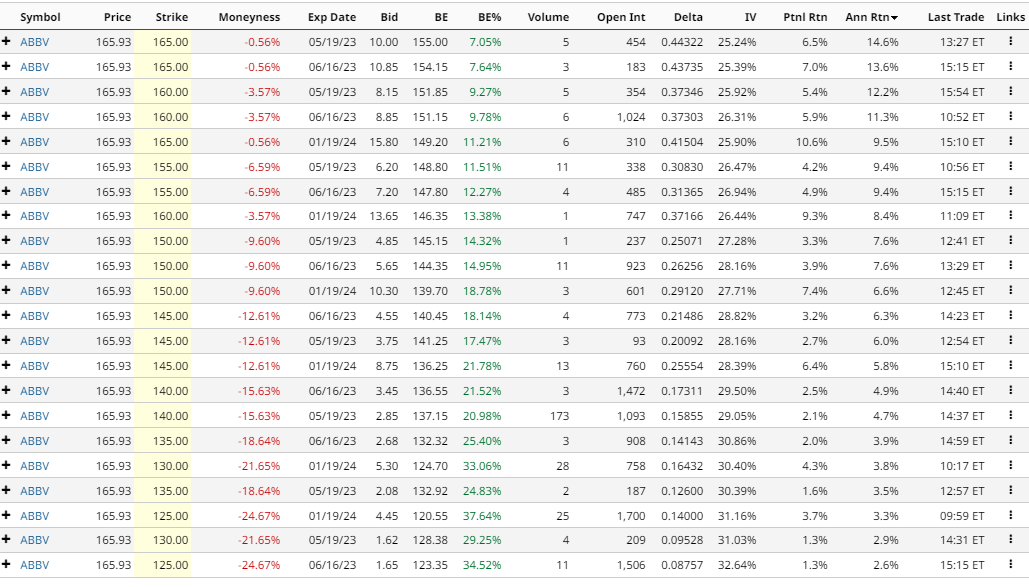
Yesterday, with Abbivie (ABBV) trading around $165, traders could sell a May 19, 2023 put option with a strike price of $165.
For selling this put, the trader would receive $1,000 in option premium.
In return for receiving this premium, they would have an obligation to buy 100 shares of ABBV for $165. By May next year, if ABBV is trading for $160, or $140, or even $50, they still have to buy 100 shares at $165.
But, If ABBV is trading above $165, the put option expired worthless, and they keep the $1,000 option premium.
The net capital at risk is equal to the strike price of 165, less the 10.00 in option premium. So, if assigned, the net cost basis will be 155. That’s not bad for a stock currently trading at $165.93.
That’s a 7.05% discount from the price it was trading yesterday.
If ABBV stays above $165, the return on capital is:
$1,000 / $15,500 = 6.5% in 161 days, which works out to 14.6% annualized.
This trade either achieves a 14.6% annualized return, or results in buying a Dividend Aristocrat stock for a 7.05% discount.
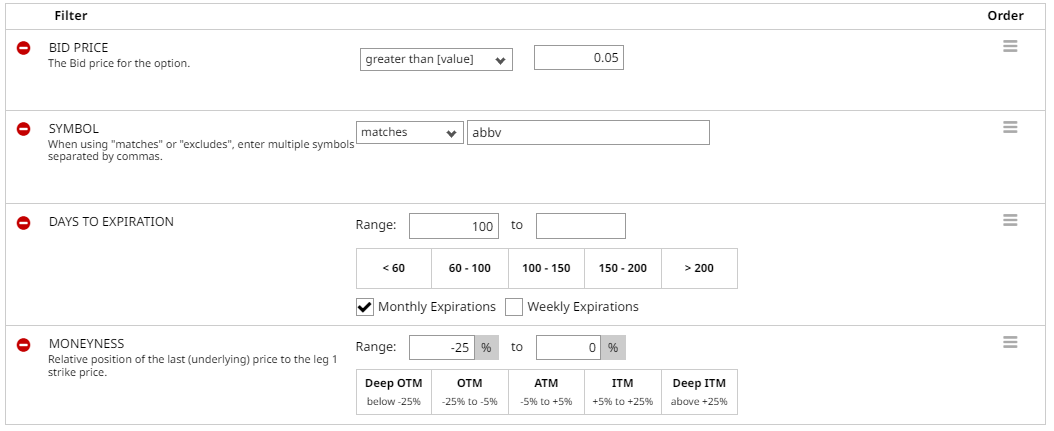
Below you can see the filters and results for this Naked Put Screener:
Company Details
Abbievie is currently rated a Strong Buy. The Barchart Technical Opinion rating is an 88% Buy with a Strongest short term outlook on maintaining the current direction. The market is in highly overbought territory. Beware of a trend reversal.
Of 16 analysts covering ABBV, 7 have a strong buy rating, 1 has a moderate buy rating, 7 have hold ratings and 1 has a strong sell rating.
AbbVie has become one of the top-most pharma companies after it acquired Allergan. The deal has transformed AbbVie's portfolio by lowering its dependence on Humira, its flagship product. AbbVie has one of the most popular cancer drugs in its portfolio, Imbruvica and its newest immunology drugs Skyrizi and Rinvoq position it well for long-term growth. AbbVie came into existence after Abbott Laboratories divested its pharmaceutical division. AbbVie enjoys leadership positions in key therapeutic areas including immunology, hematologic oncology, neuroscience, aesthetics, eye care and womens' health. Humira is approved for several autoimmune diseases like rheumatoid arthritis, active psoriatic arthritis, active ankylosing spondylitis, Crohn's disease and others. Imbruvica became part of the company's portfolio following the Pharmacyclics acquisition. Other key drugs include Venclexta, Botox Cosmetic, Botox Therapeutics, Vraylar, Skyrizi and Rinvoq.
Summary
While this type of strategy requires a lot of capital, it is a great way to generate an income from stocks you want to own.
If you end up being assigned, you can sit back and collect the healthy 3.41% dividend on offer from ABBV.
You can do this on other stocks as well, but remember to start small until you understand a bit more about how this all works.
Mitigating Risk
With any option trade, it’s important to have a plan in place on how you will manage the trade if it moves against you.
Some traders like to add a deep out-of-the-money long put to reduce risk. For example, a May 19, 2023 put option with a strike price of 120 could be purchased for around $100. Buying this put, would cap losses below 120 and reduce total capital at risk from $15,500 to $3,500.
Please remember that options are risky, and investors can lose 100% of their investment.
This article is for education purposes only and not a trade recommendation. Remember to always do your own due diligence and consult your financial advisor before making any investment decisions.
More Stock Market News from Barchart
- Tighter Fed Policy Deflates Asset Bubbles
- Stocks Climb on Signs the U.S. Labor Market May be Cooling
- Markets Today: Stock Indexes Moderately Higher as Short Covering Emerges
- Adobe Earnings: Iron Condor Could See 43% Return On Risk
On the date of publication, Gavin McMaster did not have (either directly or indirectly) positions in any of the securities mentioned in this article. All information and data in this article is solely for informational purposes.



/2d%20illustration%20of%20Cloud%20computing%20by%20Blackboard%20via%20Shutterstock.jpg)
/Elon%20Musk%2C%20founder%2C%20CEO%2C%20and%20chief%20engineer%20of%20SpaceX%2C%20CEO%20of%20Tesla%20by%20Frederic%20Legrand%20-%20COMEO%20via%20Shutterstock.jpg)