/Amazon%20Box%20Delivery.jpg)
A bear call spread is a type of vertical spread, meaning that two options within the same expiry month are being traded.
One call option is being sold, which generates a credit for the trader. Another call option is bought to provide protection against an adverse move.
The sold call is always closer to the stock price than the bought call.
As the name suggests, this trade does best when the stock declines after the trade is open.
However, there can be many cases where this trade can make a profit if the stock stays flat and even if it rises slightly.
Bear call spreads are risk defined trades. There are no naked options here, so they can be traded in retirement accounts such as an IRA.
Traders should have a bearish outlook on the stock and ideally look to enter when the stock has a high implied volatility rank.
Two stocks came up on my screens today as possible bear call spread candidates.
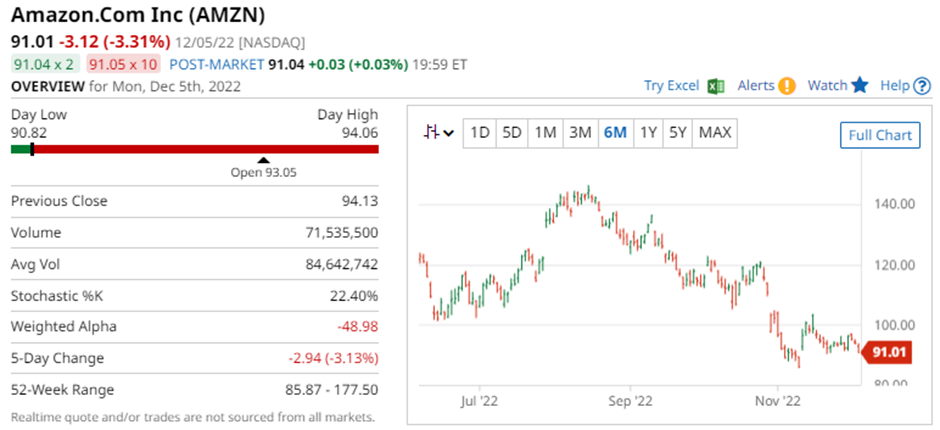
Amazon (AMZN) has drop over 45% year-to-date and is rated a 100% Sell with a strongest short term outlook on maintaining the current direction.
Looking at the chart there are plenty of areas of potential resistance between 100 and 120.
Amazon.com is one of the largest e-commerce providers, with sprawling operations spreading across the globe. Its online retail business revolves around the Prime program well-supported by the company's massive distribution network. Further, the Whole Foods Market acquisition helped Amazon establish footprint in physical grocery supermarket space. Amazon also enjoys dominant position in the cloud-computing market, particularly in the Infrastructure as a Service space, thanks to Amazon Web Services, which is one of its high-margin generating businesses. Amazon has also become a household name with its Alexa powered Echo devices. Artificial Intelligence backed Alexa is helping the company sell products and services. The company reports revenue under three broad heads'North America, International and AWS, respectively. Amazon targets three categories of customers - consumers, sellers and website developers.
AMZN is currently below declining 21, 50 and 200-day moving averages and could be a good candidate for a bearish option trade.
Implied volatility is moderate at around 41%. The twelve-month low for implied volatility is 24.89% and the twelve month high is 61.20%. The IV Percentile is 48%.
Let’s look at how a bear call spread trade might be set up on Amazon stock.
AMZN Bear Call Spread: January 100 – 105 Bear Call Spread
As a reminder, A bear call spread is a defined risk option strategy that profits if the stock closes below the short strike at expiry.
To execute a bear call spread an investor would sell an out-of-the-money call and then buy a further out-of-the-money call.
This bear call spread trade was found using the bear call spread screener and involves selling the January expiry 100 strike call and buying the 105 strike call.
Selling this spread results in a credit of around $0.95 or $95 per contract. That is also the maximum possible gain on the trade. The maximum potential loss can be calculated by taking the spread width, less the premium received and multiplying by 100. That give us:
5 – 0.95 x 100 = $405.
If we take the maximum gain divided by the maximum loss, we see the trade has a return potential of 23.46%.
The spread will achieve the maximum profit if AMZN closes below 100 on January 20, in which case the entire spread would expire worthless allowing the premium seller to keep the $95 option premium.
The maximum loss will occur if AMZN closes above 105 on January 20, which would see the premium seller lose $405 on the trade.
The breakeven point for the bear call Spread is 100.95 which is calculated as 100 plus the $0.95 option premium per contract.
Let’s look at another idea, this time on Tesla (TSLA) which was another stock that came up on my bearish scans.
TSLA Bear Call Spread: January 220 – 225 Bear Call Spread
This bear call spread trade also involves using the January expiration on TSLA and selling the 220-225 call spread.
Selling this spread results in a credit of around $0.80 or $080 per contract. That is also the maximum possible gain on the trade. The maximum potential loss can be calculated by taking the spread width, less the premium received and multiplying by 100. That give us:
10 – 0.80 x 100 = $420.
If we take the maximum gain divided by the maximum loss, we see the trade has a return potential of 19.05%.
The spread will achieve the maximum profit if TSLA closes below 220 on January 20, in which case the entire spread would expire worthless allowing the premium seller to keep the $80 option premium.
The maximum loss will occur if TSLA closes above 225 on January 20, which would see the premium seller lose $420 on the trade.
The breakeven point for the Bear call Spread is 220.80 which is calculated as 220 plus the $0.80 option premium per contract.
Mitigating Risk
With any option trade, it’s important to have a plan in place on how you will manage the trade if it moves against you.
For the AMZN bear call spread, I would set a stop loss if the stock traded above 95.
For the TSLA trade, I would close for a loss if the stock broke through 210.
Please remember that options are risky, and investors can lose 100% of their investment. This article is for education purposes only and not a trade recommendation. Remember to always do your own due diligence and consult your financial advisor before making any investment decisions.
More Stock Market News from Barchart
- Stocks Tumble as Strong U.S. Economic News Fuels Hawkish Fed
- Analysts are Positive on Activision Blizzard Even if Microsoft’s Acquisition Fails
- Stocks Decline as Strong U.S. Economic News Boosts Bond Yields
- Exxon Stock Looks Attractive to Value Investors With Short Option Income Plays

/Abbott%20Laboratories%20vials%20and%20Logo-by%20Melniov%20Dmitriy%20via%20Shutterstock.jpg)
/A%20photo%20of%20a%20Sandisk%20Solid%20State%20Drive%20by%20Top%20Popular%20Vector%20by%20Shutterstock.jpg)
/Intuit%20Inc%20logo-by%20Mojahid%20Mottakin%20via%20Shutterstock.jpg)