




The cryptocurrency winter became an arctic freeze in November 2022 as FTX’s failure dashed any hopes of a return to the boom days that took Bitcoin and other cryptos to dizzying heights. At under one-quarter the price in November 2021, Bitcoin remains under pressure and has made new lows over the past weeks.
Bitcoin and Ethereum account for over 56% of the asset class’s market cap, and the leaders have set the tone for the other nearly 21,900 tokens. The only bull market in cryptos is the number of new tokens coming to market. While some have outperformed the leading two, they are few and far between as we head into 2022’s final month.
Ugly action in Bitcoin and Ethereum
Over the past year, the two leading cryptocurrencies have made lower highs and lower lows, with many other asset class members following.
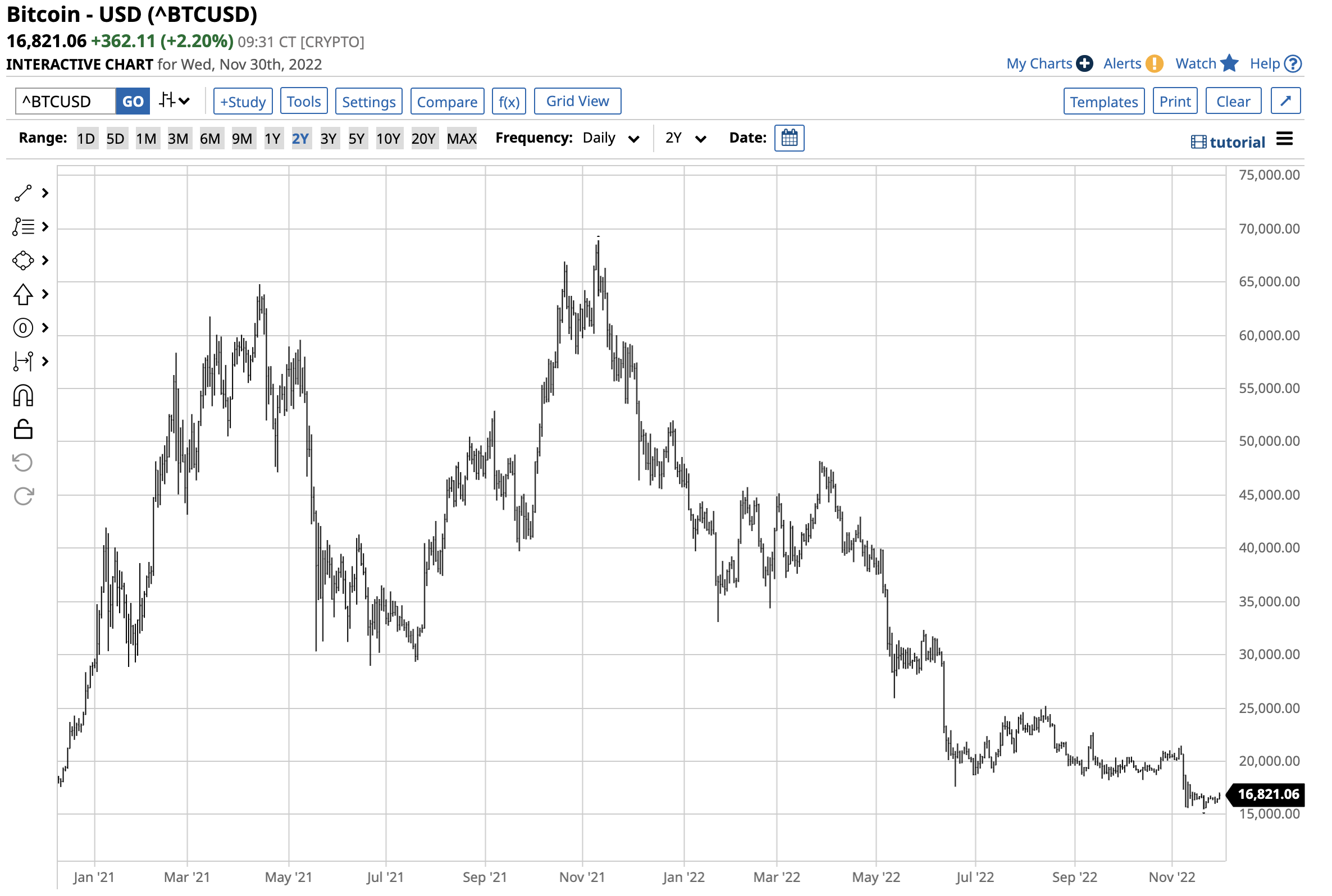
The chart shows Bitcoin’s decline from $68,906.48 in November 2021 to the latest low of $15,516.53 in November 2022. The 77.5% drop has been nothing short of carnage in the leading crypto. At the $16,821.06 level on November 30, Bitcoin was only slightly higher than the most recent low.
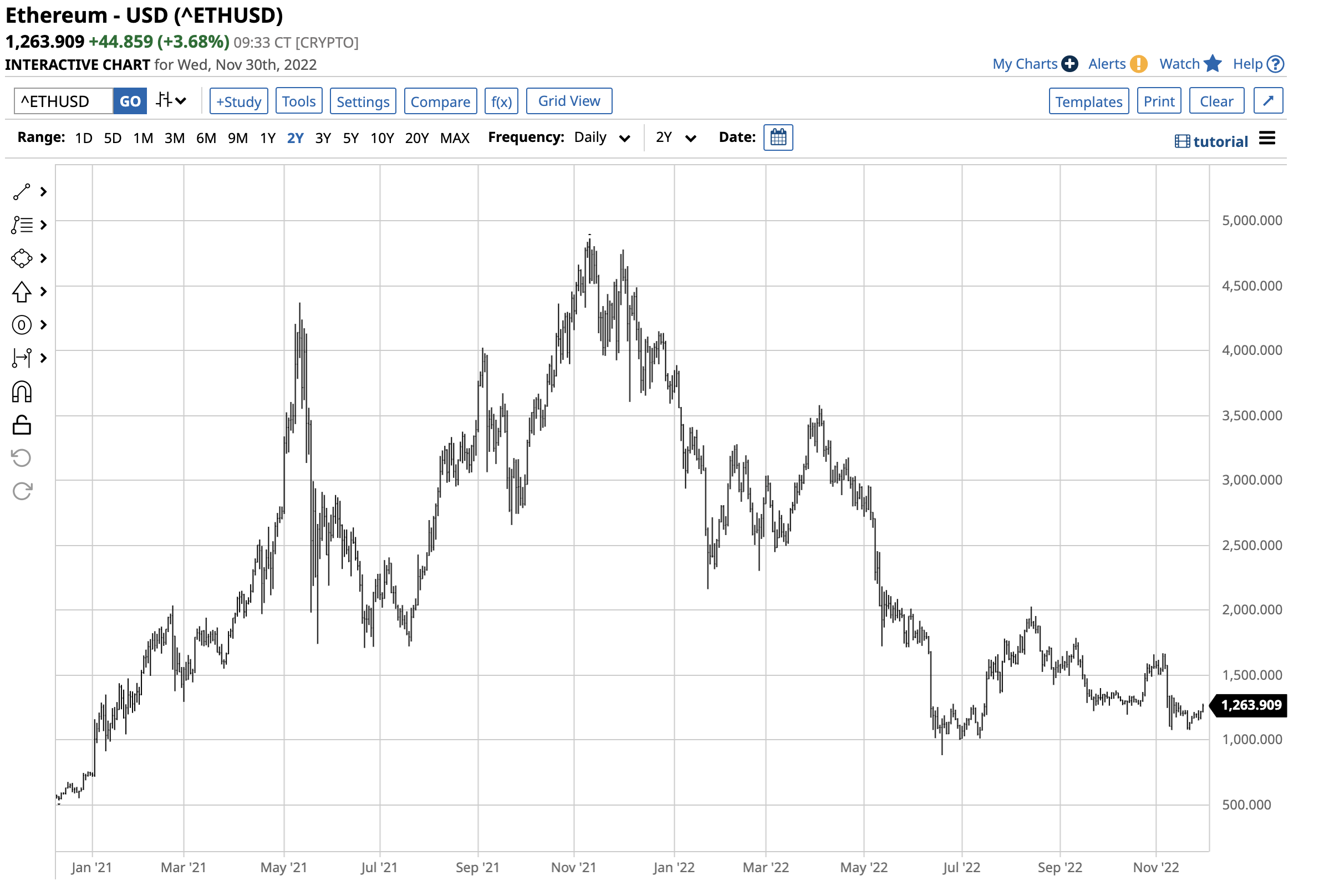
Ethereum fell from $4,865.426 in November 2021 to a low of $883.159 in June 2022, an 81.8% decline. At the $1,263.909 level on November 30, Ethereum remains closer to the June low than the November 2021 high despite the shift from a proof-of-work to a proof-of-stake protocol. Many market participants believed that the change, which reduces the energy requirements, would lift Ethereum, but the price remains far closer to the lows as of November 30.
The dust has not settled on the FTX bankruptcy
Cryptos had plunged long before FTX, one of the leading cryptocurrency exchanges, filed for bankruptcy in November 2022. In 2014, Mount Gox, a leading cryptocurrency exchange in Japan, went belly up, but at that time, cryptos had yet to reach the critical mass they have over the past years. When Mount Gox failed, the all-time high in Bitcoin was $1,135.45. Ethereum was created on July 30, 2015, after the dust cleared from the Mount Gox bankruptcy. Bitcoin eventually made a higher high above the $1,135.45 November 2013 high, but it took until January 2017 for the leading crypto to break to higher highs as the Mount Gox scandal caused a confidence crisis.
Over the past years, cryptocurrencies have experienced dramatic growth in their addressable market and the number of tokens. At the end of Q1 2019, there were 2,136 cryptos trading, and on November 30, 2022, the number was over ten times higher at 21,888. The details, ramifications, and systemic impact of FTX’s bankruptcy are in the early days; the dust has not settled on crypto’s latest scandal. It could take months, if not years, for the asset class to recover from Sam Bankman-Fried’s disaster.
Boom-and-bust is nothing new- An astonishing forecast from the ARK Innovation Manager
In 2010, one Bitcoin cost five cents, and the move to the November 2021 high turned a $10 investment into a nearly $13.8 million fortune. At $16,821.06 on November 30, those 200 Bitcoin tokens were still worth over $3.36 million.
Over the past years, boom-and-bust price action has been a repeating dynamic for cryptocurrencies. Mount Gox pushed Bitcoin’s price from $1,135.45 in late 2013 to a low of $172.45 in January 2015, an 84.8% plunge before the price powered higher. The Mount Gox carnage caused Bitcoin to decline more than the recent drop on a percentage basis. The bottom line is that boom-and-bust price action in cryptos is nothing new, and if historical trends continue, another boom could be on the horizon when the market digests the latest FTX debacle.
Cathie Wood is the founder, CEO, and CIO of Ark Invest, an investment management fund. The money manager with billions in assets under her control recently forecasted that Bitcoin would come out of the current crisis “smelling like a rose,” and Bitcoin will rise to $1 million per token by 2030.
Expect a rip-your-face-off rally
Mount Gox, Voyager, FTX, and the growing number of bankruptcies highlight the lack of regulation, abuses, and problems with crypto exchanges. While they shake the confidence of even the most committed crypto bulls, they have not eliminated the ideological libertarian case for the means of exchange that transcend borders and government control of the money supply. While the debate over Bitcoin and the other cryptos will continue, few argue over the benefits of blockchain technology that is forever linked to the crypto asset class.
The latest boost for blockchain came from the international pariah that invaded Ukraine, starting the first major European war since WW II. On November 28, Russian President Vladimir Putin said he favors blockchain for a “global payment system.” The Russian President noted that international payment systems should be processed digitally through a blockchain network because the current system is under the control of a “narrow club of states and financial groups.” Meanwhile, cryptos have likely allowed Russia to work around sanctions the US, Europe, and allies imposed.
The close relationship between the Russian leader and his counterpart in Beijing could lead the world’s second-leading economy, China, to further embrace blockchain and cryptos. China has been leading the way on the digital yuan. Russia and China will likely reject Bitcoin, Ethereum, and other cryptos. However, the ideological case for cryptos that depend on the individual bid and offers and transcend government influence could rise, causing another boom period for the asset class when it emerges from the latest issues.
The historical price action suggests that a recovery and rip-your-face-off rally in cryptos could be days, weeks, or months away.
Two ETF products that will likely soar if Bitcoin finds a bottom and soars
If another boom is on the horizon over the coming months and years, the BITQ and BITO ETF products would likely go along with Bitcoin on a bullish ride.
- The Bitwise Crypto Industry Innovators ETF (BITQ) has been punished with Bitcoin falling from $35.68 in November 2021 to $4.06 per share in November 2022, an 83% plunge. At $4.16 per share on November 30, BITQ had $42.539 million in assets under management. BITQ trades an average of 148,057 shares daily and charges a 0.85% management fee. Meanwhile, the $0.65 dividend translated to a 15.6% yield. BITQ owns a portfolio of companies that tend to rise and fall with Bitcoin’s price.
- The ProShares Bitcoin Strategy ETF product (BITO) reflects the price action in the Bitcoin futures market trading on the CME. BITO fell from $44.29 in November 2021 to the latest low of $9.48 in November 2022, a 78.6% drop. At $10.44 per share on November 30, BITO had $549.581 million in assets under management. The ETF trades an average of over 12.7 million shares daily and charges a 0.95% management fee. BITO is a highly liquid ETF product.
If Bitcoin and cryptocurrencies move from the current bust to another boom period, BITQ and BITO are a way to participate in the asset class without direct ownership of the tokens. The crypto winter continues as we enter 2022’s final month, but if history over the past years is a guide, we could see a sudden reversal and recovery in the asset class that went from the greatest bull market in history to a falling knife over the past year. The crypto winter continues in 2022, but it may not be long until they reach a level that puts a spring back in the volatile asset’s steps. BITQ and BITO are highly speculative investments at the current price levels. Only invest money you are willing to lose, as the risk is always a function of the potential for rewards.
More Crypto News from Barchart
- Here’s One Hot Stock That Could Fundamentally Rise Even Higher
- 3 Reasons Why I Trimmed My Crypto Position Significantly
- Analysts Split on the Direction of Bitcoin
- Unusual Options Activity Highlights the Damage Done to the Blockchain (AMD, NVDA)




/Netflix%20on%20tv%20with%20remote%20by%20freestocks%20via%20Unsplash.jpg)