



Gold has made higher lows and higher highs since the late 1990s, but there have been substantial corrections. After reaching a record high of $1911.60 in September 2011, COMEX gold futures made lower highs and lower lows for over four years, reaching $1046.20 in December 2015, a 45.3% decline that felt more like a bear market than a correction. Gold found a bottom in late 2015, and since then, the precious metal has moved steadily higher, making higher lows and higher highs, reaching two new all-time peaks at over the $2,000 per ounce level in 2021 and 2022. The most recent correction threatens the bullish trend since December 2015 and over the past twenty-two years. A move below the $1670 level could change the long-term technical complexion of the world’s oldest form of money, the shiny yellow metal.
An ugly correction since March 2022 continues
On March 3, 2022, August COMEX gold futures reached $2,085.20 per ounce, while the continuous futures contract moved to an all-time $2,072 high.
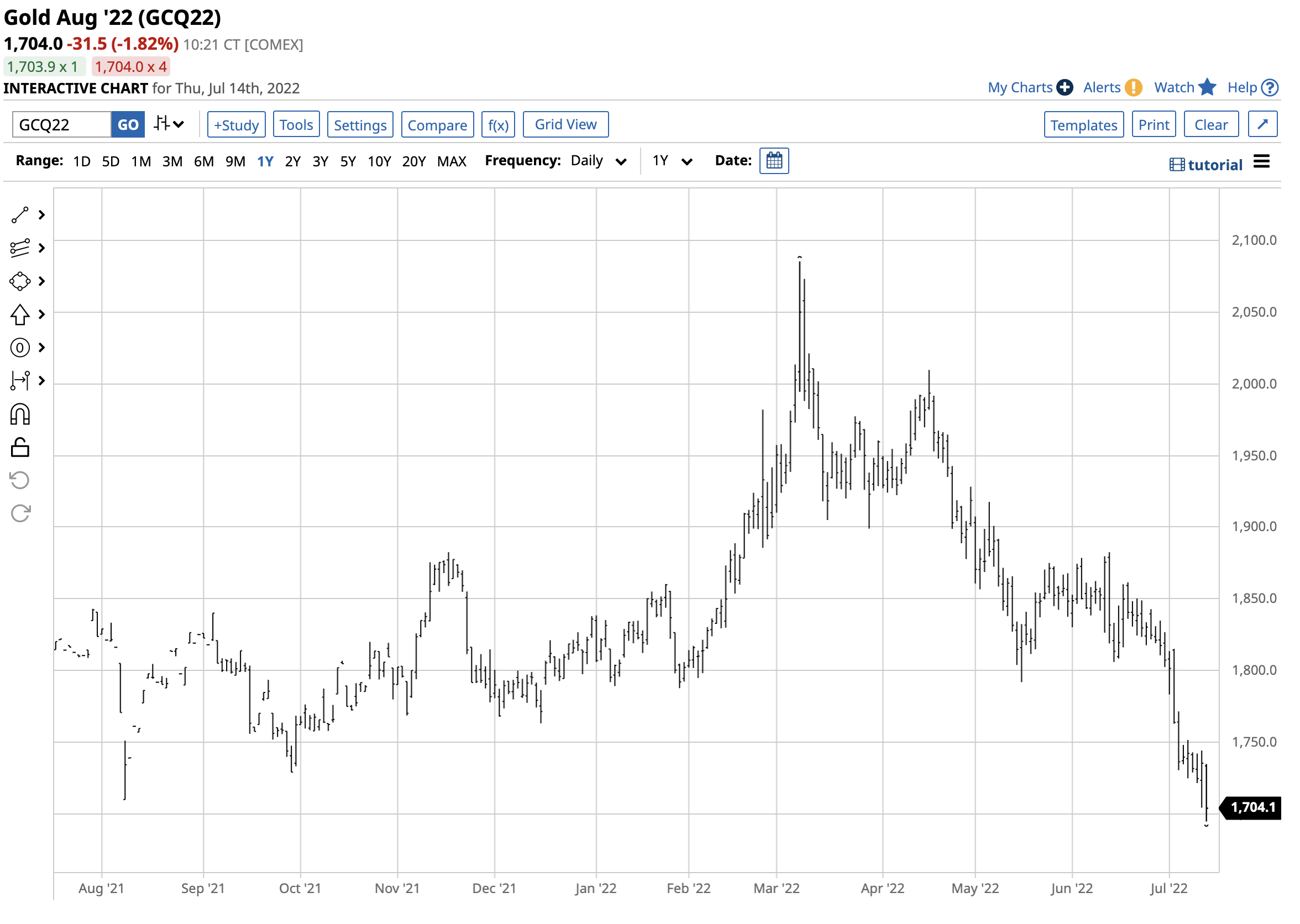
The chart highlights the decline in gold futures that took the price 17.4% lower to a low of $1,695.00 on July 14. August gold was near the low at the $1,700 level on Thursday, July 14, and remained in a bearish trend.
A threat to the long-term chart
Gold’s bull market started in 1999 when the British government decided to auction off one-half of the UK’s reserves, taking the price to a $252.50 per ounce low. At the $1700 level, gold remains over 6.7 times higher than the 1999 bottom.
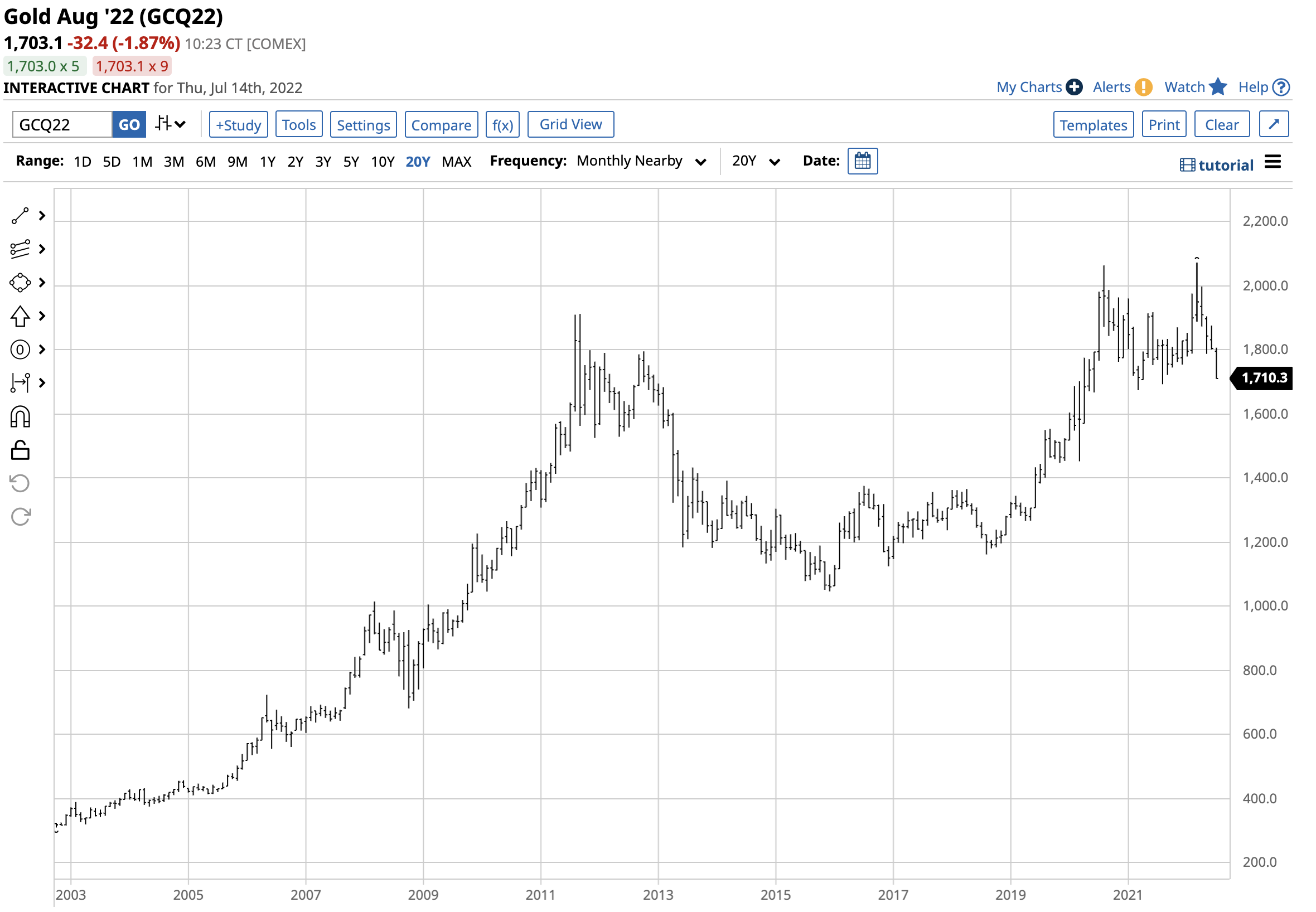
The chart illustrates the recent decline from the all-time high. Gold is approaching two critical technical support levels. The first sits at $1,692.60, the August 2021 low. Below there, the March 2021 $1,673.70 bottom is a line in the sand for the rally that began in late 2015.
Higher rates and the US dollar say lower
While the US Federal Reserve called rising inflation a pandemic-inspired “transitory” event throughout most of 2021, they have been singing a different tune since the economic condition rose to an over four-decade high. In 2022, the monetary policy path shifted with short-term Fed Fund rate hikes and quantitative tightening. Rising interest rates have weighed on gold as they increase the cost of holding gold inventories and make fixed-income assets more attractive as yields increase.
Meanwhile, the US dollar is the world’s reserve currency and the benchmark pricing mechanism for gold and most other commodities. Even though the UK is the home of the international bullion market, prices are in US dollars. The dollar has risen to the highest level in two decades against the euro as the two currencies traded just below parity on July 12. The dollar index, which measures the US currency against other reserve foreign exchange instruments, moved 9.28% higher over the first half of 2022, closing at the 104.464 level on June 30. On July 14, the index reached a new high of 109.14, 4.48% higher than the Q2 closing level. A strong dollar tends to weigh on gold prices as it causes the cost of the metal to rise in other currency terms. The combination of rising rates and a strong dollar creates a toxic bearish environment for gold’s price.
Geopolitics and inflation say not so fast
Rates and currency moves have weighed on gold, but other factors are not so bearish. Inflation continues to stand at a four-decade high. While the selling in other commodity markets could cause inflationary pressures to decline, the CPI and PPI readings continue to signal inflation far above the US Fed’s target rate.
Meanwhile, the war in Ukraine continues to rage, and US/Europe’s relations with Russia and China have deteriorated. The geopolitical landscape continues to threaten global stability. Inflation, war, and a bifurcation of nuclear powers create uncertainty that diminishes the US dollar’s worldwide role.
Over the past weeks, Russia responded to US and European sanctions by backing 5,000 roubles with one gram of gold. If China follows, it will only increase gold’s role as a worldwide means of exchange, challenging fiat currencies.
Governments continue to validate gold’s role in the worldwide financial system as they hold the precious metal as an integral part of foreign currency reserves.
Expect volatility in the gold futures market- Go with the flow
The short-term trend in the gold market remains ugly and bearish as of July 15, and it could worsen. The over 45% decline from the 2011 high to the late 2015 low warns that picking bottoms in the gold market can be dangerous.
Rising interest rates and the dollar’s path support lower lows, while geopolitics and inflation pull gold in the opposite direction. We could see a very volatile period in the gold market as uncertainty remains at the highest level since the Second World War.
The trend is always your best friend in markets, so follow the path of least resistance of prices until it bends. Going with the flow allows traders and investors to avoid substantial losses. As of July 14, gold’s trend remains bearish.
More Metals News from Barchart

/Advanced%20Micro%20Devices%20Inc_%20office%20sign-by%20Poetra_RH%20via%20Shutterstock.jpg)
/Chipset%20held%20over%20rush%20hour%20traffic%20by%20Jae%20Young%20Ju%20via%20iStock.jpg)


/The%20sign%20for%20Marvell%20Technology%20out%20front%20of%20a%20corporate%20office%20by%20Valeriya%20Zankovych%20via%20Shutterstock.jpg)