




- Over the weekend, India announced its decision to ban exports of wheat.
- This lit the fuse to an already explosive global wheat market, with US futures jumping to daily limit gains shortly after Sunday evening's open.
- For now there doesn't appear to be an end to the tight supply and demand situation as weather refuses to cooperate and Russia's Putin is still Russia's Putin.
Late last Friday I received an email asking if I would appear on the BBC Radio program “The World Tonight”. The producer was looking for someone to talk about wheat, and somehow found my name. I was honored to do it and enjoyed the conversation as we talked about key global issues playing a part in the wild wheat markets of late. And this was before India seemingly made its decision to ban wheat exports over the weekend, a news item that sent both Chicago (SRW) and Kansas City (HRW) rocketing to limit up gains shortly after the open Sunday evening. Meanwhile, Minneapolis (HRS) has been quietly going about its business pressing its 60-cent daily limit gain.
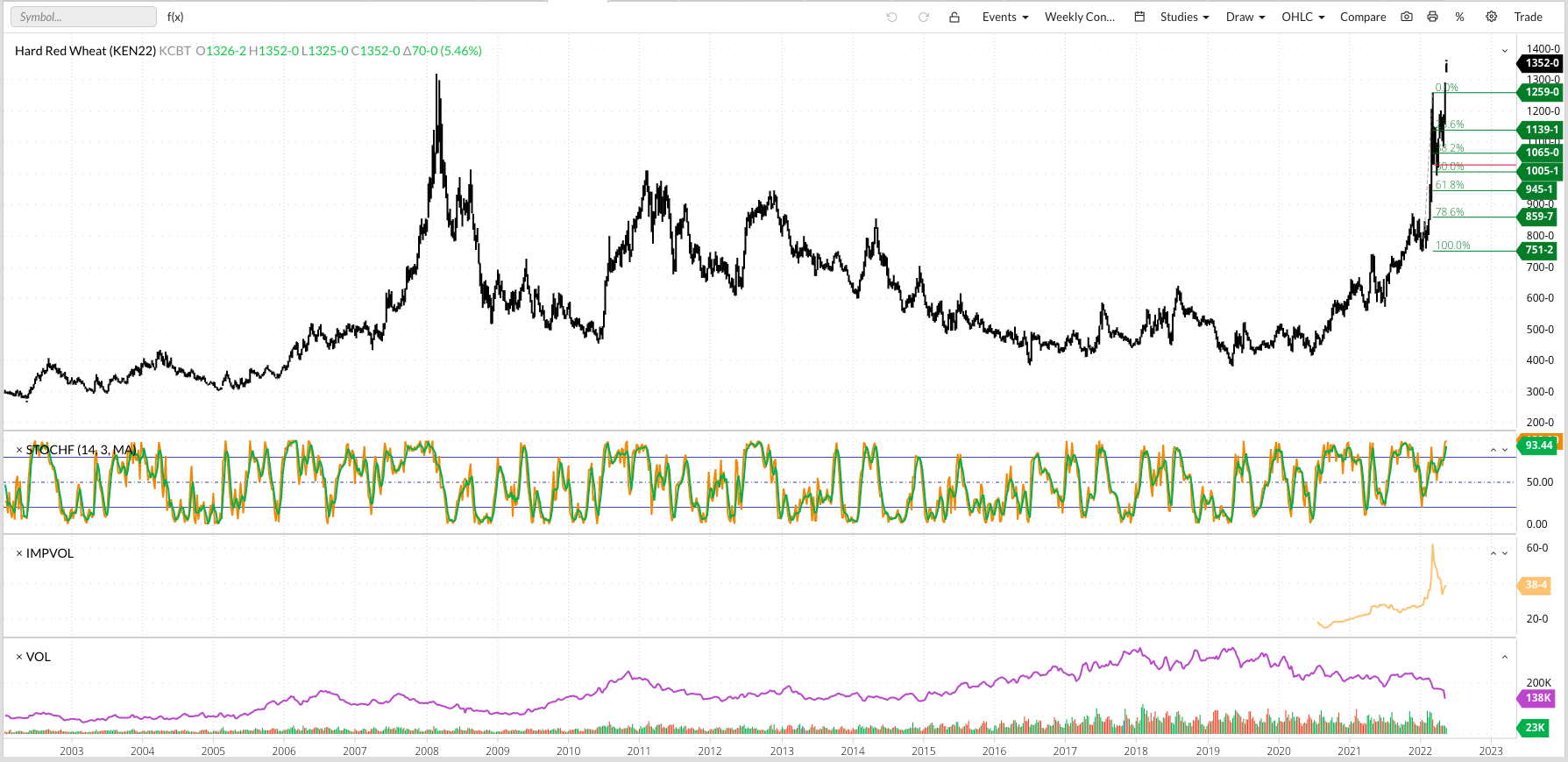
Shortly after the open of the overnight session July Kansas City (KEN22) hit a high of $13.52, taking out the previous all-time high for a July Kansas City contract of $13.20 from late February 2008. As we can see on this July-only continuous chart, back then the contract quickly collapsed to a low of $7.8250 by late May. This time around, a serious break could be more difficult to manufacture given how bullish the Kansas City market’s fundamentals are, indicated by the inverted July22-to-May23 forward curve.
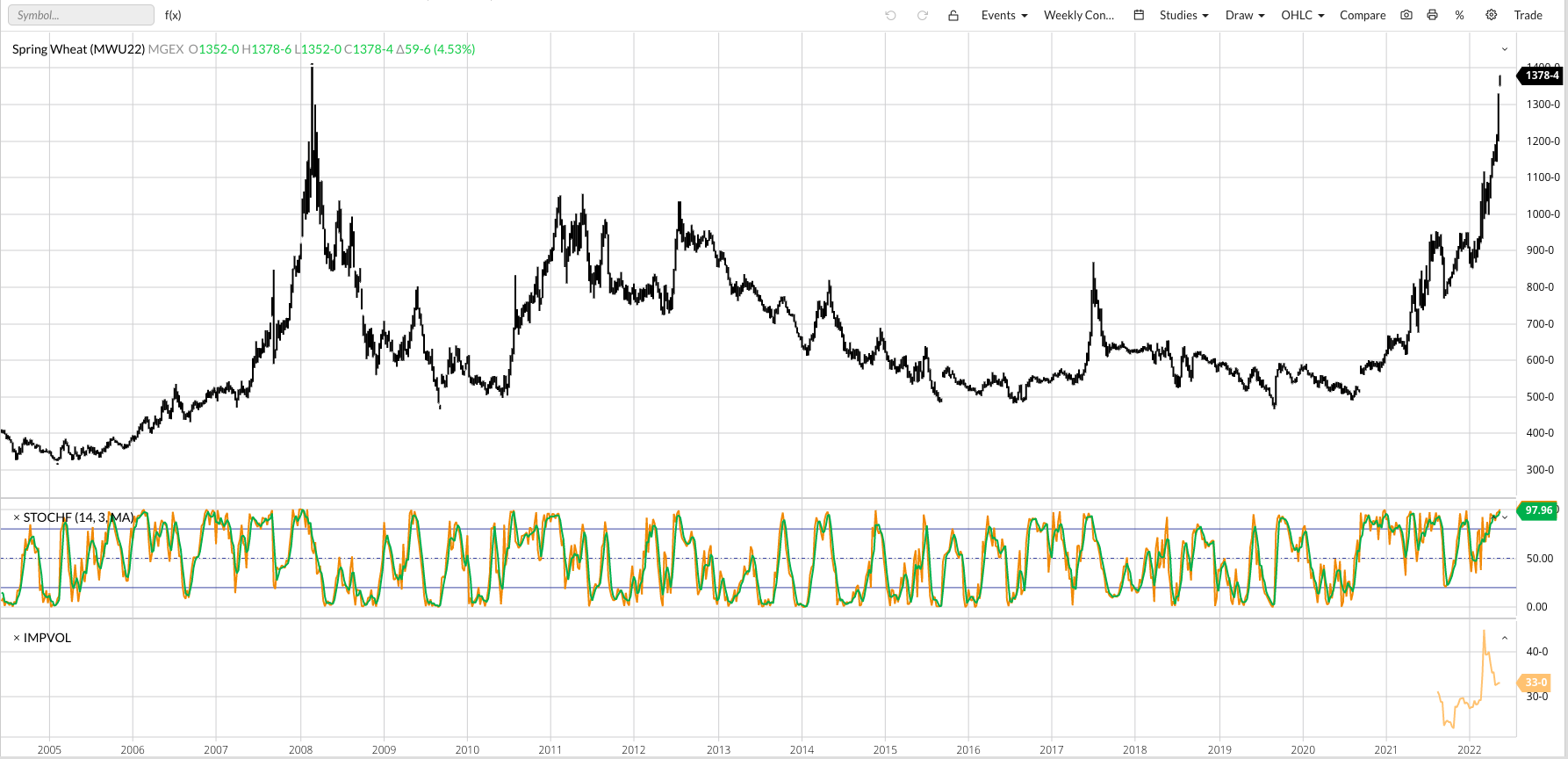
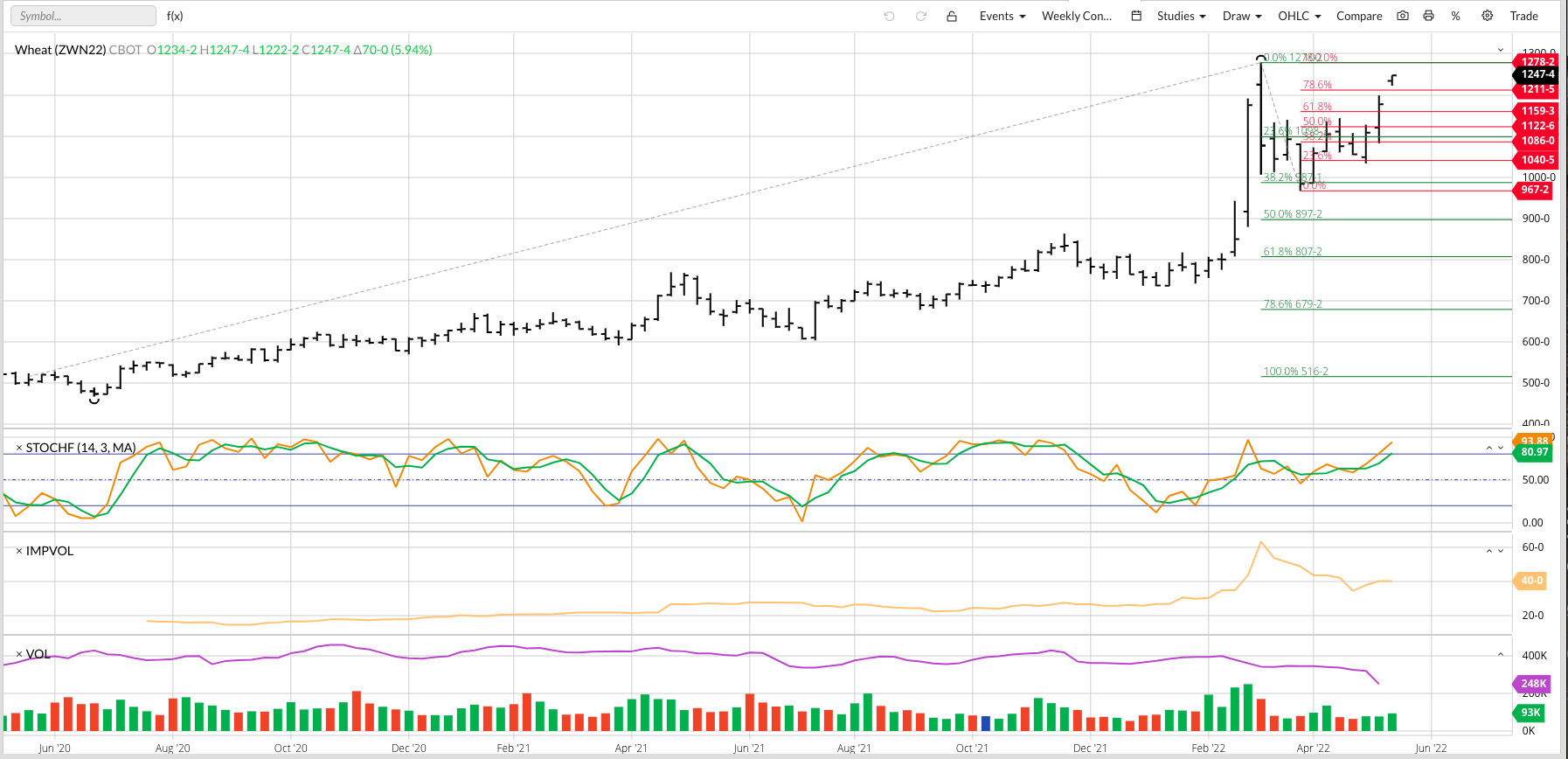
New-crop September Minneapolis (HRS) (MWU22) hasn’t quite reached new all-time high status as it hit $13.7875 overnight and Monday morning, just off its February 2008 high of $14.0225. The laggard, if one wants to call it that, is Chicago (SRW) where the new-crop July (ZWN22) issue has hit a high of $12.4750, still below its own contract high of $12.7825 from this past March.
What’s driving this historic, in some cases, rally in US wheat markets? Two big W’s (and no, not “Win” flags at Chicago’s Wrigley Field): War and Weather. As I talked about on the radio program last Friday, Russia"s war against Ukraine reshuffled the global wheat market, sending major buyers searching for new suppliers as Black Sea ports have been shut down. There has been a lot of talk about economic sanctions against Russia for its actions, but most of the chatter has been over petroleum and natural gas. Not as much has been said about wheat, corn, sunflower oil, etc. Why? Because the world needs to eat more than it needs to heat and drive.
The interview before mine on the program talked about Ukraine finding other avenues to export grain out of the country including rail, roads, and rivers. I answered a follow-up question by pointing out how it was theoretically possible, but those trains, trucks, and river barges would become military targets for Russia, not to mention the extra cost of shipment.
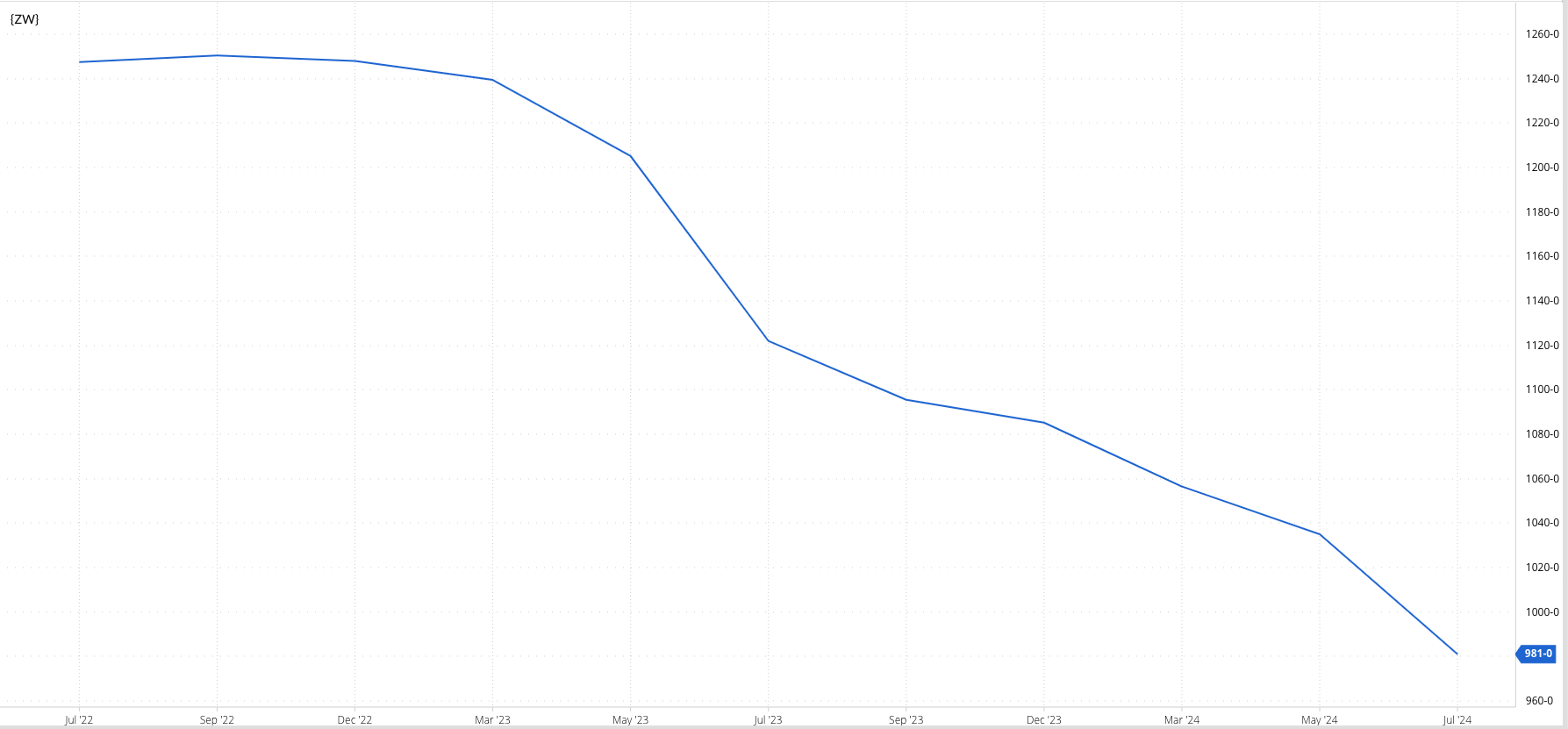
Given Russia’s madness in the Breadbasket of Europe, the rest of the world was looking for other global producers to make up some of the lost production on exportable supplies. Unfortunately, North America continues to struggle with drought (US Southern and Central Plains) and flooding (US Northern Plains), while Australia’s crop was also hit by late flooding. Which put the spotlight on the heat wave pounding India, leading to that country’s plan to ban exports. One of the last questions I was asked was how this all ends? My reply was two-fold, Mr. Putin needed to pull out of Ukraine and Mother Nature needed to play nice for a change. Neither are likely to happen any time soon. Until then, we need to keep an eye on all three markets’ forward curves, but particularly Chicago’s for signs of changes in the global supply and demand situation.



/Netflix%20on%20tv%20with%20remote%20by%20freestocks%20via%20Unsplash.jpg)

/Qualcomm%2C%20Inc_%20logo%20on%20phone-by%20viewimage%20via%20Shutterstock.jpg)