Large-cap stocks are the biggest stocks on the market. With a market capitalization of more than $10 billion, you can count on these companies be on strong financial footing.
And then you have what we can call mega-cap stocks. These are special companies that have a market capitalization of more than $200 billion. They’re well on their way to rarified air to perhaps one day join the select few companies that achieve a $1 trillion market cap.
What’s better than a mega-cap stock? How about a mega-cap stock that also happens to pay a great dividend?
That brings us to today’s list. We screened for mega-cap dividend stocks with a market cap of more than $200 billion. We limited the screen to stocks that trade on U.S. exchanges. And because we wanted to get a dividend, we limited the screen to companies that have a payout ratio of at least 3%.
And finally, we narrowed down the screen to companies that have a consensus “buy” rating from analysts.
Here are three names that jumped to the top of the list.
AbbVie (ABBV)
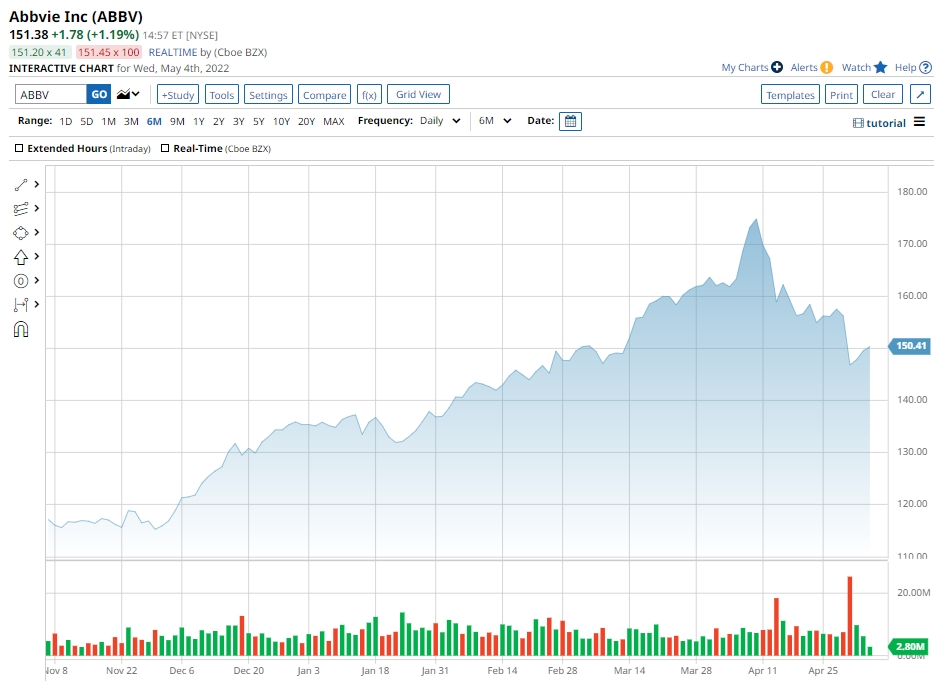
Based in North Chicago, AbbVie (ABBV) is a leading pharmaceutical company with a market capitalization of $265 billion. Its most known for its drug Humira, which is used to treat autoimmune diseases and inflammatory bowel diseases.
Last year, Humira sales generated more than $20 billion for AbbVie.
Earnings for the first quarter were mixed. Revenue came in at $13.54 billion, which was worse than analysts’ expectations for $13.66 billion. But earnings of $3.16 per share managed to beat the Street’s estimates of $3.14.
The company said several of its key drugs underperformed in the first quarter, and it lowered its forecast for the rest of the year. Humira sales alone were down by nearly 3%.
Analysts remain optimistic, however. Wells Fargo raised its price target for ABBV stock from $165 to $200, and Morgan Stanley analyst Terence Flynn called the stock’s recent woes a good buying opportunity.
ABBV stock still carries a consensus “buy” rating from 20 analysts and has a price target of $165.16 that represents nearly 10% upside. On top of that, AbbVie offers a dividend yield of 3.7%, and has increased its dividend for the last 50 years.
Chevron Corp. (CVX)
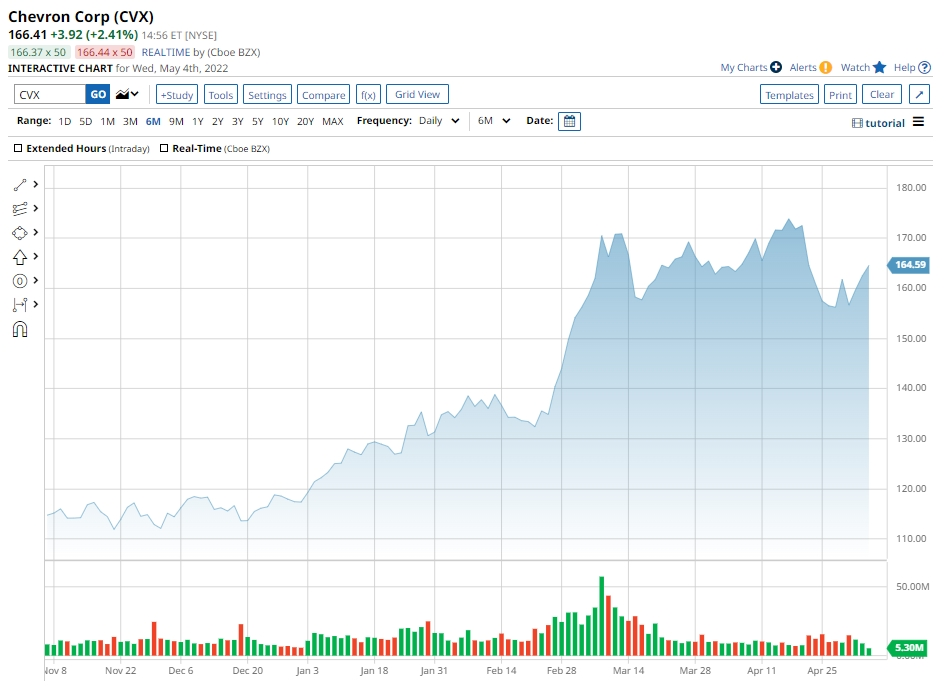
With oil and natural gas prices on the run, California-based Chevron (CVX) is one of the most well-known names in the energy sector. Chevron actually traces its roots to the California gold rush, when it was founded as Pacific Coast Oil in 1879.
Chevron sells gasoline under the Chevron, Texaco and Caltex brands. And it has a network of oil, gas and refined oil pipelines throughout the world.
Not surprisingly, CVX stock is having a strong year thanks to rising gas and oil prices and the Russia-Ukraine conflict. Chevron is up 40% so far this year and looks to run higher.
The company announced that its profits more than quadrupled in the first quarter of the year, as earnings hit $6.3 billion on revenue of $54.37 billion. Earnings per share were $3.36. Analysts had been expecting revenue of $47.94 billion and EPS of $3.27 per share.
To put that in context, the company reported revenue of $32.03 billion and profits of $1.37 billion in the same quarter a year ago.
Chevron, which has a market capitalization of $323 billion, has a current dividend yield of 3.5% and it increased its payout annually for the last 35 years.
The consensus rating from 28 analysts for CVX stock is “buy” and the stock has an average price target of $175.09. That represents about 6.5% upside in CVX stock.
JPMorgan Chase & Co. (JPM)
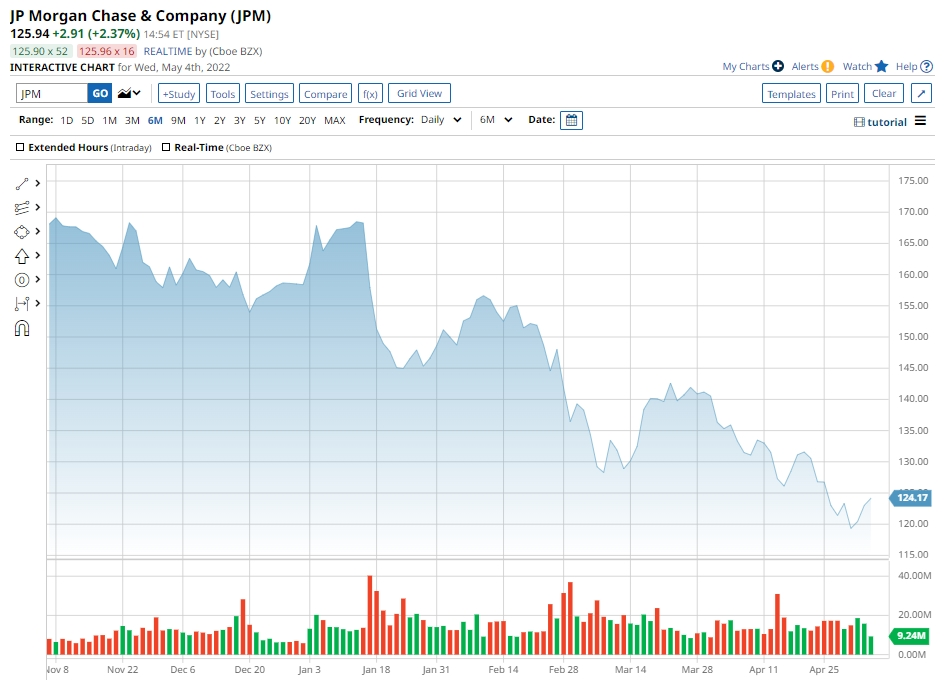
JPMorgan Chase (JPM) is the biggest of the big banks in U.S. Boasting a market capitalization of $362 billion, the bank is one of those that should profit from the Federal Reserve’s actions to raise interest rates.
Rising interest rates affect net interest margin, or the difference between the interest that banks earn on assets and the interest paid to depositors and creditors. Banks make more money when interest rates rise because the margin between those two points also increases.
JPMorgan recently reported first-quarter revenue of $31.59 billion, which beat analysts’ estimates of $30.86 billion. Earnings per share was in at $2.76, versus expectations of $2.69 EPS.
The war in Ukraine weighed heavily on earnings, as well as increased cost for bad loans. JPM said that its revenue was down 5% from a year ago, and profits were down by a whopping 42%.
However, there’s still a lot of reasons to appreciate JPM stock. It currently offers a 3.2% dividend yield and has increased its dividend payout for 11 consecutive years.
On top of that, JPM has a consensus “buy” rating from 27 analysts, who have an average price target of $158.76. That represents upside of 27%.
As of this writing, Patrick Sanders did not have a position in any of the aforementioned equities.
On the date of publication, Patrick Sanders did not have (either directly or indirectly) positions in any of the securities mentioned in this article. All information and data in this article is solely for informational purposes. For more information please view the Barchart Disclosure Policy here.


/Quantum%20Computing/A%20concept%20image%20of%20a%20green%20and%20yellow%20motherboard_%20Image%20by%20Gorodenkoff%20via%20Shutterstock_.jpg)
/An%20image%20of%20a%20Tesla%20humanoid%20robot%20in%20front%20of%20the%20company%20logo%20Around%20the%20World%20Photos%20via%20Shutterstock.jpg)