Dual Edge Research publishes two powerful newsletters that work great individually — and even better together. The Bull Strangle Newsletter focuses on stocks and options, combining stock ownership with premium-selling strategies to generate consistent income and market-beating returns. The Smart Spreads Newsletter specializes in seasonal commodity futures spreads, offering a diversified approach with low correlation to equities. Together, they deliver a complete investment perspective — one focused on income, the other on diversification — all under one simple subscription.
Introduction
In the previous articles, we've built a commodity spread one decision at a time. We began by identifying whether buying or selling has historically produced the stronger edge. Next, we examined when seasonal opportunities have historically performed best, which front-month contract cycle has generated the strongest results, and whether a two-leg or three-leg spread has historically offered the better risk-return combination. Each step relied on one common source of information:
- History.
But historical performance alone doesn't answer one critical question. Does today's market support the historical opportunity? That's where forward-curve analysis becomes one of the most valuable tools in the Smart Spreads research process.
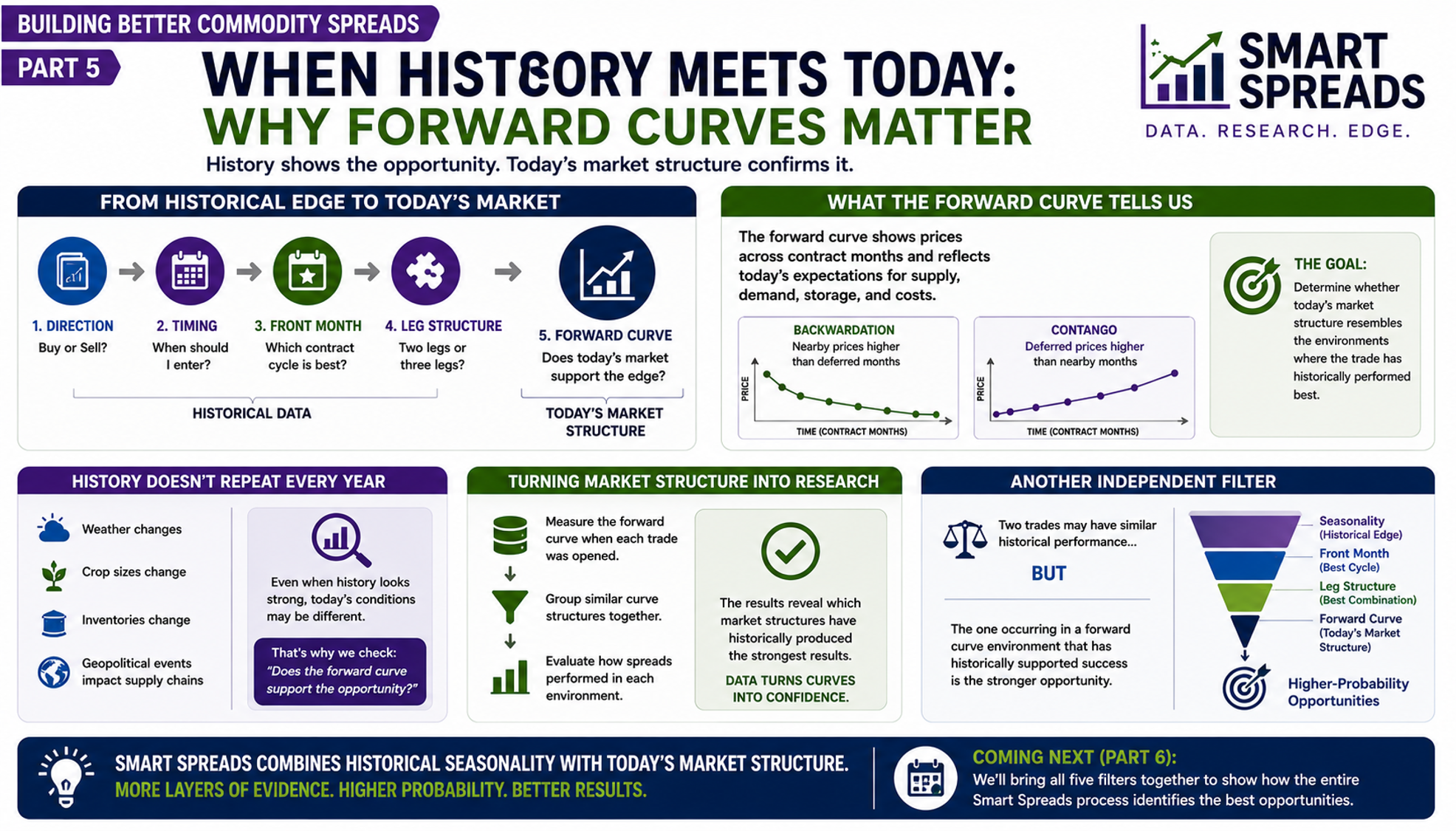
History Doesn't Repeat Every Year
Seasonal tendencies develop because many commodity markets experience recurring patterns in production, storage, transportation, and demand. Those forces create opportunities that often repeat over time. But no two years are identical. Weather changes. Crop sizes change. Inventories change. Geopolitical events alter supply chains.
Even when a spread has performed well historically, today's market conditions may look very different. That doesn't necessarily invalidate the historical opportunity—but it does suggest we should ask one more question before committing capital. Does the current forward curve resemble the environments where this trade has historically performed best? What Is the Forward Curve?
The forward curve represents the prices of futures contracts across different delivery months. Some markets trade in backwardation, where nearby contracts are more expensive than deferred contracts. Others trade in contango, where deferred contracts trade at higher prices than nearby deliveries. The shape of that curve reflects the market's current expectations about supply, demand, storage costs, and commercial behavior. In other words, it provides a snapshot of today's market structure.
Turning Market Structure into Research
Rather than treating the forward curve as a subjective opinion, we incorporated it directly into our historical testing. For every trade in our database, we measured the shape of the forward curve at the time the position was opened. We then grouped similar market structures and evaluated how spreads performed under each environment.
The results were revealing. Some markets consistently performed better when the forward curve exhibited one type of structure. Others favored an entirely different environment. Instead of simply asking whether a seasonal opportunity exists, we could now ask whether today's market resembles the historical environments in which that opportunity has been most successful.
Another Independent Filter
Forward-curve analysis doesn't replace seasonality. It strengthens it. Imagine two seasonal trades with nearly identical historical records. Both have strong average returns. Both have high win rates. Both occur during the same week of the year. Without additional information, they may appear equally attractive.
But suppose one trade is occurring under a forward-curve structure that has historically supported the seasonal edge, while the other is occurring under a market structure that has historically produced weaker results. That additional piece of evidence helps separate the stronger opportunity from the weaker one. Rather than relying on a single statistic, we now combine historical seasonality with current market structure.
Bringing History Into the Present
This illustrates one of the biggest differences between traditional seasonal analysis and the Smart Spreads methodology. Traditional seasonality often asks:
- "What has worked historically?"
Smart Spreads asks an additional question:
- "Is today's market behaving like the environments where history has been most reliable?"
By combining multiple independent layers of research, each trade earns its place on the watchlist through objective historical evidence supported by current market conditions. That creates a more disciplined and repeatable research process.
Past Articles in the Series
Part 1: Why Direction Isn't Enough
Part 2: Timing Is More Than a Calendar
Part 3: Why the Front Month Matters
Part 4: Why Three Legs Can Be Better Than Two
Looking Ahead
Over the course of this series, we've explored the major decisions involved in building a higher-probability commodity spread. We've examined:
- Direction
- Entry timing
- Front-month selection
- Leg structure
- Forward-curve analysis
Each layer has removed lower-quality candidates and increased confidence in the remaining opportunities. In the final article, we'll bring the entire process together. Starting with hundreds of thousands of historical possibilities, we'll walk through the complete Smart Spreads methodology and show how each filter narrows the field until only a handful of the highest-probability opportunities remain.
Additional Details
The Bull Strangle Newsletter focuses on stocks and options, combining stock ownership with disciplined option-selling techniques designed to generate consistent income while managing risk.
The Smart Spreads Newsletter focuses on seasonal commodity spreads, a historically proven approach that seeks opportunities across agricultural, energy, metal, and financial futures markets.
Each strategy is designed to stand on its own, but together they provide a diversified approach that can perform across a wide range of market environments. For traders looking to deepen their education, The Bull Strangle Strategy and Trading Commodity Spreads are both available on Amazon.
Visit BullStrangle.com to subscribe for just $1 for the first month.
For a video overview of the Bull Strangle Newsletter
For a video overview of the Smart Spreads Newsletter
Darren Carlat
Dual Edge Research
(214) 636-3133
DualEdgeResearch@gmail.com
Disclaimer
This information is for informational purposes only and should not be considered investment advice. Past performance is not indicative of future results, and all investments carry inherent risk. Consult with a financial advisor before making any investment decisions.


/Micron%20Technology%20Inc_%20logo%20on%20building-by%20vzphotos%20vis%20iStock.jpg)
/A%20hand%20holding%20a%20phone%20with%20the%20Reddit%20logo_%20Mamun_Sheikh%20via%20Shutterstock_.jpg)