Dual Edge Research publishes two powerful newsletters that work great individually — and even better together. The Bull Strangle Newsletter focuses on stocks and options, combining stock ownership with premium-selling strategies to generate consistent income and market-beating returns. The Smart Spreads Newsletter specializes in seasonal commodity futures spreads, offering a diversified approach with low correlation to equities. Together, they deliver a complete investment perspective — one focused on income, the other on diversification — all under one simple subscription.
Introduction
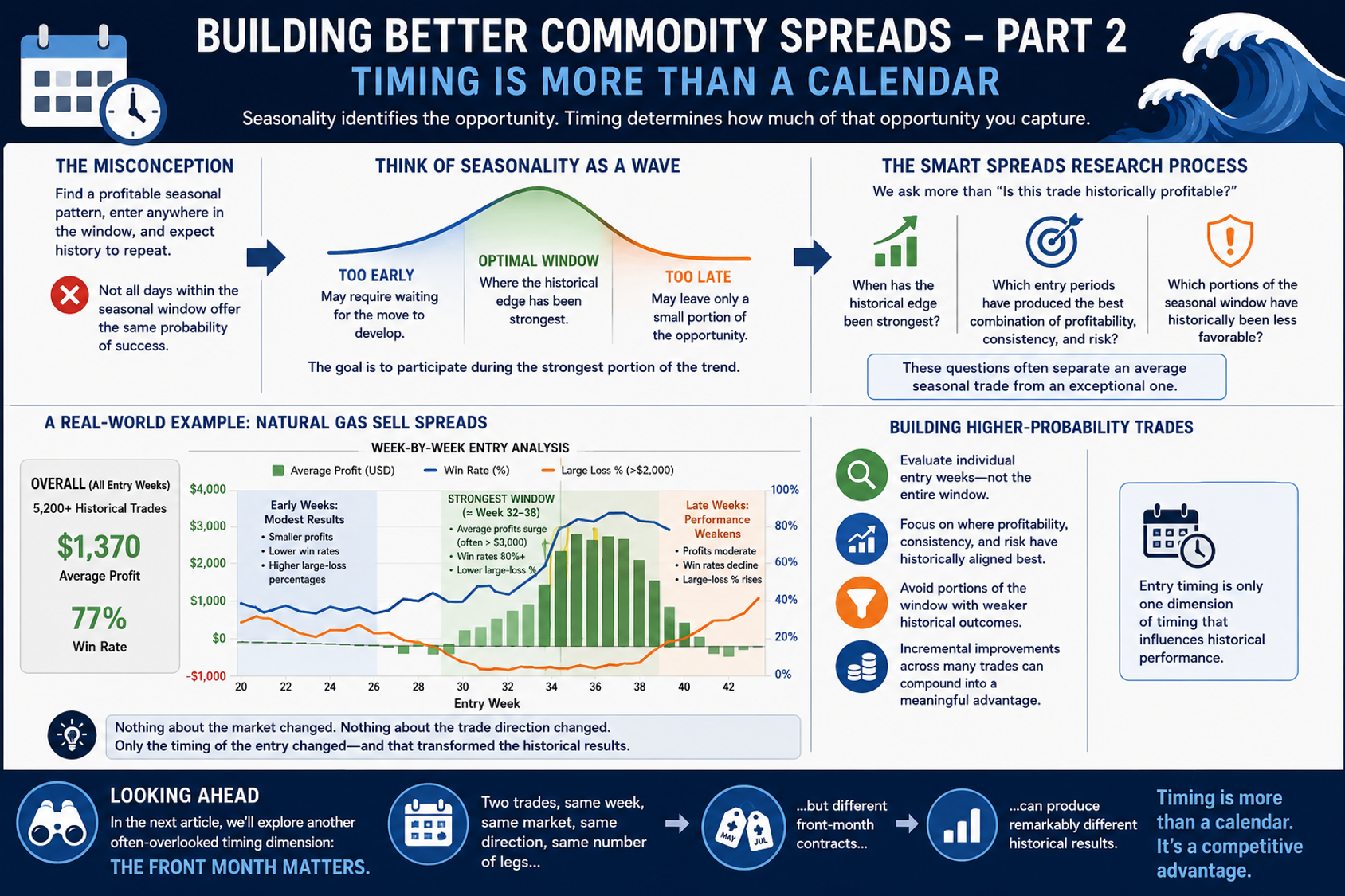
One of the most common misconceptions about seasonal commodity spreads is that identifying the right trade is enough. A trader finds a historically profitable seasonal pattern, enters the position sometime during the seasonal window, and expects history to repeat itself. Unfortunately, the research tells a different story. While seasonality identifies opportunities with a historical edge, it does not suggest that every day within the seasonal window offers the same probability of success. In many cases, the timing of an entry has historically influenced average profits, win rates, and downside risk just as much as the market or trade direction itself.
Think of a seasonal opportunity as a wave. Every seasonal pattern begins to develop, builds momentum, reaches a period when the historical edge is strongest, and eventually weakens. Entering too early may require waiting for the seasonal move to develop. Entering too late may leave only a small portion of the opportunity remaining. The objective isn't simply to participate in a seasonal trend. The objective is to participate during the portion of that trend where history has demonstrated the greatest statistical advantage. That philosophy has become an important part of the Smart Spreads research process. Rather than asking only whether a trade has historically been profitable, we also ask:
- When has the historical edge been strongest?
Which entry periods have produced the best combination of profitability, consistency, and risk? Which portions of the seasonal window have historically been less favorable? These questions often separate an average seasonal trade from an exceptional one.
A Real-World Example
Natural Gas SELL spreads provide an excellent example. Across more than 5,200 historical trades, the overall statistics appear attractive, producing an average profit of approximately $1,370 with a 77% win rate. Looking only at those aggregate results, it would be reasonable to conclude that almost any entry during the seasonal window should perform well.
The week-by-week analysis tells a very different story. The early weeks of the seasonal window produced respectable but relatively modest returns. As the season progressed, performance weakened considerably, with several entry weeks generating negative average profits and substantially higher large-loss percentages. Then, beginning around Week 32, the historical profile changed dramatically.
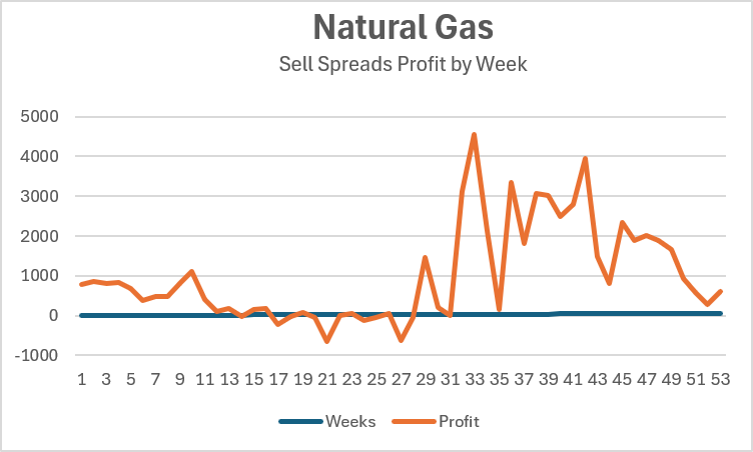
Average profits increased sharply—several entry weeks generated average gains exceeding $3,000 per trade. Win rates frequently climbed above 80%, while large-loss percentages remained comparatively low. As the seasonal window approached its conclusion, profitability gradually moderated again. Nothing about the market changed. Nothing about the trade direction changed. Only the timing of the entry changed. That single decision transformed the historical characteristics of the same seasonal opportunity.
Building Higher-Probability Trades
This illustrates one of the guiding principles behind the Smart Spreads methodology. Seasonality identifies the opportunity. Timing helps determine whether that opportunity is being pursued during its historically strongest period. Rather than treating an entire seasonal window as equally attractive, we evaluate the historical performance of individual entry weeks to identify where profitability, consistency, and risk have historically aligned most favorably.
While no historical pattern guarantees future results, focusing on the strongest portions of a seasonal window helps eliminate many opportunities that have historically produced weaker outcomes. Across hundreds of markets and thousands of historical trades, those incremental improvements can compound into a meaningful advantage. Just as importantly, this research represents only one dimension of timing. Evaluating when to enter a trade is an important step, but it is not the only timing decision that influences historical performance.
Looking Ahead
So far in this series, we've established that selecting the proper direction is only the first step, and that identifying the strongest entry window can significantly improve a trade's historical characteristics. In the next article, we'll examine another dimension of timing that many commodity spread traders overlook entirely. We'll explore why the front month of a spread can dramatically influence historical performance—and why two trades entered during the same week, in the same market, with the same direction and number of legs, can produce remarkably different results simply because they begin with different front-month contracts.
Additional Details
The Bull Strangle Newsletter focuses on stocks and options, combining stock ownership with disciplined option-selling techniques designed to generate consistent income while managing risk.
The Smart Spreads Newsletter focuses on seasonal commodity spreads, a historically proven approach that seeks opportunities across agricultural, energy, metal, and financial futures markets.
Each strategy is designed to stand on its own, but together they provide a diversified approach that can perform across a wide range of market environments. For traders looking to deepen their education, The Bull Strangle Strategy and Trading Commodity Spreads, both available on Amazon.
Visit BullStrangle.com to subscribe for just $1 for the first month.
For a video overview of the Bull Strangle Newsletter
For a video overview of the Smart Spreads Newsletter
Darren Carlat
Dual Edge Research
(214) 636-3133
DualEdgeResearch@gmail.com
Disclaimer
This information is for informational purposes only and should not be considered as investment advice. Past performance is not indicative of future results, and all investments carry inherent risk. Consult with a financial advisor before making any investment decisions.


/Micron%20Technology%20Inc_%20logo%20on%20building-by%20vzphotos%20vis%20iStock.jpg)
/A%20hand%20holding%20a%20phone%20with%20the%20Reddit%20logo_%20Mamun_Sheikh%20via%20Shutterstock_.jpg)