




Dual Edge Research publishes two powerful newsletters that work great individually — and even better together. The Bull Strangle Newsletter focuses on stocks and options, combining stock ownership with premium-selling strategies to generate consistent income and market-beating returns. The Smart Spreads Newsletter specializes in seasonal commodity futures spreads, offering a diversified approach with low correlation to equities. Together, they deliver a complete investment perspective — one focused on income, the other on diversification — all under one simple subscription.
Introduction
One of the first decisions every commodity spread trader faces is deceptively simple:
- Should I buy the spread or sell it?
For many traders, that's where the research begins—and where it ends. They identify the direction that has historically produced the strongest seasonal tendency, place the trade, and hope history repeats itself. At first glance, that approach seems perfectly reasonable. After all, if buying a particular spread has consistently outperformed selling it over many years, why look any further? The answer is simple. Because direction alone rarely determines whether a trade succeeds. During the research that ultimately became the Smart Spreads methodology, I analyzed more than 500,000 historical commodity spread opportunities across energy, grains, livestock, metals, and soft commodities. One conclusion became apparent very early in the process. Selecting the correct direction is important. But it is only the first of several critical decisions that determine the quality of a trade. Think of direction as opening the correct door. Once you're through that door, there are still numerous paths you can take—and some lead to dramatically better outcomes than others.
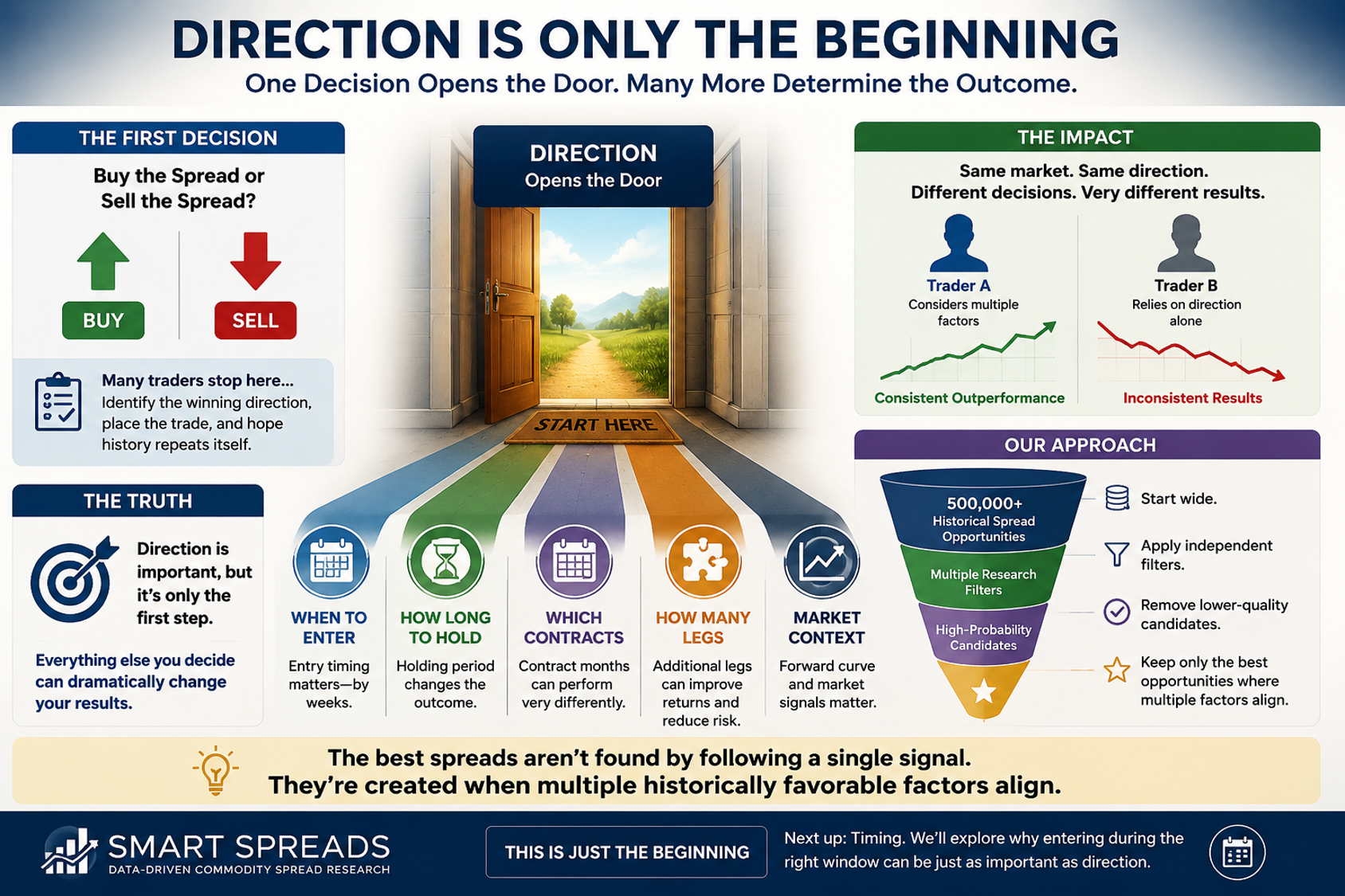
For example, consider two traders who both decide to buy the same commodity spread. They agree on the market. They agree on the direction. Yet one trader consistently outperforms the other. How is that possible? Because direction answers only one question, the remaining decisions often have just as much influence on the final result. When should the position be initiated? How long should it be held? Which contract months provide the strongest historical seasonal relationship? Would adding a third leg reduce volatility or improve returns? Does the current forward curve support the seasonal tendency, or is the market sending a different message?
Every one of these decisions changes the historical characteristics of the trade. In many cases, those differences are substantial. A spread entered two weeks earlier may produce significantly different historical returns than the identical spread entered later. One contract month combination may exhibit exceptional consistency, while another appears almost random. In some markets, introducing a third leg has historically increased average returns while simultaneously reducing the frequency of large losses. The direction never changed. Everything else did. That realization fundamentally changed the way I approached commodity spread research. Rather than searching for a single indicator capable of identifying profitable trades, I began asking a different question:
- What combination of characteristics has historically produced the highest-probability opportunities?
Answering that question required evaluating every trade through multiple independent filters rather than relying solely on seasonality or market direction. Each filter contributed additional information. Each filter removed lower-quality candidates. And each filter improved the overall quality of the remaining opportunities. That process eventually evolved into the Smart Spreads research methodology. Today, every recommended trade begins as one of more than 500,000 historical spread combinations. Each candidate is evaluated through multiple layers of historical analysis that examine different characteristics of the trade. No single statistic determines the final recommendation. Instead, opportunities advance only when multiple independent factors align.
Direction remains an essential part of that process. It simply isn't enough by itself. A single characteristic rarely identifies the best commodity spread opportunities. Instead, they emerge when multiple historically favorable factors align to create a trade with a stronger statistical foundation. That philosophy lies at the heart of every Smart Spreads recommendation.
Looking Ahead
This article marks the beginning of a new series exploring the major decisions involved in constructing higher-probability commodity spreads. Over the coming weeks, we'll examine the individual research components that transform a simple seasonal tendency into a carefully selected trading opportunity. Next, we'll turn our attention to one of the most overlooked factors in commodity spread trading:
- Timing.
Many seasonal trades have historically produced attractive returns—but only when entered during the proper window. We'll explore why entry timing can be just as important as selecting the correct direction and how even small changes in timing can dramatically alter historical performance.
Additional Details
The Bull Strangle Newsletter focuses on stocks and options, combining stock ownership with disciplined option-selling techniques designed to generate consistent income while managing risk.
The Smart Spreads Newsletter focuses on seasonal commodity spreads, a historically proven approach that seeks opportunities across agricultural, energy, metal, and financial futures markets.
Each strategy is designed to stand on its own, but together they provide a diversified approach that can perform across a wide range of market environments. For traders looking to deepen their education, The Bull Strangle Strategy and Trading Commodity Spreads, both available on Amazon.
Visit BullStrangle.com to subscribe for just $1 for the first month.
For a video overview of the Bull Strangle Newsletter
For a video overview of the Smart Spreads Newsletter
Darren Carlat
Dual Edge Research
(214) 636-3133
DualEdgeResearch@gamil.com
Disclaimer
This information is for informational purposes only and should not be considered as investment advice. Past performance is not indicative of future results, and all investments carry inherent risk. Consult with a financial advisor before making any investment decisions.



/Netflix%20on%20tv%20with%20remote%20by%20freestocks%20via%20Unsplash.jpg)
/Netflix%20open%20on%20tablet%20by%20rswebsols%20via%20Pixabay.jpg)