


The information and opinions expressed below are based on my analysis of price behavior and chart activity
Sign Up to receive Walsh Trading’s 1st Half of 2026 Market Outlook First Half of 2026 Outlook for the Livestock and Grain markets.
Tuesday, January 13, 2026
If you like this article and would like to receive more information on the commodity markets from Walsh Trading, please use the link to join our daily email list -Click here
April Live Cattle (Daily)
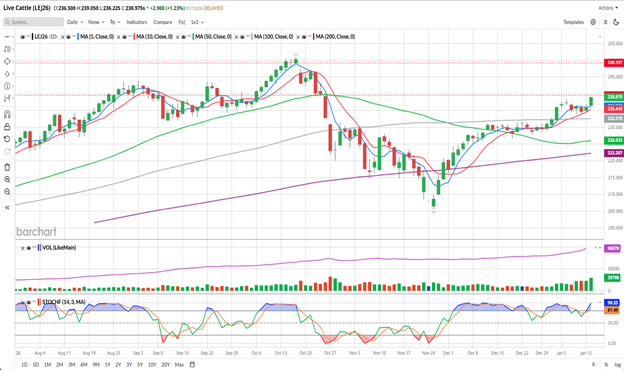
April Live Cattle contract have now become the front month, as open interest and trading volume now exceeds the February.
April Live Cattle closed at 238.975 on Tuesday, gaining 2.900 from Monday’s settlement. That close marks the highest of the year, so far, taking out last Tuesday’s close of 237.375 and the high posted that day of 238.200. This is the highest since October 23rd. There’s also a gap in the price chart from that day’s low at 239.525, denoted by the lower dotted horizontal line, just a little above today’s high of 239.050. There’s also still a price gap from October 16th, at 249.175, which is denoted by the higher dotted horizontal line.
If you recall, it was that afternoon that President Trump said that he wanted “beef prices to come down.” That comment spurred a drop of 45.400 from the contract high on October 16th to the low posted on November 25th. Not counting the contract high day or the November low day, it took 26 days to reach that low and it’s taken 32 days just to get back to where we are now. I think that’s a great illustration of markets falling much faster, typically, than they rally. And I think it’ll probably take another month or so to get back to the contract high and set a new one!
The 5- and 10-day moving averages (blue/red, 236.225/235.445) are both below the market, inclined higher and the 5-day held as support today. The 100-day average (grey, 232.575) basically appears to be a flat line, but it does have very mild inclination, at the moment. The 50-day average (green, 226.033) and is also pointing toward higher prices, as is the 200-day average (purple, 222.287) The 50 and 100 made a bearish crossover at the beginning of December, but since the December 11th close above the 50-day, I think that’s been negated somewhat. The sharp jump higher on the first trading day of 2026 got the market over the 100-day average, indicating to me that there’s more bullish control in the Cattle markets.
Open Interest and Volume (1st sub-graph) have been increasing as traders roll positions from the February to the April, with today’s volume posting the highest since the last really large down day on October 27th. I think that’s supportive of prices and bullish.
Stochastics (bottom sub-graph) have just ticked up into overbought territory. Over this 6-month view of the market, it appears to me that it’s been much more willing to be overbought, than oversold.
The closest price gap at 239.525 may offer some resistance later this week. There may be a bit of short-term profit taking there, but I would still expect the rally to continue from there.
Even if the US/MX border were to re-open fully, like the Screwworm shut-down never happened, we’re are still a year behind on those feeder weight cattle needed to refill the production pipeline. When it does re-open, I would expect imports to resume in stages or waves, not a full-on firehose of cattle, so to speak. It’s going to take quite some time to fully rebuild the herd and get us back to what might be considered a bearish level of inventory. And we may never see the herd rebuild. It’s quite possible that we will have to get comfortable with a shrinking beef herd. With prices where they are, producers have little to no incentive to hold back heifers. They can sell them for beef at very good prices, and I think most producers might lean that way.
When I wrote about Live Cattle in this space about a month ago, I advocated for long futures positions for the aggressive and well-margined traders out there near (225.325, the 5-day MA at the time) and for long Call options, the Feb 230 Calls at 5.075. I doubt that you’re still in the futures position, as the profit target was hit on January 2nd. You should still be in those Call Options, in my opinion. While they haven’t hit my 3x target yet, they should be profitable for you, if you chose to put them on last month.
For the aggressive and well-margined traders out there, I would suggest a long futures position in the April contract. The closest support that I see might be near the high from a week ago, at 238.200. That may turn out to be a good entry point, with a risk or Sell Stop below the 10-day moving average at 235.400. A good target might be the upper price gap at 249.175. That would work out to a potential risk of 2.80, or $1,120 before your commission/fees and a potential gain of 10.975, or $4,390 before your commissions/fees.
Less aggressive traders may do well to consider a Long Call Spread. Today the 240/250 April Calls settled at a 3.775 difference. I would suggest trying to buy that spread for 3.500, or $1,400 out-of-pocket before your commissions/fees. I would then suggest taking a profit at 7.000 on the spread, gaining $1,400 before commissions/fees, with an exit risk at ½ of what you paid for the spread, again before your commissions/fees. I’m not sure that I’d recommend a resting, GTC Sell Stop on a Cattle option spread, but that’s a conversation between you and your broker.
For the Beef producers out there, if you have “fat cattle” to sell, I wouldn’t expect a glaring need to hedge them until we get closer to Valentine’s day. If you’re concerned about the market dropping, make sure that you have your fats hedged about 30-days before you intend to sell them. I think that type of hedge strategy reduces your margin risk and out of pocket costs until just before delivery, when it’s likely most critical for you.
My bottom line is this: We have less Cattle and more people to feed. Until the US consumer balks at the meat counter, I think we have higher prices ahead.
April Live Cattle (Weekly)
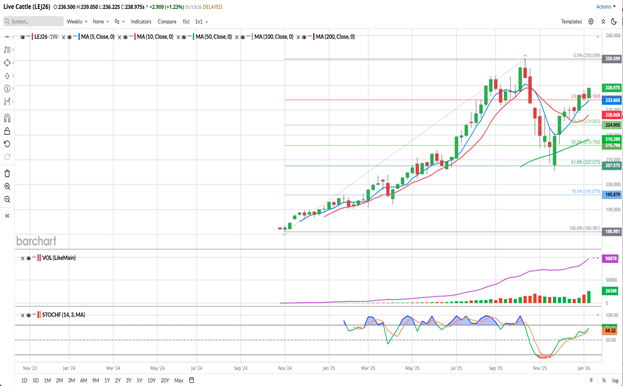
The weekly view of the April contract appears to show a “textbook” Fibonacci retracement. On the chart above, I’ve added that drawing, from the contract low (Nov ’24) to the contract high (Oct ’25) to the chart above. The market tested (and held) the 62% retracement level and has rallied since then. To my eye, that further illustrates the ongoing bull market in Cattle prices. And if the bull market continues, I’m expecting significantly higher contract highs in the June-July time frame. Would you agree?
The moving averages are all in a bullish configuration, as the 5- and 10-week made that bullish cross the week of Christmas and are both inclined higher. Those are the blue/red averages. The green one, the 50-week, is also inclined and pointing toward higher prices. Stochastics are also pointing higher and seem to be headed back to an overbought condition. And looking back over this chart, it’s certainly been overbought much more than it’s been oversold over the life of this contract.
You can view Barchart’s Seasonal Data for the April contract here. According to their data, January and February typically favor the bulls, with March being a 50/50 chance either way before trading lower in April. I’d take that a step further and suggest higher prices until right around the middle of February, a sell off or retracement during the last half of February and then another push higher in March.
Sign Up to receive Walsh Trading’s 1st Half of 2026 Market Outlook First Half of 2026 Outlook for the Livestock and Grain markets.
If you like what you’ve read here and would like to see more like this from Walsh Trading, please Click here and sign up for our daily futures market email.
Jefferson Fosse Walsh Trading
Direct 312 957 8248 Toll Free 800 556 9411
jfosse@walshtrading.com www.walshtrading.com
Walsh Trading, Inc. is registered as a Guaranteed Introducing Broker with the Commodity Futures Trading Commission and an NFA Member.
Futures and options trading involves substantial risk and is not suitable for all investors. Therefore, individuals should carefully consider their financial condition in deciding whether to trade. Option traders should be aware that the exercise of a long option will result in a futures position. The valuation of futures and options may fluctuate, and as a result, clients may lose more than their original investment. The information contained on this site is the opinion of the writer or was obtained from sources cited within the commentary. The impact on market prices due to seasonal or market cycles and current news events may already be reflected in market prices. PAST PERFORMANCE IS NOT NECESSARILY INDICATIVE OF FUTURE RESULTS. All information, communications, publications, and reports, including this specific material, used and distributed by Walsh Trading, Inc. (“WTI”) shall be construed as a solicitation for entering into a derivatives transaction. WTI does not distribute research reports, employ research analysts, or maintain a research department as defined in CFTC Regulation 1.71.

/Alphabet%20Inc_%20and%20Google%20logos%20by%20IgorGolovinov%20via%20Shutterstock.jpg)
/Nvidia%20logo%20and%20sign%20on%20headquarters%20by%20Michael%20Vi%20via%20Shutterstock.jpg)
/NVIDIA%20Corp%20logo%20on%20phone-by%20Evolf%20via%20Shutterstock.jpg)