



PPL Corporation (PPL), headquartered in Allentown, Pennsylvania, focuses on providing electricity and natural gas to approximately 3.6 million customers. Valued at $26.5 billion by market cap, the company generates electricity from power plants, as well as markets wholesale and retail energy and natural gas. It also delivers natural gas to customers in Kentucky and Rhode Island and generates electricity from power plants in Kentucky.
Shares of this leading utility company have underperformed the broader market over the past year. PPL has declined 2.3% over this time frame, while the broader S&P 500 Index ($SPX) has rallied nearly 22.6%. In 2026, PPL stock is down marginally, compared to the SPX’s 12.8% rise on a YTD basis.
Narrowing the focus, PPL’s underperformance is also apparent compared to the State Street Utilities Select Sector SPDR ETF (XLU). The exchange-traded fund has gained about 1.1% over the past year. Moreover, the ETF’s 2.3% returns on a YTD basis outshine the stock’s marginal losses over the same time frame.
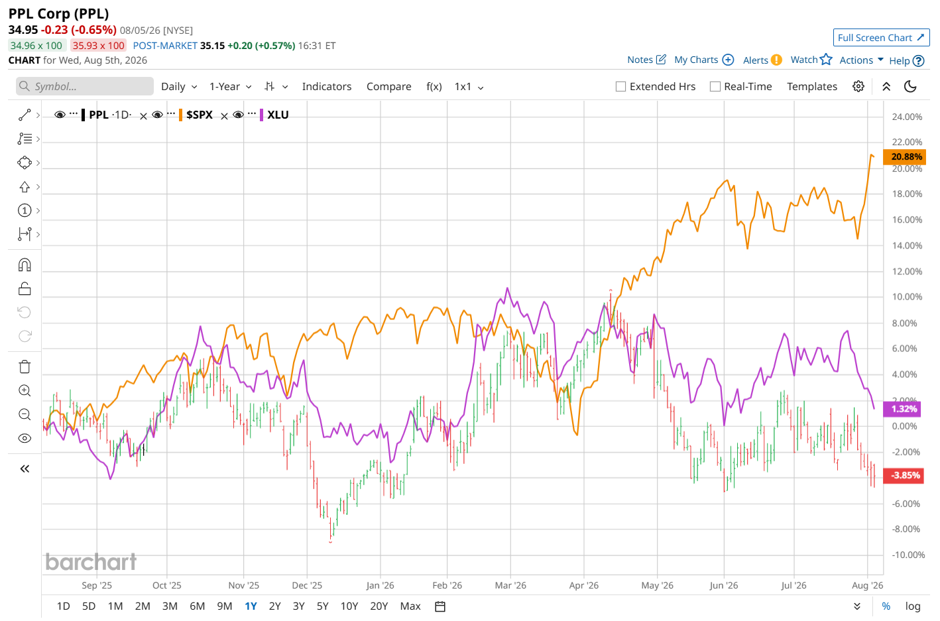
PPL’s underperformance was driven by a combination of macroeconomic, and capital-spending pressures rather than operational failure. Macroeconomically, elevated interest rates throughout the utility sector increased debt borrowing costs for capital-intensive infrastructure projects while making fixed-income assets more attractive relative to standard utility dividends. On the capital side, PPL's aggressive multi-billion-dollar infrastructure expansion plan required significant equity financing, raising investor concerns over near-term per-share dilution even as it builds long-term grid reliability and data center capacity. Additionally, short-term operational headwinds, such as higher localized operating costs in segments like Rhode Island and increased interest expense, further weighed on sentiment despite strong underlying load-growth demand across Pennsylvania and Kentucky.
For the current fiscal year, ending in December, analysts expect PPL’s EPS to grow 7.2% to $1.94 on a diluted basis. The company’s earnings surprise history is mixed. It beat the consensus estimate in two of the last four quarters while missing the forecast on two other occasions.
Among the 16 analysts covering PPL stock, the consensus is a “Strong Buy.” That’s based on 11 “Strong Buy” ratings, one “Moderate Buy,” and four “Holds.”
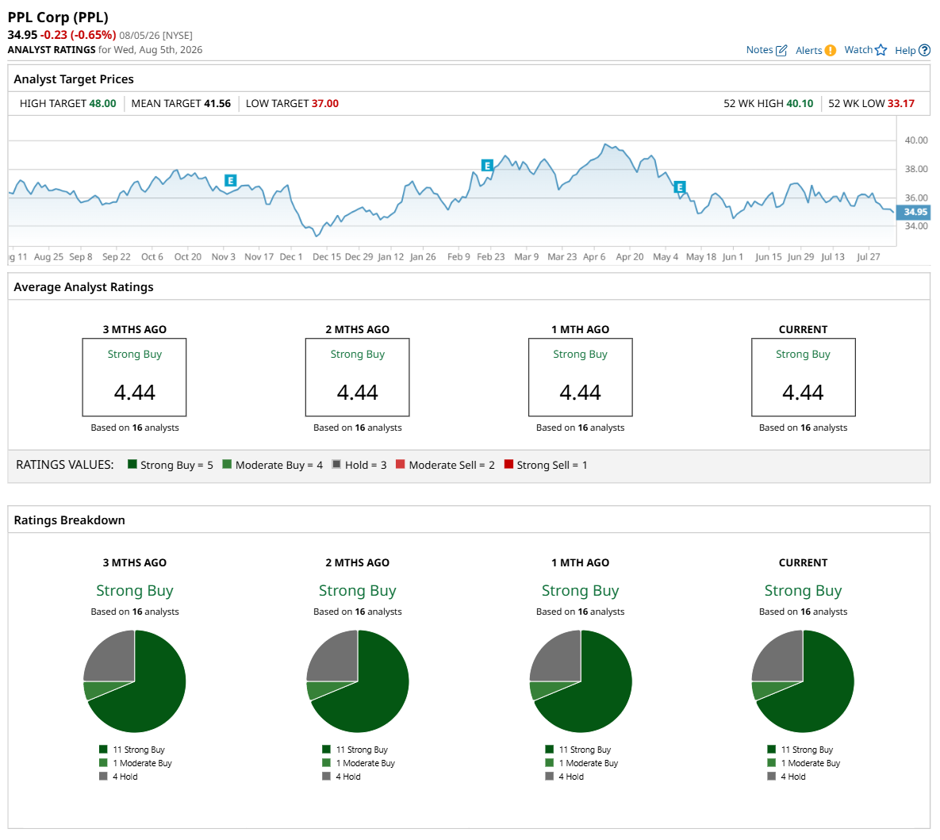
The configuration has been consistent over the past three months.
On Jul. 22, Morgan Stanley (MS) analyst David Arcaro kept an “Overweight” rating on PPL and raised the price target to $43, implying a potential upside of 23% from current levels.
The mean price target of $41.56 represents an 18.9% premium to PPL’s current price levels. The Street-high price target of $48 suggests a notable upside potential of 37.3%.
On the date of publication, Neha Panjwani did not have (either directly or indirectly) positions in any of the securities mentioned in this article. All information and data in this article is solely for informational purposes. For more information please view the Barchart Disclosure Policy here.


/An%20image%20of%20the%20Snowflake%20logo%20on%20a%20corporate%20office_%20Image%20by%20Grand%20Warszawski%20via%20Shutterstock_.jpg)


/Netflix%20on%20tv%20with%20remote%20by%20freestocks%20via%20Unsplash.jpg)