


Dual Edge Research publishes two powerful newsletters that work great individually — and even better together. The Bull Strangle Newsletter focuses on stocks and options, combining stock ownership with premium-selling strategies to generate consistent income and market-beating returns. The Smart Spreads Newsletter specializes in seasonal commodity futures spreads, offering a diversified approach with low correlation to equities. Together, they deliver a complete investment perspective — one focused on income, the other on diversification — all under one simple subscription.
Introduction
In the weeks since cocoa was added to the upcoming January rebalancing schedules for the Bloomberg Commodity Index (BCOM) and S&P GSCI, traders have been watching closely for confirmation that passive flows were beginning to influence price. That confirmation is now increasingly visible—not only in the magnitude of recent gains, but in how the market is behaving technically.
While the original article focused on the scale of required index buying, recent price action suggests cocoa has moved beyond a simple rebound and into a transition phase, where anticipated flow-driven demand is beginning to overwhelm persistent selling pressure.
Updated Index Buying Estimates: Still a Structural Shock
Updated projections now call for approximately 36,500 cocoa futures contracts to be purchased during the January rebalance window.
- Required buying: ~36,500 contracts
- Share of open interest: ~30% of total OI
- Execution window: Concentrated in early January
Even with modest downward revisions from earlier estimates, the magnitude remains extraordinary. A requirement approaching one-third of total open interest represents a structural imbalance that few commodity markets can absorb without material price adjustment.
This remains one of the largest single-market index rebalancing impacts expected this cycle.
What the Cocoa Chart Is Signaling Now
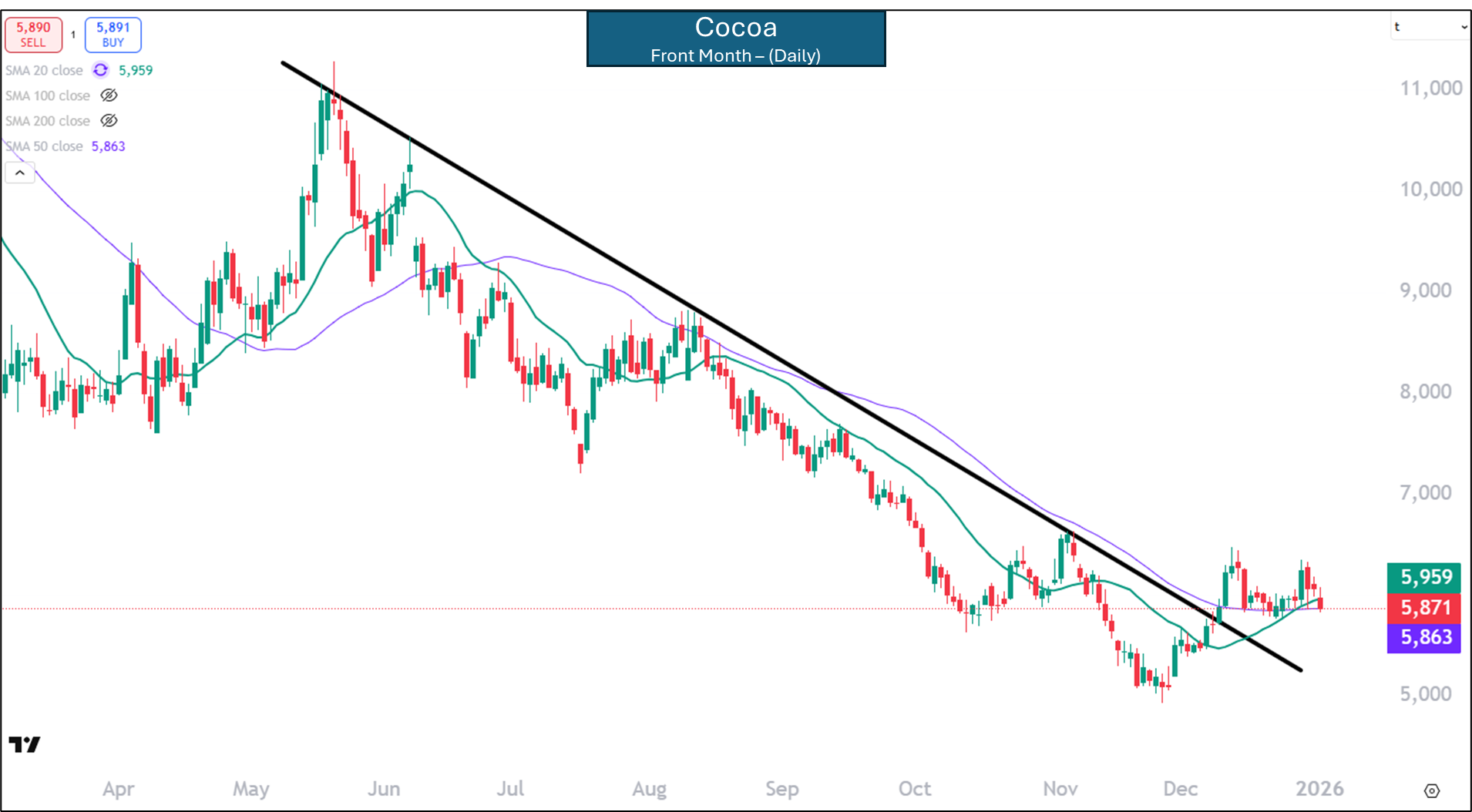
Recent price action adds important context to the flow narrative. For much of the past year, cocoa traded within a well-defined downtrend, with rallies consistently capped by a descending trendline and key moving averages. That structure reflected sustained seller control.
Over the past several weeks, that condition has changed:
- Price has broken above the primary downtrend line, signaling a shift in market character.
- The market has stabilized above short-term moving averages, indicating easing selling pressure.
- Pullbacks since the breakout have been shallow and controlled, rather than impulsive or trend-resuming.
This type of behavior is typical when non-economic buyers, such as index-linked funds, begin to exert influence. Passive flows are largely price-insensitive and tend to compress volatility initially before producing more directional movement as execution windows approach.
Notably, cocoa has not moved vertically. Instead, the market appears to be absorbing supply and building a base, a pattern that often precedes stronger continuation once forced buying begins in earnest.
Why the Cocoa Move May Still Be Early
Despite the technical shift:
- Most index-linked buying has not yet occurred.
- Discretionary participation remains relatively light.
- Commercial selling has not materially expanded.
Structurally, cocoa appears to have transitioned from trend exhaustion to flow anticipation. Historically, this phase often features volatility compression followed by re-expansion as execution timing narrows and liquidity thins.
Silver: A Rebalance at the Other End of the Spectrum
Silver provides a useful contrast.
Current estimates suggest that the January rebalance will require selling approximately 9,300 silver futures contracts, representing about 6% of total open interest.
- Estimated flow: ~9,300 contracts to sell
- Share of open interest: ~6%
While directionally negative, this is an order of magnitude smaller than cocoa’s rebalancing impact. Silver is a deep, highly liquid market with substantial daily volume, broad commercial participation, and diverse investor exposure. As a result, the anticipated selling pressure is far more likely to be absorbed without dramatic dislocation.
In practical terms, silver’s rebalance represents a marginal headwind, not a structural shock. Unlike cocoa—where forced buying is large relative to available liquidity—silver’s adjustment is unlikely to overwhelm existing market participants or materially alter trend structure on its own.
Bottom Line
Cocoa has moved from theory to execution:
- ~36,500 contracts still need to be purchased
- ~30% of total open interest
- A narrow, calendar-driven execution window
The chart confirms that the market is already responding—breaking its prior downtrend and stabilizing as buyers gain control. If this transition is occurring before the bulk of index buying begins, the coming weeks may see renewed volatility and upward pressure as forced demand meets limited supply. Silver, by contrast, illustrates the opposite end of the rebalancing spectrum: a manageable, absorbable adjustment unlikely to generate the same degree of structural stress. Taken together, these markets highlight why index rebalancing impacts must be evaluated relative to liquidity and open interest—not just contract count. Cocoa remains one of the clearest examples of a flow-driven setup in the commodity complex heading into year-end.
Closing Comment — Smart Spreads Newsletter
For traders interested in applying this type of flow-aware, structurally driven analysis in practice, the Smart Spreads Newsletter focuses on identifying and tracking high-probability commodity spread opportunities using extended historical datasets and rigorous testing. While seasonality is a core input, each trade is filtered through a broader framework that includes Commitment of Traders data, hedge fund positioning estimates, relative strength, carry dynamics, CTA momentum, and overall market context. The goal is to highlight opportunities where historical tendencies and current positioning align, helping traders avoid crowded or structurally weak setups before capital is committed.
More Information
Now you can get two powerful newsletters — for one simple price!
- For stocks and options, the Bull Strangle Newsletter shows you how to combine stock ownership with dual option selling — a disciplined strategy that has consistently outperformed the S&P 500.
- For commodity futures, the Smart Spreads Newsletter focuses on seasonal commodity spreads — a proven, low-correlation approach that thrives in all types of markets.
Each newsletter is designed to deliver consistent income on its own — but when used together, they create a complete, diversified trading approach that works in any market environment.
Visit BullStrangle.com to subscribe for just $1 for the first month.
For a video overview of the Bull Strangle Newsletter
For a video overview of the Smart Spreads Newsletter
Darren Carlat
Dual Edge Research
(214) 636-3133
DualEdgeResearch@gamil.com
Disclaimer
This information is for informational purposes only and should not be considered as investment advice. Past performance is not indicative of future results, and all investments carry inherent risk. Consult with a financial advisor before making any investment decisions.


/A%20concept%20image%20of%20space_%20Image%20by%20Canities%20via%20Shutterstock_.jpg)
/Intel%20Corp_%20Santa%20Clara%20campus-by%20jejim%20via%20Shutterstock.jpg)

/The%20CrowdStrike%20logo%20on%20an%20office%20building%20by%20bluestork%20via%20Shutterstock.jpg)