Dual Edge Research publishes two powerful newsletters that work great individually — and even better together. The Bull Strangle Newsletter focuses on stocks and options, combining stock ownership with premium-selling strategies to generate consistent income and market-beating returns. The Smart Spreads Newsletter specializes in seasonal commodity futures spreads, offering a diversified approach with low correlation to equities. Together, they deliver a complete investment perspective — one focused on income, the other on diversification — all under one simple subscription.
Introduction
Why Leg Configuration Matters: Building Better Commodity Calendar Spreads
In the previous article, we explored how direction influences the performance of commodity calendar spreads. Historical testing showed that many markets consistently perform better when traded from one side than the other. That research answered an important question:
- Should this market be traded from the Buy or Sell side?
Once that decision has been made, another equally important question remains:
- How should the spread be constructed?
For many traders, the answer seems obvious. A calendar spread is simply a calendar spread. Historical testing tells a different story. As I analyzed more than 31,000 historical commodity spread trades, it became clear that the number of contracts used within a spread—the leg configuration—can significantly influence historical performance. In many markets, adding or removing a single leg completely changed the profitability, consistency, and overall quality of the trade.
The Same Market Can Behave Very Differently
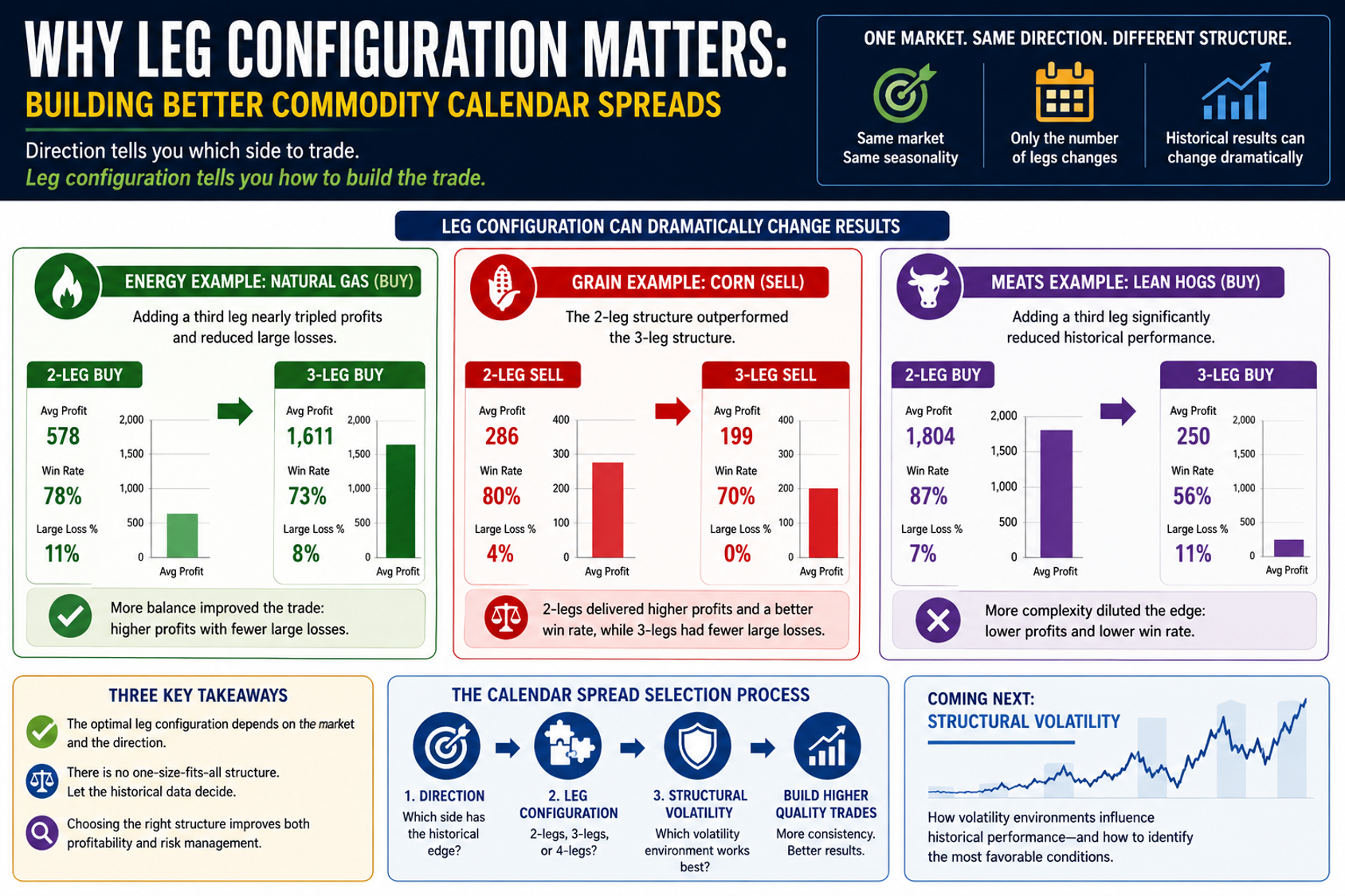
Consider Natural Gas. Historical testing showed that buying a two-leg spread produced an average profit of 578 with a 78% win rate. However, simply expanding the position into a three-leg spread increased the average profit to 1,611 while actually reducing the frequency of large losses. The win rate declined only slightly, but the overall historical performance improved dramatically.
Nothing else changed. The market was the same. The seasonal tendency was the same. Only the structure of the spread was different.
Sometimes Simpler Is Better
The opposite occurred in Lean Hogs. Historical testing showed that a two-leg Buy spread produced an average profit of 1,804 with an outstanding 87% win rate. Adding a third leg dramatically reduced the historical edge. Average profit fell to just 250, while the win rate dropped to 56%. More complexity did not create a better trade. In this market, the simpler structure consistently produced superior historical results.
Leg Configuration Also Matters on the Sell Side
The impact isn't limited to Buy spreads. Corn provides an excellent example. Once historical testing identified the Sell side as the preferred direction, the next decision became the structure of the trade. A two-leg Sell spread generated an average profit of 286, an 80% win rate, and only a 4% frequency of large losses.
The three-leg version remained profitable, but average profit declined to 199, while the win rate slipped to 70%. Although the three-leg spread virtually eliminated large losses, the historical data showed that the two-leg configuration delivered stronger overall performance. The lesson is clear:
- Selecting the correct direction is only part of the process.
- Selecting the optimal structure can be equally important.
Let the Data Choose the Structure
Many traders naturally assume that more sophisticated spreads must produce better results. The historical evidence suggests otherwise. Some markets clearly benefit from the additional balance provided by a third leg. Others perform best using a straightforward two-leg calendar spread. There is no universally superior configuration. The optimal structure depends on the individual market and should be determined by historical performance rather than preference or convention.
Another Layer of Objective Analysis
Leg configuration doesn't replace seasonality. It doesn't replace carry, liquidity, or market selection. Instead, it becomes another objective layer in the decision-making process.
After identifying the preferred direction, historical testing can then determine whether a two-leg, three-leg, or even four-leg structure has historically produced the best combination of profitability, consistency, and risk.
Like direction, leg configuration helps describe how a market has historically behaved, allowing traders to build positions that better reflect each market's unique characteristics.
Coming Next
Direction answers which side of the market to trade. Leg configuration answers how to build the trade. The final structural characteristic may be the most important of all. In the next article, we'll examine Structural Volatility—how the underlying volatility environment influences the historical performance of commodity calendar spreads—and why recognizing favorable volatility regimes can further improve trade selection.
The Bull Strangle Newsletter focuses on stocks and options, combining stock ownership with disciplined option-selling techniques designed to generate consistent income while managing risk.
The Smart Spreads Newsletter focuses on seasonal commodity spreads, a historically proven approach that seeks opportunities across agricultural, energy, metal, and financial futures markets.
Each strategy is designed to stand on its own, but together they provide a diversified approach that can perform across a wide range of market environments. For traders looking to deepen their education, The Bull Strangle Strategy and Trading Commodity Spreads, both available on Amazon.
Visit BullStrangle.com to subscribe for just $1 for the first month.
For a video overview of the Bull Strangle Newsletter
For a video overview of the Smart Spreads Newsletter
Darren Carlat
Dual Edge Research
(214) 636-3133
DualEdgeResearch@gamil.com
Disclaimer
This information is for informational purposes only and should not be considered as investment advice. Past performance is not indicative of future results, and all investments carry inherent risk. Consult with a financial advisor before making any investment decisions.

/A%20close-up%20of%20an%20AMD%20office%20by%20gehapromo%20via%20Adobe%20Stock.jpeg)
/Applied%20Materials%20Inc_%20campus%20sign-by%20Sundry%20Photography%20via%20iStock.jpg)