




Dual Edge Research publishes two powerful newsletters that work great individually — and even better together. The Bull Strangle Newsletter focuses on stocks and options, combining stock ownership with premium-selling strategies to generate consistent income and market-beating returns. The Smart Spreads Newsletter specializes in seasonal commodity futures spreads, offering a diversified approach with low correlation to equities. Together, they deliver a complete investment perspective — one focused on income, the other on diversification — all under one simple subscription.
Introduction
In the first two articles of this series, we examined two characteristics that consistently improved the quality of stocks selected for the Bull Strangle Strategy. Institutional ownership helped identify companies supported by long-term investors rather than short-term speculation. Price divided by Average True Range (Price/ATR) measures how much a stock typically moves relative to its price, helping avoid stocks with excessive day-to-day volatility. Those metrics answered two important questions:
- Who owns the stock?
- How much does it normally move?
The next question is equally important: Are the options market accurately pricing that movement? To answer that, we compare Implied Volatility to Historical Volatility.
Two Different Ways to Measure Volatility
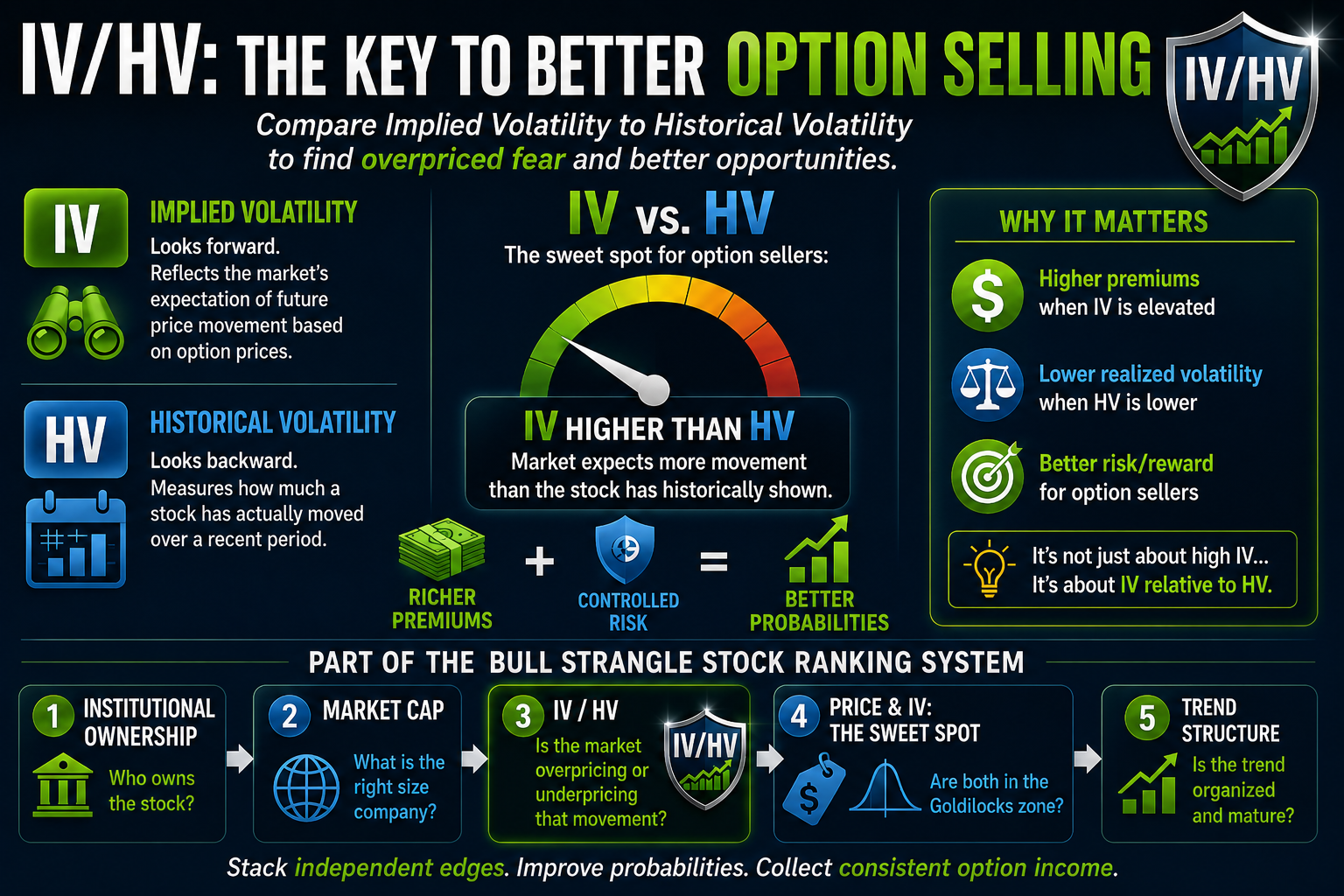
Although both are expressed as percentages, Implied Volatility (IV) and Historical Volatility (HV) measure very different things. Historical Volatility looks backward. It measures how much a stock has actually moved over a recent period.
Implied Volatility looks forward. Rather than measuring past price changes, it reflects the market's expectation of future movement as implied by option prices. Because option premiums rise when traders expect larger moves, implied volatility directly determines how much premium option sellers receive.
Why the Comparison Matters
Many traders search for the highest implied volatility they can find. At first glance, that seems logical. Higher implied volatility generally means higher option premiums. But high premiums don't automatically create better trades. If implied volatility reflects that a stock truly experiences violent price swings, the additional premium may only compensate for the increased risk.
The more interesting opportunities arise when implied volatility exceeds what the stock's historical behavior would suggest. In other words, the market is expecting more movement than the stock has recently demonstrated. That difference creates what option sellers hope to find:
- Rich option premiums without a proportional increase in realized volatility.
Looking Beyond Premium
Imagine two stocks with identical option premiums. One has been making unusually large daily moves for months. The other has traded in a much more orderly fashion, yet option buyers are pricing in much larger future swings. Both offer similar premiums. Only one appears relatively expensive.
That second stock is generally the more attractive candidate for an option income strategy. The comparison between implied and historical volatility helps identify exactly these situations. Rather than simply asking, "How much premium can I collect?" The better question becomes, "Is the market paying me more than recent price behavior suggests it should?"
What the Research Found
As I analyzed hundreds of completed Bull Strangle trades, one trend became increasingly clear. Stocks with implied volatility exceeding historical volatility generally produced stronger overall results than stocks with relatively low implied volatility relative to realized movement. No single indicator guaranteed success.
Unexpected news can always overwhelm historical tendencies. But as part of a systematic screening process, the IV/HV relationship consistently helped separate higher-quality candidates from stocks whose premiums weren't adequately compensating for their risk. Like Institutional Ownership and Price/ATR, it became another independent factor contributing to better probabilities.
One Piece of a Larger System
Successful stock selection rarely depends on finding one perfect indicator. Instead, each metric contributes a small statistical advantage. Institutional ownership identifies stronger sponsorship. Price/ATR measures normal daily movement.
IV/HV evaluates whether option premiums appear expensive relative to actual price behavior. Together, these independent characteristics help identify stocks that are better suited to consistent option income strategies. The objective isn't to predict what any stock will do tomorrow. It's to stack the odds in your favor consistently.
Coming Next
So far, we've examined who owns the stock, how much it typically moves, and whether option premiums appear fairly priced. The next article looks at another factor that proved surprisingly important:
- Market Cap
Is bigger always better? Next week, we'll use historical data to determine how Market Capitalization influences the probability of successful Bull Strangle trades.
Want to build a more complete trading toolkit?
The Bull Strangle Newsletter focuses on stocks and options, combining stock ownership with disciplined option-selling techniques designed to generate consistent income while managing risk.
The Smart Spreads Newsletter focuses on seasonal commodity spreads, a historically proven approach that seeks opportunities across agricultural, energy, metal, and financial futures markets.
Each strategy is designed to stand on its own, but together they provide a diversified approach that can perform across a wide range of market environments. For traders looking to deepen their education, The Bull Strangle Strategy and Trading Commodity Spreads, both available on Amazon.
Visit BullStrangle.com to subscribe for just $1 for the first month.
For a video overview of the Bull Strangle Newsletter
For a video overview of the Smart Spreads Newsletter
Darren Carlat
Dual Edge Research
(214) 636-3133
DualEdgeResearch@gamil.com
Disclaimer
This information is for informational purposes only and should not be considered as investment advice. Past performance is not indicative of future results, and all investments carry inherent risk. Consult with a financial advisor before making any investment decisions.

/Microsoft%20headquarters%20By%20Peter.jpeg)
/Micron%20Technology%20Inc_%20logo%20on%20building-by%20vzphotos%20vis%20iStock.jpg)
/NVIDIA%20Corp%20logo%20outside%20building-by%20BING-JHEN_HONG%20via%20iStock.jpg)
/Amazon%20-%20Image%20by%20bluestork%20via%20Shutterstock.jpg)