



Berkshire Hathaway (NYSE:BRK-A)(NYSE:BRK-B), one of the largest companies in the world, has two classes of shares. The original Class A shares have been around since Berkshire went public and have enjoyed an incredible run, with each share now trading at a good deal more than a half-million dollars.
Berkshire introduced the Class B shares in the 1990s to make the stock more affordable to smaller investors. However, with the advent of fractional shares, investors can now purchase as little as they want of the Class A stock, making it accessible for all. Should people invest in the Class A shares of Berkshire while they trade for less than $700,000? Let's take a look.
How is Berkshire's valuation determined?
Stock prices don't mean a whole lot when investing in stocks. For instance, a company whose shares trade at a high price can also have a low market cap and valuation. So, just because Berkshire Class A shares trade at a high price, it doesn't necessarily mean they are overvalued. One way Berkshire is typically valued is on a price-to-tangible book value (P/TBV) basis, which looks at a company's market value compared to its net worth. This is a common way to value financials such as insurance companies and banks, which makes sense because Berkshire owns one of the largest insurance companies in the U.S. with Geico.
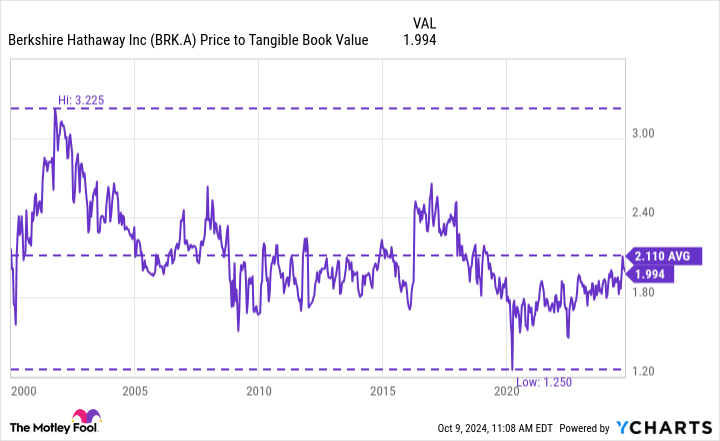
BRK.A Price to Tangible Book Value data by YCharts.
As you can see, Berkshire's P/TBV has been on the rise, but the stock has traded at a higher valuation before and trades below its average P/TBV since the turn of the century. Looking at the company's price-to-earnings (P/E) ratio, Berkshire is very attractively priced compared to its average, but not terribly far off from where it traded during most of the decade between 2010 and 2020.
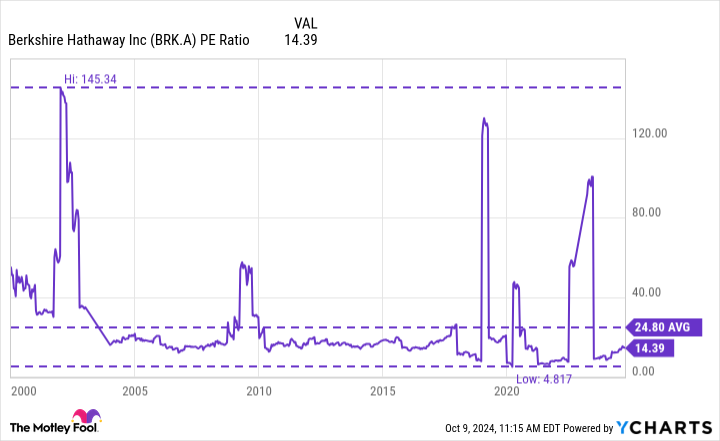
BRK.A PE Ratio data by YCharts.
Is the stock a buy at less than $700,000?
Given its sheer size and looking at some of the businesses Berkshire owns, it's clear that Buffett has built a moat that won't be easy to replicate. Berkshire owns the third-largest auto insurance company in the U.S., one of the largest railroads in North America, large mortgage and manufacturing businesses, and a significant number of energy assets. The company is also sitting on a hoard of more than $271 billion in cash that it can use to buy stocks to add to its $300 billion-plus stock portfolio or repurchase its own stock.
Berkshire has a phenomenal track record. Between 1965 and 2023, Berkshire's stock generated overall gains of more than 4,300,000%, compared to the S&P 500's 31,200% including dividends. That's a compound annual growth rate of 19.8%, as opposed to the S&P 500's 10.2%.
Berkshire's longtime Vice Chairman Charlie Munger recently passed away at the age of 99. Buffett is 94, and his remaining years running Berkshire are limited. But Buffett and Munger instituted a strong succession plan, and Berkshire has many strong investing lieutenants who have learned from the best and are more than capable.
Given all these qualities, people can invest in Berkshire Class A shares while they trade for less than $700,000. It's one of those stocks you can buy and hold forever, without having to check it too often.
Should you invest $1,000 in Berkshire Hathaway right now?
Before you buy stock in Berkshire Hathaway, consider this:
The Motley Fool Stock Advisor analyst team just identified what they believe are the 10 best stocks for investors to buy now… and Berkshire Hathaway wasn’t one of them. The 10 stocks that made the cut could produce monster returns in the coming years.
Consider when Nvidia made this list on April 15, 2005... if you invested $1,000 at the time of our recommendation, you’d have $826,069!*
Stock Advisor provides investors with an easy-to-follow blueprint for success, including guidance on building a portfolio, regular updates from analysts, and two new stock picks each month. The Stock Advisor service has more than quadrupled the return of S&P 500 since 2002*.
*Stock Advisor returns as of October 7, 2024
Bram Berkowitz has no position in any of the stocks mentioned. The Motley Fool has positions in and recommends Berkshire Hathaway. The Motley Fool has a disclosure policy.



/Super%20Micro%20Computer%20Inc%20HQ%20photo-by%20Tada%20Images%20via%20Shutterstock.jpg)
/Micron%20Technology%20Inc_logo%20and%20website-by%20Mojahid%20Mottakin%20via%20Shutterstock.jpg)