

Shares of retail giant Walmart (NYSE:WMT) were up 28.8% in the first half of 2024, according to data provided by S&P Global Market Intelligence. This compares to a 14.5% return for the S&P 500 during this time. Through mid-May, Walmart was only outperforming the market by a trivial amount. But after it reported financial results for its fiscal first quarter of 2025 on May 16, Walmart stock took a pronounced jump higher.
Walmart's fiscal 2024 ended in January. And during the fiscal year, the company's total revenue jumped 6% year over year to nearly $650 billion, and net income took a big 44% jump to over $16 billion. Those were good numbers.
Moreover, Walmart had a highly publicized 3-for-1 stock split in February. Both the earnings report and the split news seem to have given Walmart stock a boost early in the year. But again, the bigger jump came later, as seen in the chart.
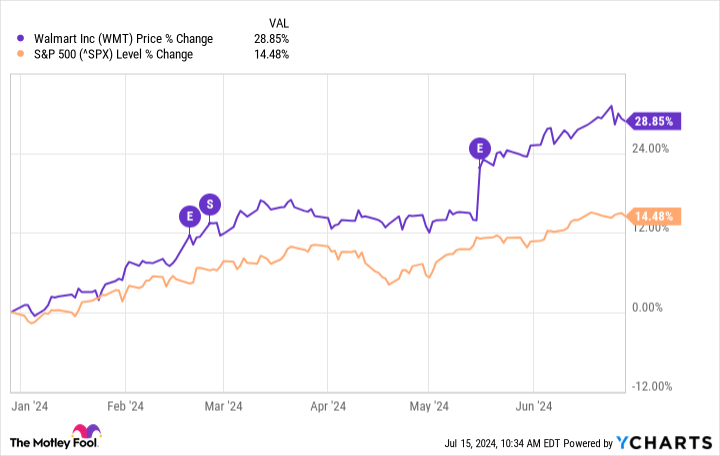
In Q1, Walmart generated revenue of nearly $162 billion, up 6% from the prior-year period. In the U.S., same-store sales were up nearly 4% -- quite good for a business this mature. These numbers were better than what analysts had expected.
Investors are aware of Walmart's retail locations and its Sam's Club warehouse chain. But analysts also celebrated the company's plan to expand its Luminate platform, a clue as to what was particularly encouraging with Q1 results.
The under-the-radar digital business
On May 16, Walmart announced that its Luminate platform would expand from the U.S. into international markets. For those unaware, Luminate is Walmart's way of taking its vast first-party shopping data and making it available to retailers and suppliers so they can make better decisions.
Considering it has hundreds of billions of dollars of annual sales data at its disposal, Walmart's dataset is quite valuable if it can package it well. That's why some investors are excited about Luminate -- it's one of many ways that Walmart is leveraging what it has.
Leveraging what's already there typically adds to a company's profits. And that's the case for Walmart. In Q1, its revenue was up about 6%, as mentioned. But operating income was up nearly 10%. And some of the improvement to profitability is from leveraging its consumer data.
What should Walmart investors do?
I applaud many of Walmart's recent initiatives. But one thing I should point out is that the market is getting enthusiastic for this stock -- maybe too enthusiastic. A price-to-sales ratio of about 0.9 might not sound expensive. But it's been over a decade since Walmart stock was valued this richly.
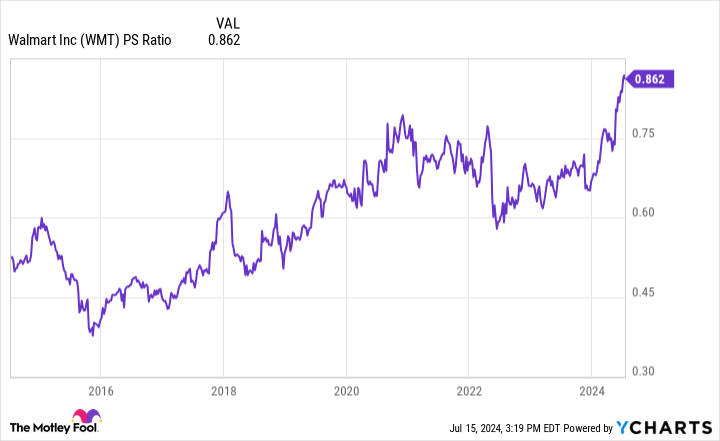
WMT PS Ratio data by YCharts
Walmart is a mature, low-growth business. Therefore, it's important to not overpay when making a long-term investment in Walmart stock. Investors will consequently want to consider that it trades at once-in-a-decade highs right now, which may limit some of the upside today.
Should you invest $1,000 in Walmart right now?
Before you buy stock in Walmart, consider this:
The Motley Fool Stock Advisor analyst team just identified what they believe are the 10 best stocks for investors to buy now… and Walmart wasn’t one of them. The 10 stocks that made the cut could produce monster returns in the coming years.
Consider when Nvidia made this list on April 15, 2005... if you invested $1,000 at the time of our recommendation, you’d have $791,929!*
Stock Advisor provides investors with an easy-to-follow blueprint for success, including guidance on building a portfolio, regular updates from analysts, and two new stock picks each month. The Stock Advisor service has more than quadrupled the return of S&P 500 since 2002*.
*Stock Advisor returns as of July 15, 2024
Jon Quast has no position in any of the stocks mentioned. The Motley Fool has positions in and recommends Walmart. The Motley Fool has a disclosure policy.


/A%20concept%20image%20of%20space_%20Image%20by%20Canities%20via%20Shutterstock_.jpg)

/A%20photo%20of%20a%20Sandisk%20Solid%20State%20Drive%20by%20Top%20Popular%20Vector%20by%20Shutterstock.jpg)
/Broadcom%20Inc%20logo%20on%20phone%20and%20site-by%20Majahid%20Mottakin%20via%20Shutterstock.jpg)