



Investing through an exchange-traded fund (ETF) gives investors an incredible number of choices. Just like stocks, there are some ETFs that are more volatile and some that are less, some more focused on growth and some more focused on value. The list goes on.
Yet, what's similar about all of them is that they provide pre-made diversification. Even if you invest in an ETF with few holdings and centered around a specific trend, you're dividing up your eggs into different baskets. Take Cathie Wood's ETFs, for example. Her flagship Ark Innovation ETF owns only 36 stocks. Or you can invest in Vanguard's Russell 3000 ETF, which as you might have already guessed, invests in that index's 3,000 stocks. The advantage of the former is concentrated investments in disruptive technology, while the advantage of the latter is low-risk diversification.
If you're looking for a high-growth option that leans toward growth stocks but minimizes risk, the Vanguard Growth ETF (NYSEMKT:VUG) is a no-brainer option.
Why this ETF?
It's not easy to beat the market. An ETF that tracks the S&P 500, a commonly used measure of the "market," has typically provided an annualized return of around 10% over the long term. That doesn't mean the S&P 500 gains 10% every year -- it doesn't. It goes through better and worse, great and awful years.
However, if you plug in your investment and then "set and forget," you'll end up gaining about 10% over the long haul, on average. That's an excellent rate to grow your money, especially when factoring in how it compounds annually. Most investors do well having some portion of their portfolio invested in this kind of index fund, which features about 500 of the top U.S. public companies.

Image source: Getty Images.
Yet, beating the market can be done. The Vanguard Growth ETF takes the idea of indexing up a notch and invests in about 200 of the largest U.S. companies, mirroring the makeup of the CRSP U.S. Large Cap Growth Index. That takes the cream of the crop and gets you exposure to the largest growth companies.
And it's still well diversified. It's focused on growth stocks, but it owns enough stocks to keep the collection broad -- everything from drugmaker Eli Lily to payment services provider Visa.
The ETF's top five holdings are Microsoft, Apple, Nvidia, Amazon, and Meta Platforms. Because it's a weighted index, these stocks make up about 50% of the ETF's total value. But the remaining 50% is spread out among many other stocks. And because it's a passively managed ETF, which means it just follows an index, it will automatically sell underperforming stocks when the index does and keep your ETF in growth mode.
Finally, the fund has an extremely low expense ratio of 0.04%, so it's cheap to own.
Outperforming the market
Actively managed funds for the most part don't beat the market in any given year. Last year, 60% underperformed the market's gains. But the Vanguard Growth fund has soundly beaten the market, on average, throughout its lifetime, leading to higher annualized gains of 11.86% over the past 20 years vs. 10.34% for the overall market.
Those small percentage points translate into a substantial discrepancy in how much money you would have made if you had invested $1,000 in it vs. a standard S&P 500 ETF two years ago.
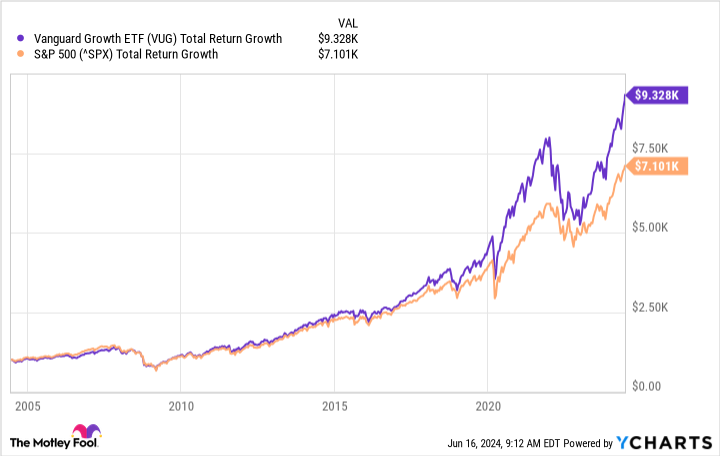
VUG Total Return Level data by YCharts
For most investors, it still makes sense to invest in a broader market index fund. That provides a level of security that can't be beat. But if you're looking for additional investments, the Vanguard Growth ETF is a fantastic, no-brainer ETF to buy and hold forever.
Should you invest $1,000 in Vanguard Index Funds - Vanguard Growth ETF right now?
Before you buy stock in Vanguard Index Funds - Vanguard Growth ETF, consider this:
The Motley Fool Stock Advisor analyst team just identified what they believe are the 10 best stocks for investors to buy now… and Vanguard Index Funds - Vanguard Growth ETF wasn’t one of them. The 10 stocks that made the cut could produce monster returns in the coming years.
Consider when Nvidia made this list on April 15, 2005... if you invested $1,000 at the time of our recommendation, you’d have $830,777!*
Stock Advisor provides investors with an easy-to-follow blueprint for success, including guidance on building a portfolio, regular updates from analysts, and two new stock picks each month. The Stock Advisor service has more than quadrupled the return of S&P 500 since 2002*.
*Stock Advisor returns as of June 10, 2024
John Mackey, former CEO of Whole Foods Market, an Amazon subsidiary, is a member of The Motley Fool's board of directors. Randi Zuckerberg, a former director of market development and spokeswoman for Facebook and sister to Meta Platforms CEO Mark Zuckerberg, is a member of The Motley Fool's board of directors. Jennifer Saibil has no position in any of the stocks mentioned. The Motley Fool has positions in and recommends Amazon, Apple, Meta Platforms, Microsoft, Nvidia, Vanguard Index Funds-Vanguard Growth ETF, Vanguard S&P 500 ETF, and Visa. The Motley Fool recommends the following options: long January 2026 $395 calls on Microsoft and short January 2026 $405 calls on Microsoft. The Motley Fool has a disclosure policy.

/Amazon_com%20Inc_%20%20package%20by%20-%20AdrianHancu%20via%20iStock.jpg)
/Salesforce%20Inc%20HQ%20building-by%20JHVEPhoto%20via%20Shutterstock.jpg)

/Dell%20Technologies%20by%20Poetra_RH%20via%20Shutterstock.jpg)
/Intel%20Corp_%20Santa%20Clara%20campus-by%20jejim%20via%20Shutterstock.jpg)