



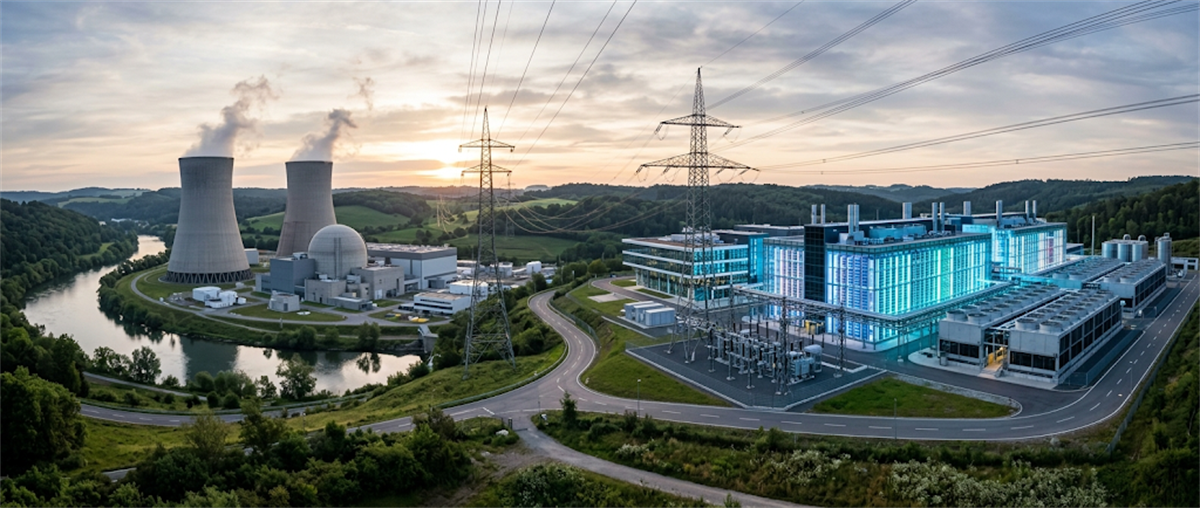
The global power grid is facing a dual crisis: structural degradation and unprecedented localized load growth. Broad-spectrum nuclear deployment is a mathematical necessity. Power demand from artificial intelligence (AI) data centers, mass electric vehicle adoption, and the impending commercialization of quantum computing are overwhelming legacy infrastructure.
Renewable energy sources, while vital, lack the consistent baseload capability required to run a hyperscaler facility 24 hours a day without massive battery storage costs. The physical energy draw of these advanced computational models forces a structural shift toward widespread grid nuclearification, spanning from traditional centralized utility models to decentralized, behind-the-meter microreactors.
Investors looking to capitalize on this once-in-a-lifetime multi-decade physical infrastructure supercycle might deploy a barbell strategy. This approach pairs the multi-billion-dollar cash flow stability of legacy fleet operators with the explosive growth potential of fully funded, development-stage reactor developers. Investors are witnessing a fundamental rerating of how capital markets value reliable power.
Heavyweight Anchors: Utilities Funding the Nuclear Buildout
At the low-beta end of the portfolio barbell, established utility operators and infrastructure providers offer immediate, fundamentally sound exposure to the technology sector power grab. Constellation Energy (NASDAQ: CEG) stands out as the premier fleet operator, securing long-term power purchase agreements with tech giants such as Microsoft (NASDAQ: MSFT) and Meta Platforms (NASDAQ: META).
Constellation Energy recently posted robust first-quarter 2026 earnings before interest, taxes, depreciation, and amortization (EBITDA) of $3.58 billion. Sustained operating margins insulate Constellation Energy's balance sheet from broader macroeconomic headwinds.
This significant cash flow directly funds the substantial capital expenditures required to restart the Crane Clean Energy Center at Three Mile Island. Technically, Constellation Energy is consolidating near its 200-day moving average following a massive rally, offering a low-volatility entry point for a core holding.
NextEra Energy (NYSE: NEE) provides another defensive anchor. A stabilizing interest rate environment heavily favors the capital-intensive math behind utility-scale grid upgrades. Lower borrowing costs accelerate infrastructure deployment, and NextEra Energy channels predictably within the standard deviation of its 50-day moving average. This creates reliable, lower-risk mean reversion setups for premium sellers and long-term accumulators alike.
Providing the physical supply chain, regardless of which reactor design wins market share, BWX Technologies (NYSE: BWXT) is the ultimate infrastructure play. BWX Technologies recently expanded its naval nuclear propulsion contracts with the Department of Defense by $1.4 billion while securing early-stage commercial orders for small modular reactor (SMR) components.
Although BWX Technologies commands a premium 55x price-to-earnings ratio, massive institutional accumulation validates the valuation. JPMorgan Chase & Co. recently increased its BWX Technologies position by 497%, absorbing 1.69 million shares. Pullbacks to the 50-day exponential moving average remain primary high-probability entry zones before the upward trend for BWX Technologies resumes.
The Raw Materials Moat
The nuclear infrastructure buildout is fundamentally supported by an impending global uranium supply deficit. Rather than attempting to trade short-term spot price fluctuations, the most resilient mining operations are locking in long-term contracting floors. Cameco Corp (NYSE: CCJ) is the blue-chip anchor of the materials sector. By successfully integrating the Westinghouse acquisition and securing utility contracts well above the $80-per-pound spot floor, Cameco neutralizes immediate commodity pricing risks.
Cameco is currently building a formidable base of multi-year structural support zones near $105. Institutional confidence remains extremely high, with Vanguard, the Global X Uranium ETF, and hedge funds driving institutional ownership of Cameco to 70.21%.
For portfolios seeking unhedged leverage to domestic sovereign supply chain development, Uranium Energy Corp (NYSEAMERICAN: UEC) and Energy Fuels (NYSE American: UUUU) serve as excellent high-beta proxies. Uranium Energy is restarting production at its Wyoming in-situ recovery hubs, offering leveraged upside when spot prices inevitably squeeze. The implied volatility profile of Uranium Energy. offers excellent premium-selling ranges.
Energy Fuels provides a diversified critical minerals moat by expanding its White Mesa mill to process both uranium and rare earth elements. Trading in a tight six-month horizontal channel, Energy Fuels offers clearly defined technical boundaries for mean-reversion trading strategies.
The Future of a Decentralized Grid
The speculative end of the barbell focuses on decentralized, substation-level assets designed to bypass grid transmission bottlenecks entirely. Small modular reactors and microreactors are essential localized capacity mechanisms for data centers that cannot wait a decade for regional transmission line upgrades. Small modular reactors have been used reliably by the military in critical systems such as submarines and aircraft carriers for decades. Moving this technology from maritime to terrestrial applications is not a question of if but when, as it is a well-established progression rather than a speculative endeavor.
NuScale Power (NYSE: SMR) is advancing its 6-gigawatt ENTRA1 and Tennessee Valley Authority deployment framework. While development-stage operators inherently carry execution risk, NuScale Power mitigates immediate concerns about toxic dilution with approximately $1 billion in available liquidity relative to current cash burn rates. NuScale Power prints extreme implied volatility, making it a prime candidate for fading overextensions: sell premium during retail hype cycles while accumulating core positions during deep pullbacks.
Oklo Inc. (NYSE: OKLO) offers another fully funded deployment vehicle navigating novel fast-reactor licensing with the Nuclear Regulatory Commission. Oklo recently received preliminary approval from the Department of Energy for a documented safety analysis for its Aurora Powerhouse at the Idaho National Laboratory.
Market mechanics are rapidly shifting in favor of Oklo, as short interest recently contracted by 21.9% to 19.4% of the public float, signaling a forced-covering dynamic among bearish funds.
Supported by a massive $2.5 billion liquidity runway and median analyst price targets hovering near $83, representing healthy upside from current $62 levels, the capital markets are pricing in a high probability of successful commercial deployment for Oklo.
The Critical Mass Investor Portfolio
Grid constraints dictate that centralized utility modernization and decentralized microreactor deployment must occur simultaneously. The physical degradation of current power generation assets ensures that the capital expenditure cycle will persist, independent of short-term news cycles in the technology sector.
Investors looking to position themselves ahead of the curve might consider constructing a portfolio that weights established fleet operators and infrastructure suppliers heavily for low-beta yield, while allocating measured, high-conviction capital into small modular reactor developers to capture the alpha of localized grid modernization.
Where Should You Invest $1,000 Right Now?
Before you make your next trade, you'll want to hear this.
MarketBeat keeps track of Wall Street's top-rated and best performing research analysts and the stocks they recommend to their clients on a daily basis.
Our team has identified the five stocks that top analysts are quietly whispering to their clients to buy now before the broader market catches on... and none of the big name stocks were on the list.
They believe these five stocks are the five best companies for investors to buy now...
The article "AI’s Power Problem Is Turning Nuclear Stocks Into a Bigger Market Story" first appeared on MarketBeat.

/A%20corporate%20sign%20for%20SK%20Hynix%20by%20Tada%20Images%20via%20Adobe%20Stock.jpeg)

/Server%20racks%20by%20dotshock%20via%20Shutterstock.jpg)

/Netflix%20open%20on%20tablet%20by%20rswebsols%20via%20Pixabay.jpg)