I asked if silver was a trading or investment commodity in a May 7, 2026, Barchart article, concluding with the following:
Silver remains in a long-term bullish trend, with prices nearly $20 above its critical support level at the 1980 high. However, the price is more than $50 below the late-January high. Expect silver to continue displaying wide price swings, making trading, rather than investing, optimal.
Nearby COMEX silver futures were trading at $78.185 per ounce on May 6. One month later, the price was lower at under $74. Silver is currently around $48 below its January record high and technical resistance level, and more than $23 per ounce above its 1980 high and critical technical support level. Silver’s price history suggests that a substantial price move could be on the horizon at under $74 per ounce.
Silver’s historical volatility is double that of gold
Silver is a more volatile precious metal than gold.
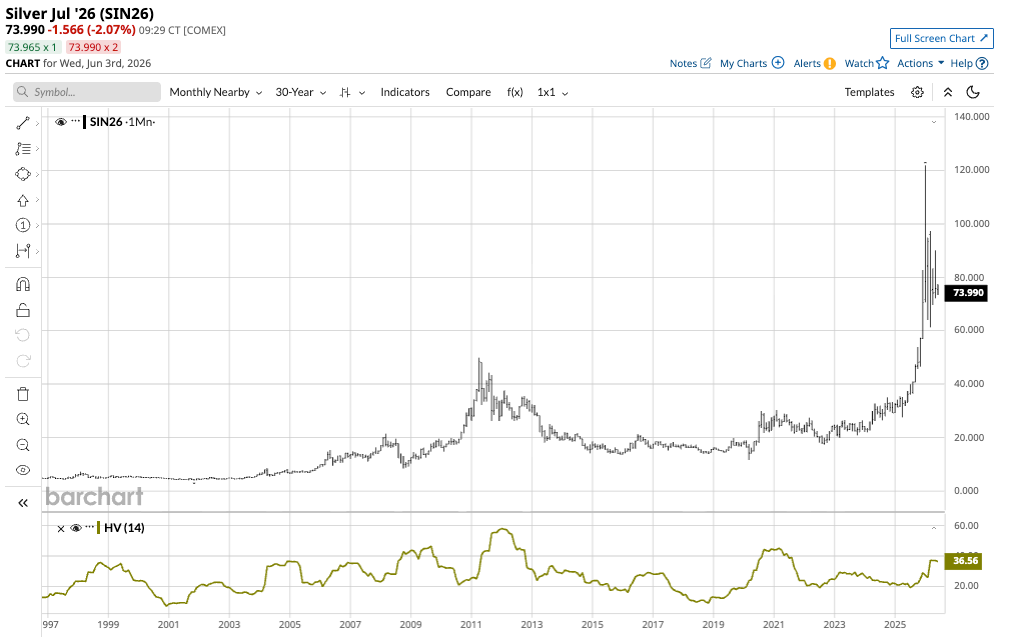
The monthly chart shows that the 30-year historical volatility of silver is 36.56%.
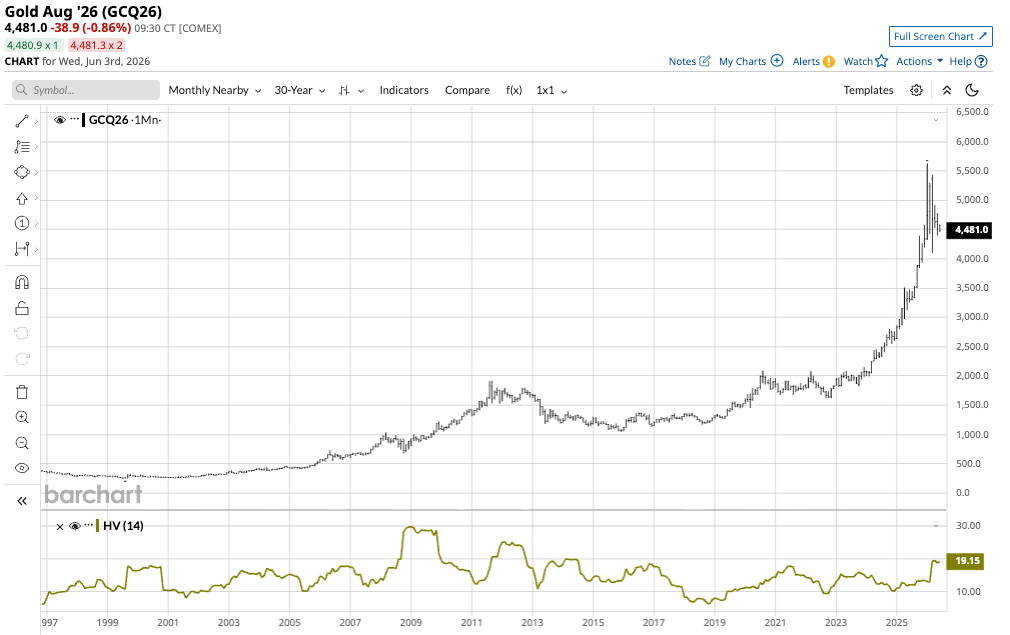
At 19.15%, gold’s historical volatility is nearly half that of silver.
A bullish long-term trend, but a bearish trend since the January 2026 high
While the long-term trends in silver and gold remain bullish, the short-term path of least resistance has been lower since the January 29 high.
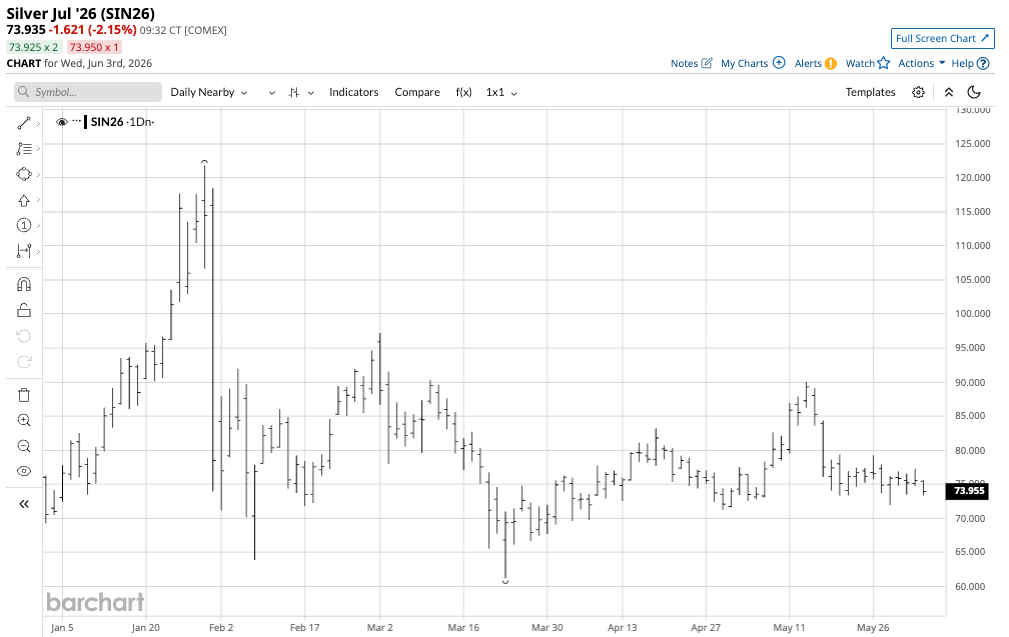
The daily continuous COMEX silver futures chart shows it has made lower highs since reaching a record high of $121.785 on January 29, 2026.
Technical support is at the March 23 low of $61.21, with resistance at the May 13 high of $90.105, the March 2 high of $97.30, and the January 29 record high.
Silver faces bullish and bearish factors in June 2026.
The factors that could drive silver higher
The factors that could drive silver prices higher over the coming months include:
- Silver broke out above the critical long-term technical resistance level at the $50.36 high in October 2025. Long-term technical support is now at that 1980 high, which is over $25 below the current price.
- According to the Silver Institute, silver remains in a supply-demand deficit for the sixth consecutive year. Although 2026 demand is forecast to decline by 2%, supply is falling faster, tightening the physical market.
- Silver’s bull market has attracted growing speculative and investment demand, which could widen the deficit. The World Silver Survey projects that coin and bar purchases will increase by 18% in 2026.
- Industrial demand for silver from solar panels, EVs, semiconductors, and AI infrastructure is increasing.
- Gold has corrected from over $5,600 to around $4,600 per ounce. Analysts at leading financial institutions forecast a recovery in gold prices, with many projecting $6,000 per ounce in 2026. If gold recovers and reaches a new high, silver will likely follow higher.
Fundamentals and technical factors support higher silver prices over the coming weeks and months.
The factors that could send silver toward a test of the 1980 high
The factors that could push silver toward a test of critical technical support at the $50.36 level include:
- Silver volatility and its price history suggest that price corrections can be substantial.
- Silver declined more than 92% from the 1980 high to below $4 per ounce in the early 1990s.
- Silver declined 76.6% from the 2011 high of $49.82 to the 2020 low of $11.64 per ounce.
- Silver fell 42.7% from the early 2021 high of $30.35 to the 2022 low of $17.40 per ounce.
- Risk-off events could send silver prices substantially lower from nearly $74 per ounce.
Silver’s historical volatility suggests the price will not remain around $74 per ounce for long.
Expect lots of volatility, and continue to trade rather than invest in silver
Silver’s supply and demand fundamentals support higher prices, as does the long-term bullish trend that broke out to the upside in October 2025. However, its volatility and uncertainty in the economic and geopolitical landscape could prove challenging if risk-off conditions affect all asset classes.
Many investors and traders are likely holding long risk positions, which could force liquidation to cover losses in other markets if markets enter a risk-off period.
Silver’s high historical volatility creates trading opportunities. Buying price weakness with a clear risk-reward plan, and taking profits on rallies, is likely optimal in the current environment. While investing in silver since 2020 has created substantial profits, trading over the coming months could yield significant returns.
Silver could be preparing for a big price move, but bullish and bearish factors make picking a direction challenging in June 2026.
On the date of publication, Andrew Hecht did not have (either directly or indirectly) positions in any of the securities mentioned in this article. All information and data in this article is solely for informational purposes. For more information please view the Barchart Disclosure Policy here.


/Quantum%20Computing/A%20concept%20image%20of%20a%20green%20and%20yellow%20motherboard_%20Image%20by%20Gorodenkoff%20via%20Shutterstock_.jpg)
/An%20image%20of%20a%20Tesla%20humanoid%20robot%20in%20front%20of%20the%20company%20logo%20Around%20the%20World%20Photos%20via%20Shutterstock.jpg)