
In 2022, the tech-heavy NASDAQ composite fell 33.10%, and the small-cap Russell 2000 was down 21.6%. The S&P 500, the most diversified U.S. stock market index, fell 19.44%, and the high-profile Dow Jones Industrial Average posted an 8.78% loss. After attempting to move higher in early 2023, the indices have come under pressure, which could accelerate given the many troublesome issues facing the equities assets class.
In a February 13 Barchart article on The Fed and Markets, I wrote, “When investing or trading, approach risk positions in markets with a clear and defined risk-reward plan.” The recent action in the stock market calls for increased vigilance as volatility has returned with a vengeance.
Battling inflation continues despite its consequences
The U.S. Fed has been committed to pushing inflation to its 2% target rate. While 2% is an arbitrary level, central banks worldwide seem to agree that it is the appropriate level that balances economic conditions. Meanwhile, inflation remains at multiples of that level as of the February 2023 data. At a midpoint of 4.625%, the Fed increased the short-term Fed Funds Rate by 4.5% since March 2022. Over the past weeks, a continuation of nagging inflation caused Fed Chairman Jerome Powell and other voting FOMC members to reiterate that a continuation of increasing the short-term rate is appropriate. The consensus is that the rate will rise above the 5% level, with some warning that a move to over 6% could be necessary to address inflation.
Meanwhile, the Fed has also been using quantitative tightening to push rates higher further out along the yield curve. The QE program continues to reduce the central bank’s balance sheet at $95 billion monthly.
The Fed has told markets it is willing to accept a slowing economy to address inflation, but there are other, potentially dangerous, ramifications for the trajectory of credit tightening.
A reactive versus proactive Fed- The VIX sends a signal
The U.S. central bank depends on data when it decides on the monetary policy path. The data is a snapshot of the past, while the markets tend to reflect real-time factors.
In 2021, when inflationary pressures gripped markets, the Fed and U.S. administration blamed them on “transitory” pandemic-related supply chain issues. The central bank only acted once inflation rose to the highest level in four decades when it began increasing the Fed Funds Rate and began its quantitative tightening program. Most economists believe the central bank waited far too long to tighten credit. To compensate for its reactive approach, the Fed jumped into tight monetary policy with both feet, running the risk of pushing the economy into a recession.
In 2023, the chickens have come home to roost. All the major stock market indices fell in 2022, with the NASDAQ dropping over 33% and the diversified S&P 500 nearly 20% lower. The Fed’s hawkish rhetoric continued, saying the impact of rate hikes lags the economic data. However, other issues have emerged with capital moving from stocks to bonds. The VIX measures the implied volatility of put and call options on S&P 500 stocks. The VIX tends to fall when stocks move higher and rise during selloffs, as options are price insurance, and market participants employ options when the stock market declines to insure portfolios.
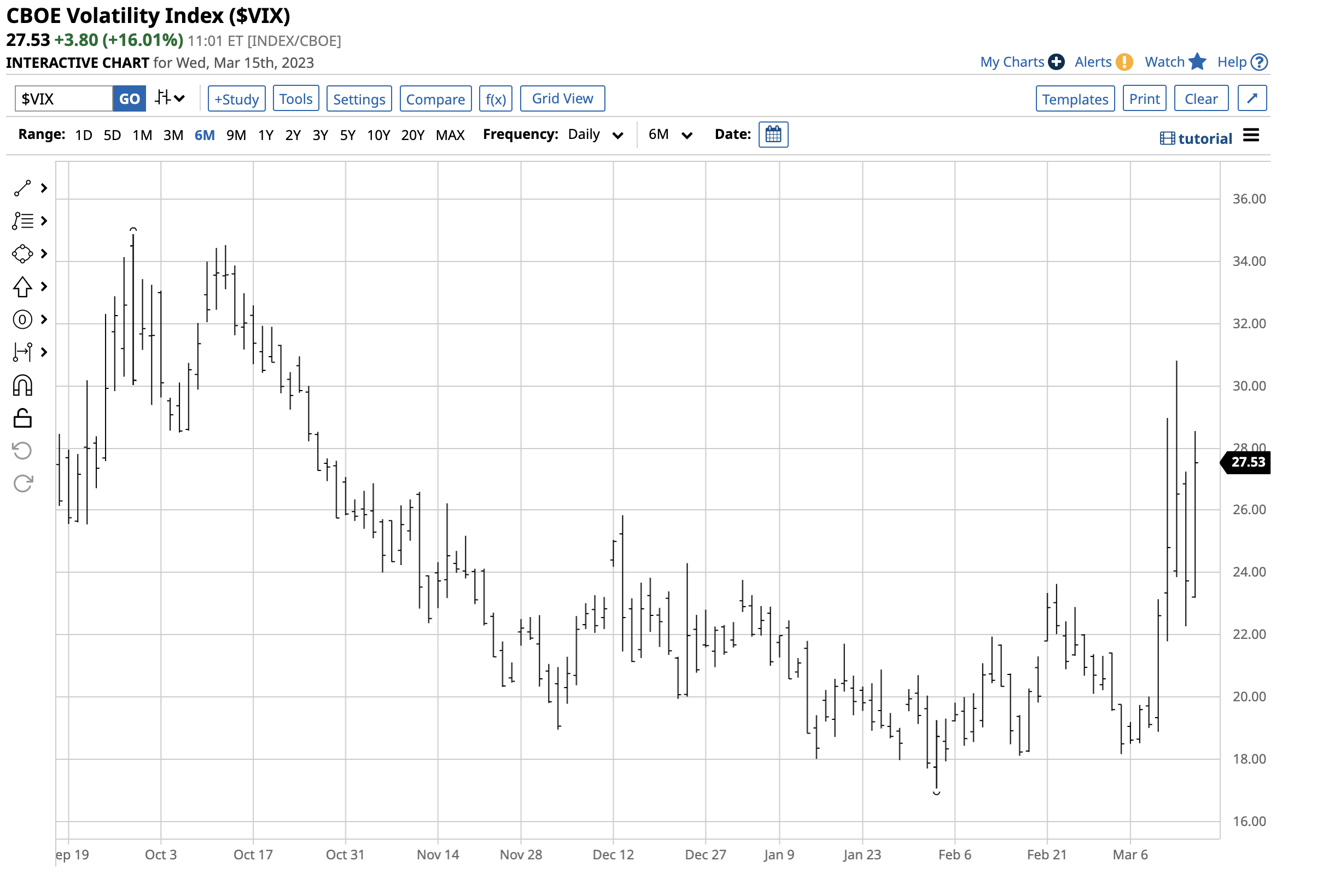
The chart shows The VIX index closed at 21.67 on December 30, 2022. A bounce in the stock market in early 2023 sent the VIX to a 17.06 low on February 2. On March 13, the index rose 30.81 as the impact of rate hikes hit the banking sector like a ton of bricks.
Bank Failures- Regulators, stress tests, and dangers in the small-caps
A run on the bank occurs when depositors rush to withdraw funds simultaneously, and the bank runs out of cash to meet the obligations. SBV was one of the leading U.S. banks with over a $200 billion asset base. Silicon Valley Bank (SIVB) funded many technology and start-up companies over the past years and was a go-to institution for emerging companies in Silicon Valley. SVB failed because it invested cash in U.S. government bonds. While government bonds are a safe investment when held to maturity, rising interest rates make the value fall if liquidated early. SBV and two other institutions experienced withdrawals that forced them to sell the bonds at a loss, and the losses became more than the banks could handle, causing them to collapse.
The regulators and U.S. government have stepped in to guarantee depositors, but the failure has widespread systemic ramifications and highlights that the oversight level and stress-tests failed. The Fed tests banks’ capital requirements for adverse situations. SBV apparently passed the stress tests, but it still failed when there was a run on the bank.
Meanwhile, the other danger is that the leading financial institution supporting and funding emerging companies went belly up, which could weigh on small-cap stocks needing funding for growth. The IWM is the ETF that tracks the small-cap Russell 2000 index.
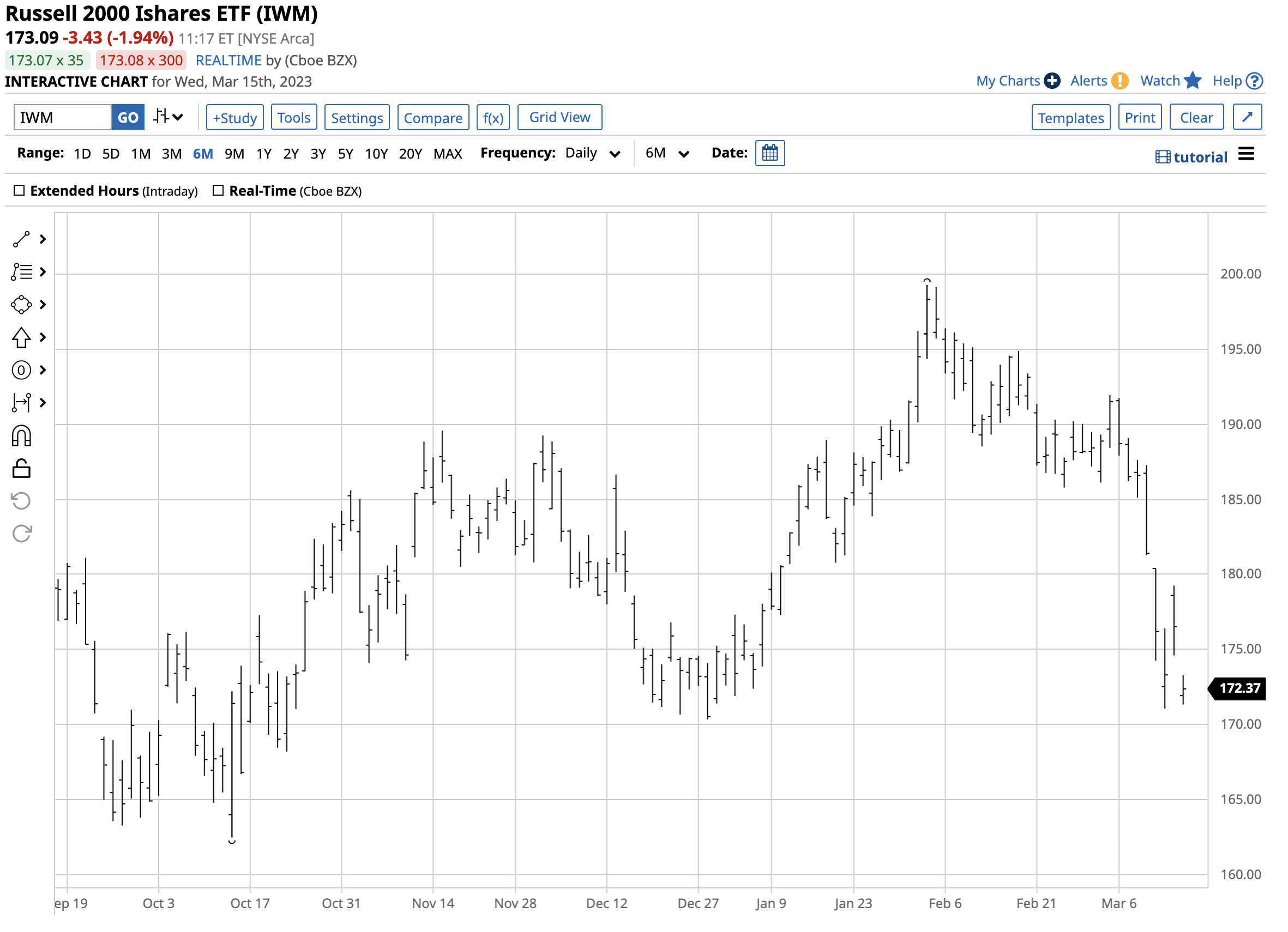
The short-term chart illustrates the 14.1% decline from $199.26 on February 2 to $171.07 on March 13. The Russell 2000 had been signaling danger for weeks before the SVB and other failures.
Systemic risks are dangerous- Raising taxes could add to the selling
Systemic risks are those that threaten the entire financial system or market. Financial failures limited to one individual company or entity that are contained to that entity do not threaten the financial system and do not have systemic risks. However, the banking system is so intertwined that the failure of an over $200 billion financial institution caused panic. Over the weekend of March 11, U.S. regulators and policymakers worked to contain the systemic risks, guaranteeing depositors. The Fed must now incorporate SVB and other failures into account when the FOMC meets to decide if another rate hike is appropriate.
Meanwhile, the U.S. administration’s latest budget included significant tax hikes for the wealthiest taxpayers with incomes over $400,000 per year with increases in corporate taxes. The slim Republican majority in the House of Representatives makes passage doubtful. However, the administration proposed taxes on market value for the wealthy instead of realized profits, which could cause havoc and increase selling in the already weak stock market.
The latest failures required a government and regulatory bailout to protect depositors and payrolls and guard against systemic risks. The stress test system has failed in SVB’s case.
Sell rallies could be the optimal approach
Markets reflect the economic and geopolitical landscapes. While the government and regulatory moves will likely prevent a catastrophic systemic spread of bankruptcies, it is another sign that markets are teetering on the brink. The war in Ukraine, the bifurcation of the world’s nuclear powers, inflation at the highest level in decades, and the recent trajectory of interest rate hikes are a potent cocktail for markets across all asset classes to swallow.
Stocks and bonds may rally in the aftermath of the recent bank failures as the government stepped in, but the path of least resistance of stocks and bonds remains lower. For over a year, any rallies in the leading stock market indices or the bond market have been selling opportunities, and the latest events will likely cause that trend to continue.
The Federal Reserve could pause, and the markets could vacuum higher. Still, the current environment suggests the path of lower highs and lower lows in stocks and bonds will unfortunately continue.
More Stock Market News from Barchart
- Markets Today: Stock Index Futures Sink Amid Fresh Banking Woes
- S&P Futures Plunge Ahead of Key U.S. PPI and Retail Sales Data
- Finding Opportunity in Chaos: 3 Opportunities for Dividend Growth Investors
- Elon Musk Might Not Be Buying Charles Schwab Stock but These People Are
On the date of publication, Andrew Hecht did not have (either directly or indirectly) positions in any of the securities mentioned in this article. All information and data in this article is solely for informational purposes. For more information please view the Barchart Disclosure Policy here.

/AI%20(artificial%20intelligence)/Ai%20chip%20by%20Quality%20Stock%20Arts%20via%20Shutterstock.jpg)

/A%20close-up%20of%20the%20Broadcom%20logo%20on%20a%20smartphone%20by%20Timon%20via%20Adobe%20Stock.jpeg)