
After pushing rates significantly higher with a series of 75 basis point Fed Fund Rate increases in 2022, the FOMC raised the short-term rate by 50 points at the final December 2022 meeting. In early 2023, the 25-basis point increase, pushing rates to 4.625%, was a sign that the trajectory of increases this year will be far lower than in 2022. Meanwhile, with the consumer and producer price indices above the current rate level, the Fed has told markets, “Ongoing increases are appropriate.”
The Fed has stated its goal is to push inflation to its 2% target rate. In a January 19 Barchart article, I wrote, “While the Federal Reserve significantly impact demand-side inflationary pressures, the worldwide economy’s supply side is above the central bank’s pay grade. Political changes can only address the geopolitical tensions creating price dislocations in the raw material markets.” The supply issues are a function of the geopolitical problems that will continue and could increase in 2023.
If the Fed has etched the 2% inflation target in stone, further interest rate hikes are on the horizon, and the fallout could be ugly for markets across all asset classes.
The Fed was not the only central bank that hiked rates in early February
On February 1, 2023, the Federal Open Market Committee of the U.S. central bank unanimously increased the short-term Fed Funds by one-quarter of one percent. The committee said monetary policy would remain “sufficiently restrictive” but acknowledged that inflationary pressures had eased while remaining elevated. The most significant change in the central bank’s statement was the shift to the “extent” of future interest rate increases from the “pace” of hikes in the language from previous meetings.
The U.S. Fed is not alone in its inflation battle. On February 2, the Bank of England and the European Central Bank increased interest rates by 50 basis points.
Energy and food prices remain high and could move higher
The war in Ukraine continues to rage in February 2023, which has put upside pressure on food and energy prices, critical factors boosting inflationary conditions. Ukraine and Russia are Europe’s breadbasket as they produce and export many agricultural products that feed the world. Russia is the third-leading wheat producer, and Ukraine is eighth. Ukraine is the sixth top corn producer, and Russia is the tenth. Critical growing regions in Russia and Ukraine have become battlefields, and the Black Sea Ports, a crucial logistical hub, is a war zone. Grain balance sheets have tightened over the past years, putting upward pressure on prices, and the war has only exacerbated the fundamental tightness.
Russia is the most influential non-member of OPEC, the international oil cartel. Over the past years, Russia has cooperated with the cartel, and production policy has been a function of decisions in Riyadh, Saudi Arabia, and Moscow. Moreover, Russia supplies the lion’s share of natural gas to Western Europe via the pipeline network. Russia has punished “unfriendly” countries supporting Ukraine using oil and gas as an economic weapon.
The upward pressure on food and energy commodities has been a function of supply-side factors. The Fed and other central banks’ monetary policies can influence regional and global economies’ demand side, but supply-side issues are geopolitical and beyond the central bank’s monetary policy reach.
The bearish trend in bonds continues
Since March 2020, the bond market has been in a bearish trend.

The chart of the 30-Year U.S. Government Treasury Bond futures shows the bearish pattern of lower highs and lower lows that took the long bond futures to a 117-19 low in October 2022, the lowest level since February 2011. While the bonds recovered to over 127, the bearish pattern remained intact on February 13.
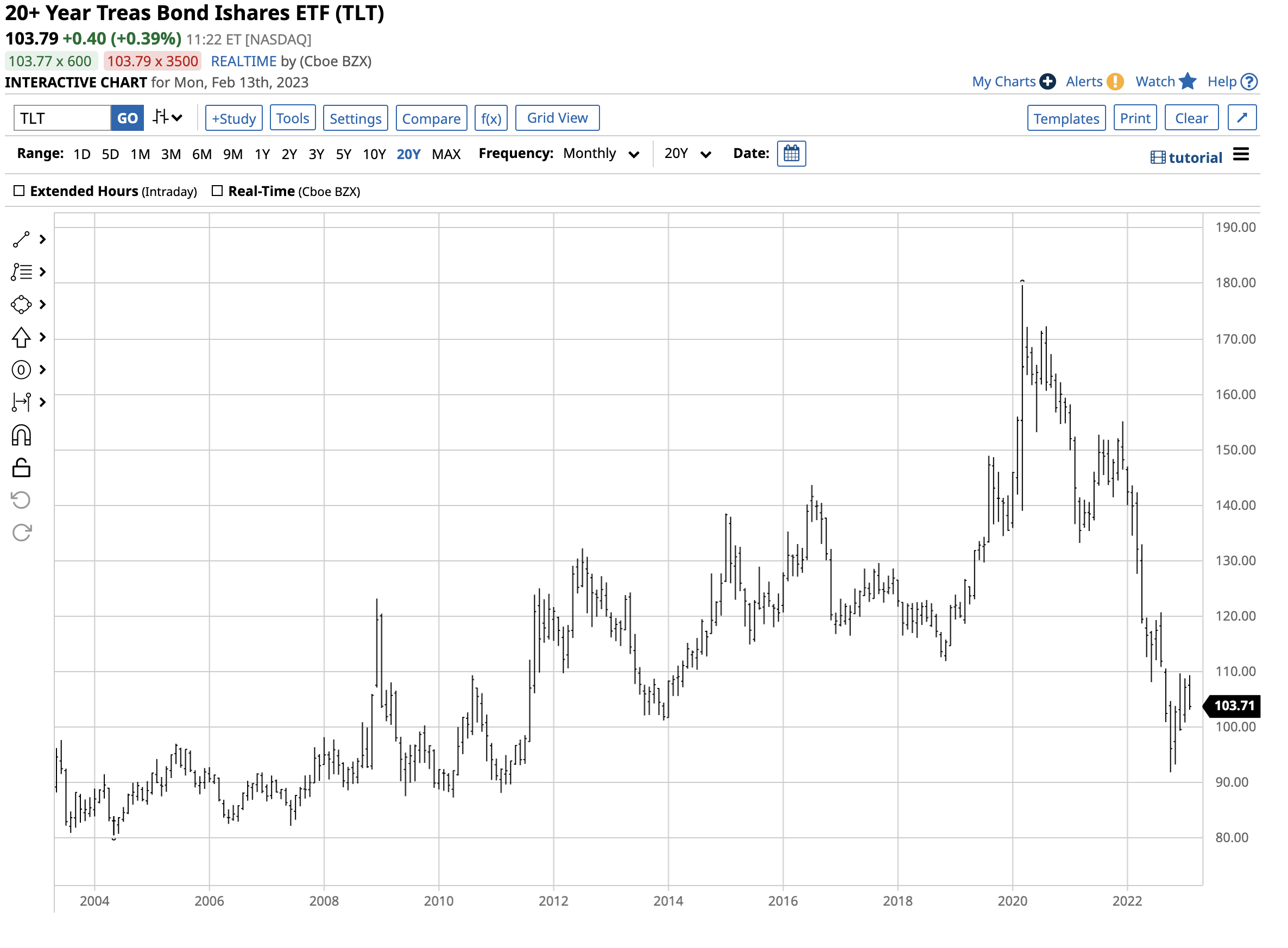
The chart shows the highly liquid iShares 20+ Year Treasury Bond ETF product (TLT) displays the same bearish pattern as the long bond futures.
While bear markets rarely move in straight lines, the path of least resistance in bonds has been lower, and interest rates have been rising along the yield curve.
Quantitative tightening keeps the upside pressure on rates
While the U.S. Fed has increased short-term rates consistently since March 2022, it has also been reducing its swollen balance sheet, that increased during the central bank’s quantitative easing program. The Fed bought public and private debt securities and mortgages during the global pandemic to stimulate economic growth.
When the Fed shifted from a dovish to a hawkish monetary policy path, it instituted the current quantitative tightening program, not so gradually reducing its balance sheet by $95 billion monthly. QT has put downside pressure on the bond market and upward pressure on interest rates along the yield curve.
Is the inflation miscalculation leading to another central bank error?
Many economists agree the U.S. central bank erred by waiting too long to address rising inflationary pressures. The dovish period lasted from March 2020 through March 2022, even though the inflationary pressures showed up in the data in late 2020 and throughout 2021. The Fed abandoned the “transitory- supply chain” excuse, realizing inflation became a structural economic problem. While the central bank has not overtly accepted its role in igniting inflation, they have addressed it via tight monetary policies. However, the trajectory of rate hikes that choke economic growth could lead to recessionary pressures alongside persistent inflation caused by geopolitical issues. The Fed and other central banks are in a precarious position as the treatment for inflation could lead to economic contraction, while geopolitics bring other variables into play.
The U.S. stock market fell in 2022 as the Fed pushed rates higher. The leading indices are slightly higher in 2023 than December 31, 2022, closing levels, but they are not running away on the upside. Stocks rose on hopes that the Fed will curb its enthusiasm for higher interest rates later this year. Meanwhile, the long bond futures are slightly higher than the 2022 closing level on February 13. Commodity prices are steady, with some sectors higher and others marginally lower than at the end of last year. Cryptocurrencies have rallied while real estate prices remain under pressure. Some of the weaknesses in raw material markets could be seasonal, as construction and energy demand tend to increase when winter ends. Moreover, China’s economic weakness on the back of COVID-19 lockdowns could end. Still, frictions between Washington and Beijing remain a clear and present danger because of China’s “no-limits” alliance with Russia and other factors.
The bottom line is that markets face lots of uncertainty in February 2022, and hawkish central bank monetary policy is only one variable that will determine the path of least resistance of markets across all asset classes. Over the coming days and weeks, the uncertainty will likely cause prices to move higher and lower with the daily news cycle until definitive fundamental trends emerge.
When investing or trading, approach risk positions in markets with a clear and defined risk-reward plan.
The Fed’s monetary policy path and the central banks that follow the U.S. is only one factor that will determine future market action.
More Stock Market News from Barchart
- Stocks Push Higher on U.S Inflation Optimism
- Markets Today: Stock Indexes Climb on Hopes U.S. CPI Will Continue to Moderate
- As AT&T May Not Hike Its Dividend, Covered Calls Are Becoming Popular
- Option Volatility And Earnings Report For Feb 13 - 17
On the date of publication, Andrew Hecht did not have (either directly or indirectly) positions in any of the securities mentioned in this article. All information and data in this article is solely for informational purposes. For more information please view the Barchart Disclosure Policy here.


/AI%20(artificial%20intelligence)/Ai%20chip%20by%20Quality%20Stock%20Arts%20via%20Shutterstock.jpg)

/A%20close-up%20of%20the%20Broadcom%20logo%20on%20a%20smartphone%20by%20Timon%20via%20Adobe%20Stock.jpeg)