



In a January 25, 2023, Barchart article, I wrote, “After a significant price correction from the February 2022 high, the impact of climate change on the critical growing regions for Arabica and Robusta beans and inflation that has increased production costs could cause the soft commodity to recover over the coming weeks and months.” On January 25, nearby ICE coffee futures were at the $1.6185 per pound level, with the nearby Robusta coffee futures at $1.955 per pound. Since then, prices increased, and the short-term trends have turned bullish after significant corrections from the 2022 highs.
The iPath Series B Coffee Subindex TR ETN product (JO) tracks the ICE Arabica coffee futures price higher and lower.
Coffee futures have turned higher over the past weeks
After trading at $2.6045 in February 2022, nearby Arabica coffee futures made lower highs and lower lows on the way to a $1.4205 bottom during the week of January 9, 2023.
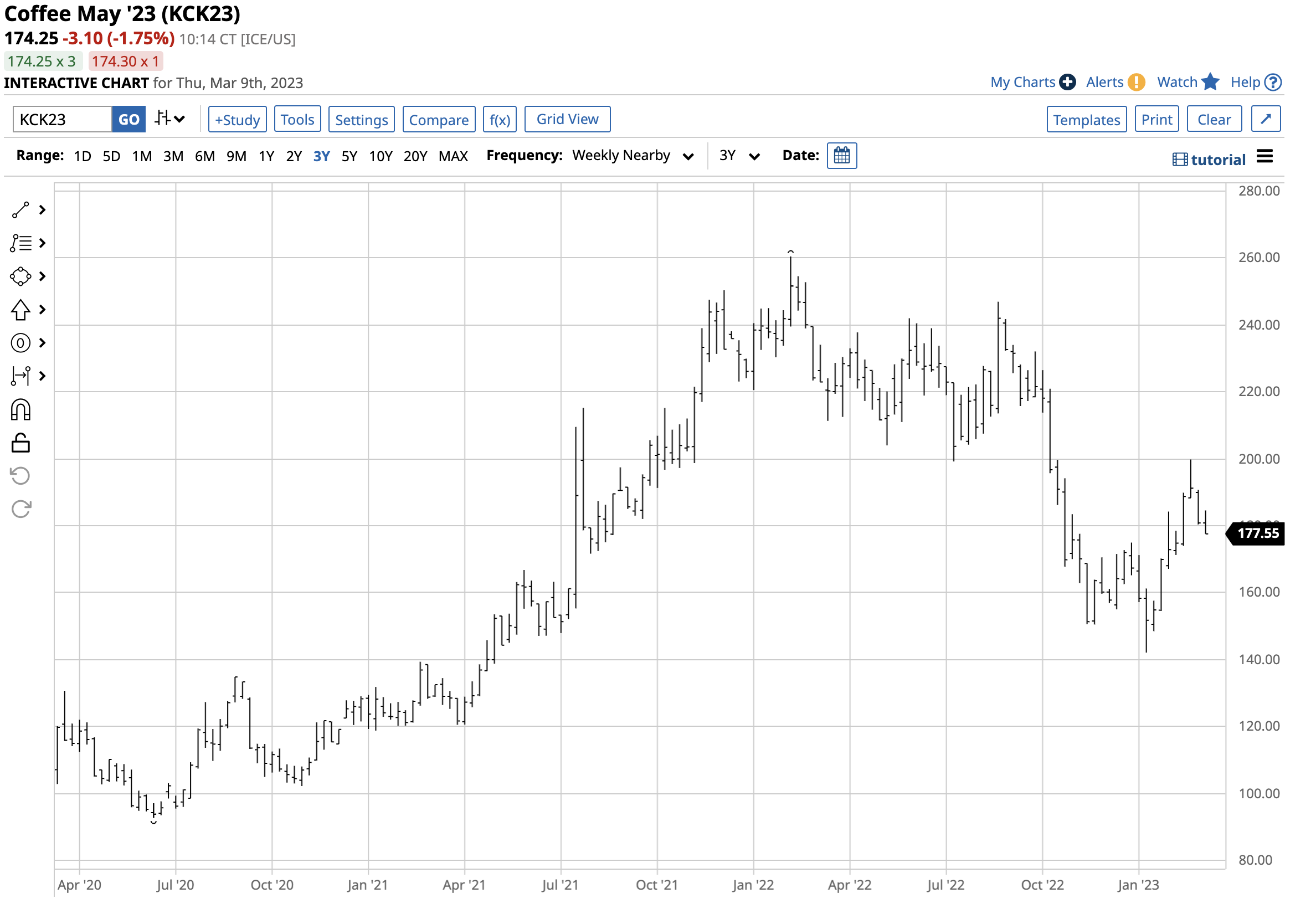
The weekly chart highlights the bounce in the coffee futures market that took the price over the $1.75 level in early March 2023.

Meanwhile, European Robusta futures reached highs and lower earlier. The nearby contract peaked at $2,499 per ton in December 2021 and fell to a low of $1,802 in late November 2022. At over the $2,150 level on March 9, Robust futures recovered. As of March 9, the short-term Robusta and Arabica futures were mostly bullish.
Inflation is causing higher production costs
The International Coffee Organization, the leading intergovernmental organization for coffee, expects stable coffee prices despite a decline in global exports.
Meanwhile, coffee is an agricultural product facing the same inflationary pressures as other commodities. The highest energy, labor, and additional input costs in decades continue to put upward pressure on Arabica and Robusta bean prices.
While the strongest U.S. dollar index in two decades is a bearish factor, input costs have more than compensated for the currency factors. They have caused coffee prices to stabilize after falling to bottoms in late 2022 and early 2023.
Brazil leads in production- Political change could increase production costs
Brazil and Vietnam are the leading coffee-producing countries.

Source: Elevencoffees.com
The chart shows that Brazil produced nearly twice the quantity of coffee beans in 2022, and Brazil and Vietnam’s output far outpaced the third through eleventh-producing countries. While Brazil produces the most Arabica beans, Vietnam is the top Robusta producer, as over 90% of the coffee beans from Vietnam are of the Robusta variety.
The weather, crop diseases, and currency exchange rates between the U.S. dollar and the Brazilian real/Vietnamese dong are critical factors for the path of least resistance of coffee prices. While Arabica and Robusta beans retreated from the 2022 highs, the futures market remains in long-term bullish trends after the recent recoveries.
Levels to watch in the coffee futures arena
ICE Arabica coffee beans held the $1.40 per pound level and bounced.

At over $1.74 per pound on May 9, the ICE Arabica futures were at the midpoint of the April 2019 86.35 cents low and the February 2022 $2.6045 high.

At $2,164 per ton on March 9, ICE Robusta futures were also above the median from the April 2020 $1,073 low and the December 2021 $2,499 high. Arabica’s $1.7340 and Robusta’s $1,786 midpoints are critical pivot points for the soft commodity. Resistance is at the late 2021 and early 2022 highs, with support around the midpoint levels.
JO is the Arabica coffee ETN product
The most direct route for a risk position in the volatile coffee futures market is via the ICE futures and related options trading on the U.S. and European exchanges. Meanwhile, in the U.S., the iPath Series B Coffee Subindex TR ETN product (JO) provides an alternative for market participants seeking exposure to Arabica prices without venturing into the leveraged and margined futures arena.
At $50.51 per share on March 9, JO had $126.786 million in assets. JO trades an average of 25,207 shares daily and charges a 0.45% management fee. Nearby ICE Arabica coffee futures rose from $1.4205 in January 2023 to $1.7415 on March 9, or 22.6%.
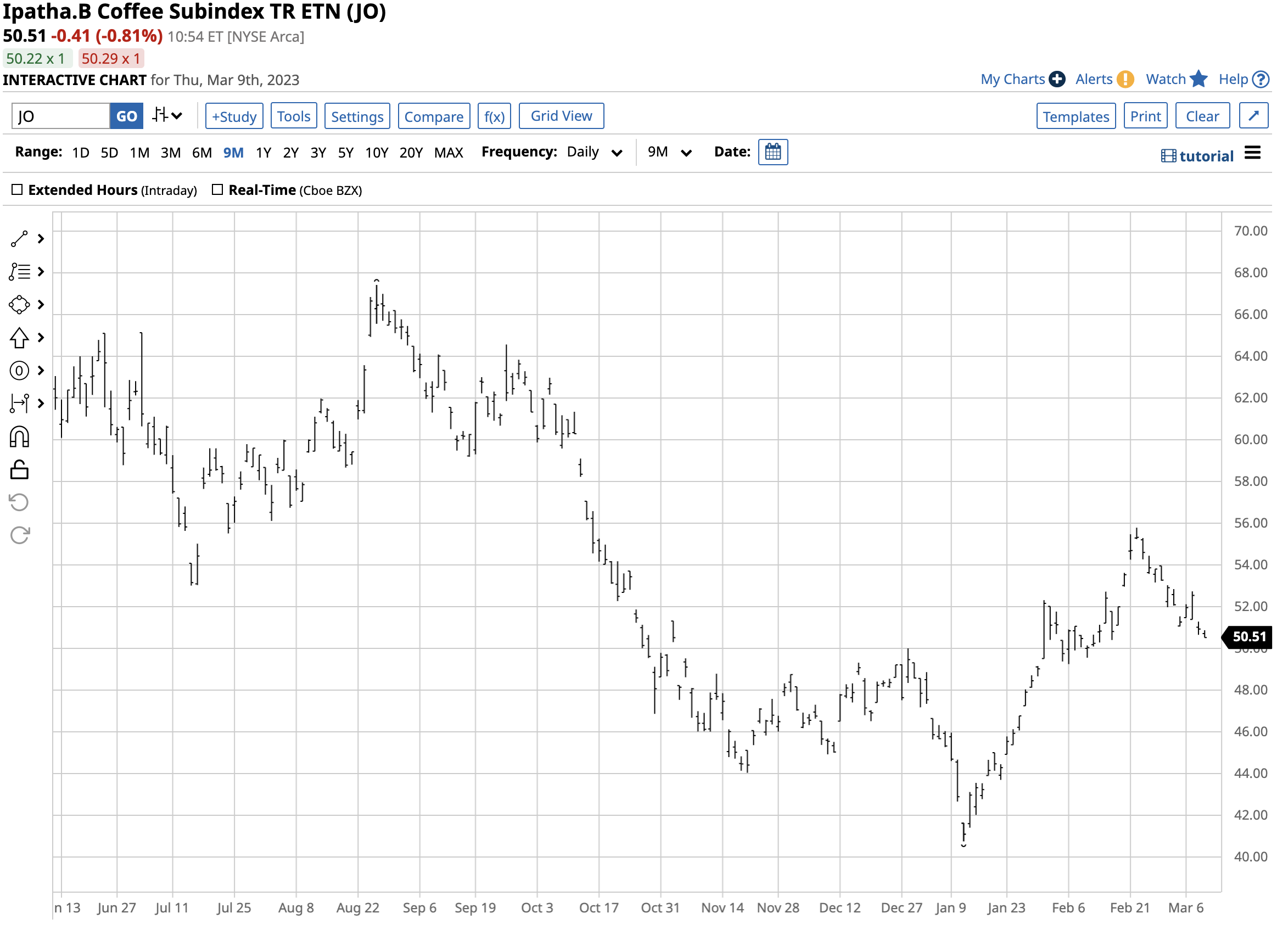
Over the same period, JO rose from $40.75 to $50.51 per share or 24%, as the ETN did an excellent job tracking the Arabica futures.
We could see a stable coffee market over the coming months, but surprises are likely to come on the upside, given inflation is at the highest level in decades. Buying coffee on price weakness could be the optimal approach to the soft commodity in 2023.
More Softs News from Barchart
- Cotton Gaining for Thursday
- Red Day for Cotton Futures
- Arabica Closes Lower on Dollar Strength and Robust Central American Coffee Exports
- Sugar Prices Fall Back on the Outlook for Stronger Brazil Sugar Output
On the date of publication, Andrew Hecht did not have (either directly or indirectly) positions in any of the securities mentioned in this article. All information and data in this article is solely for informational purposes. For more information please view the Barchart Disclosure Policy here.


/A%20corporate%20sign%20for%20SK%20Hynix%20by%20Tada%20Images%20via%20Adobe%20Stock.jpeg)

/2d%20illustration%20of%20Cloud%20computing%20by%20Blackboard%20via%20Shutterstock.jpg)
/Server%20racks%20by%20dotshock%20via%20Shutterstock.jpg)