Yesterday, I wrote that the relief rally was likely to reverse as the relief itself was an illusion. And it seems that most markets are already realizing that.
Gold is down 0.29%. Silver is down 1.45%. Bitcoin is down 1.60%. Copper is down 0.61%. The dollar is up 0.23% and firming through the session. WTI crude is up 2.34%. Brent crude is up 3.03%, outpacing WTI by nearly 70 basis points.
This is yet another channel confirmation.
Technically, the situation didn’t change much since yesterday.
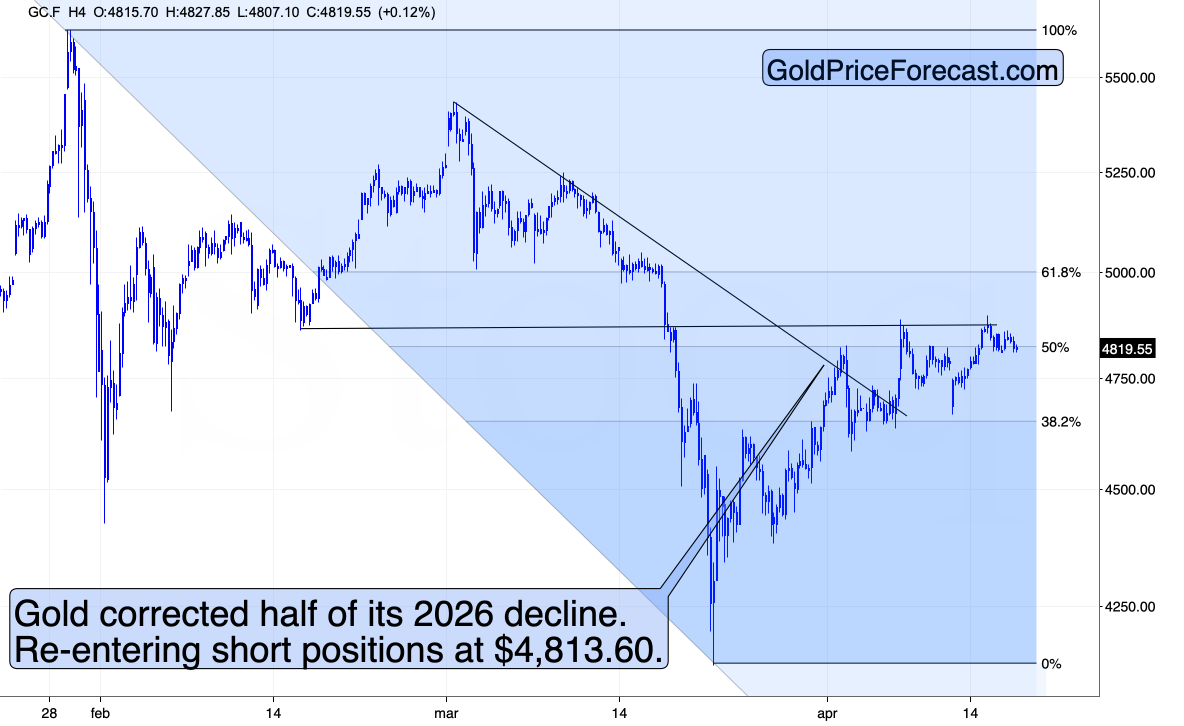
Gold moved a bit below its 50% Fibonacci retracement after touching its mid-Feb low.
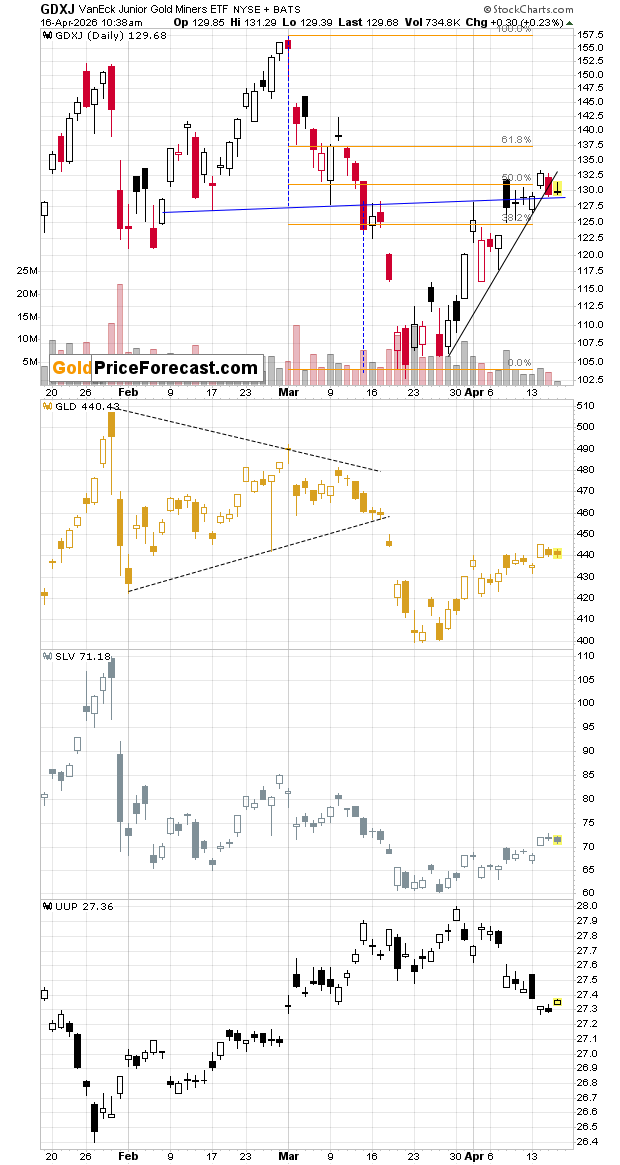
Mining stocks broke below their rising support line yesterday, which means that we saw a breakdown.
Earlier today, the GDXJ moved back to the previously broken support line and then declined after verifying it as resistance. It looks like miners are preparing for a move lower and that we won’t have to wait for that for much longer.
The final confirmation will come from the market that’s currently experiencing “peak delusion”.
The stock market.
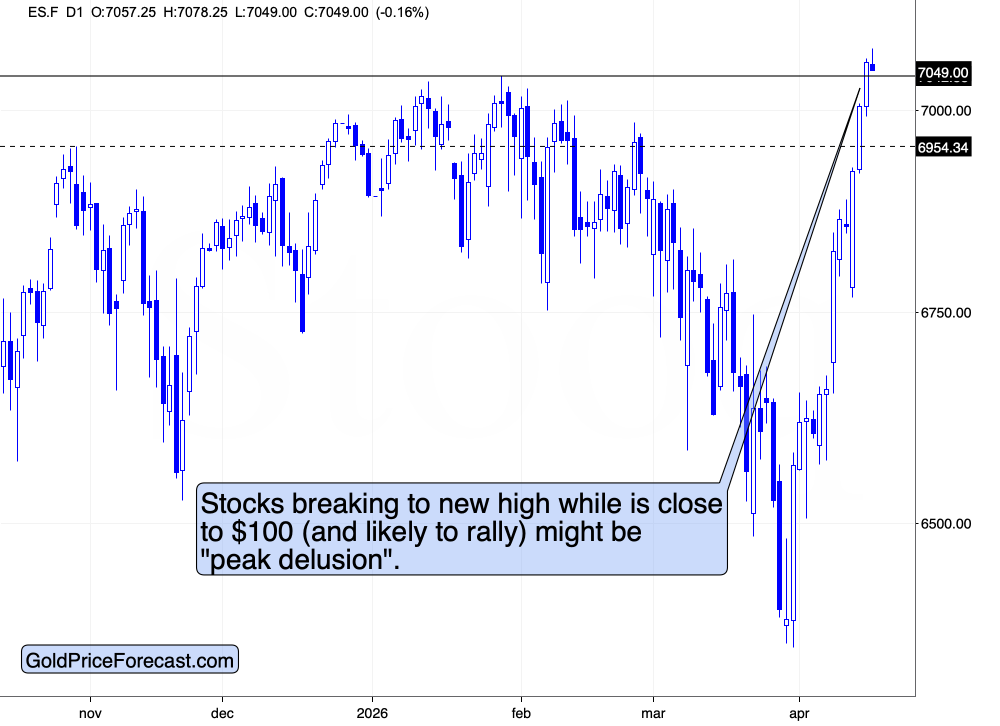
Amid serious – and possibly long-term – oil disruption and despite accelerating AI job displacement, stocks moved to new highs.
Markets can be emotional and irrational in the short run, but investors are likely to realize what’s going on sooner rather than later. And when that happens, we’ll see an invalidation of the breakout, which will serve as a powerful sell signal with ripples reaching all other markets.
Operation Economic Fury
The news flow explains the price action. Yesterday afternoon at the White House, Treasury Secretary Scott Bessent formally named the escalation: Operation Economic Fury. He called it "the financial equivalent" of a bombing campaign.
The substance behind the name is significant. Bessent announced the US would apply secondary sanctions on countries buying Iranian oil or holding Iranian money in their banks. He specified that two Chinese banks have already received letters from Treasury. Before the blockade, China bought more than 80% of Iran's shipped oil. Bessent predicted "a pause of Chinese buying."
Treasury also sanctioned a new network: three people, 17 entities, and nine oil tankers connected to Mohammad Hossein Shamkhani, the 41-year-old son of Ali Shamkhani (the senior Iranian security official killed on February 28). His Dubai-based company, Milavous Group, was allegedly generating billions in revenue by shipping Iranian and Russian crude globally. That network is now frozen.
One detail stood out for anyone following the gold market: Treasury also targeted what they called a "Hezbollah Gold Scheme Benefitting Iran's Military." Physical gold has become a sanctions-evasion rail in the Middle East. The US is now cracking down on it. For gold investors, this cuts two ways. It reduces illicit supply channels (mildly supportive of retail demand), and it confirms that gold is being weaponized as a non-dollar payment mechanism by sanctioned actors.
Meanwhile, the Pentagon deployed the first physical intercept of the blockade. CENTCOM announced that USS Spruance (DDG 111), a guided-missile destroyer, "successfully redirected" an Iranian cargo vessel that tried to evade the blockade after leaving Bandar Abbas. The blockade is no longer just warning letters and Truth Social posts. It's kinetic.
The Washington Post reported that the Pentagon is deploying 6,000 more troops to the region in the coming days, with another 4,200 by end of month. That's 10,200 additional personnel going into a theater the President describes as "close to over."
Words Get Softer, Sanctions Get Harder
The gap between rhetoric and reality widened again today, and the table I featured yesterday needs an update.
Trump told Fox Business the war is "close to over." Hours later, Bessent launched Operation Economic Fury. The AP reported an "in principle agreement" to extend the ceasefire. A senior US official told CNBC the US "has not formally agreed." Leavitt at the White House denied the US had "formally requested" an extension. Same day, different messages.
Iran's response continued to reject the capitulation narrative. Parliament Speaker Ghalibaf (the lead negotiator in Islamabad) tweeted: "Resistance and Iran are one soul, both in war and in ceasefire." He added that "the completion and consolidation of a comprehensive ceasefire in Lebanon will be the result of the resistance and steadfast struggle" of Hezbollah. Lebanon remains a precondition from Iran's side.
Israel continues to reject Lebanon being part of any ceasefire. Netanyahu confirmed Wednesday that Israel is continuing strikes on Hezbollah. The security cabinet met to discuss a possible ceasefire, but as of today, no agreement exists.
Trump announced in a late-night Truth Social post that the leaders of Israel and Lebanon would speak "for the first time in 34 years." Neither side publicly confirmed. The pattern is familiar.
Brent Leads WTI: The Supply Premium is Rising
Brent crude is up 3.03% today. WTI is up 2.34%. Brent is outperforming WTI by nearly 70 basis points.
That spread matters analytically. Brent is the global oil benchmark, priced off Middle East and European supply. WTI is the US benchmark, priced off Cushing, Oklahoma. When Brent outperforms WTI meaningfully in a single session, the market is pricing a specific geopolitical risk, not a general demand story.
This is the market adding a Middle East supply premium on top of the existing baseline. Operation Economic Fury, the USS Spruance intercept, and the 10,200 troop deployment are all being read as escalation signals. Each one narrows the probability of a quick resolution to the Strait closure. The Brent-WTI spread widening is the cleanest expression of that repricing.
For the gold thesis, this reinforces the channel rather than contradicting it. Higher Brent means higher European inflation, higher jet fuel costs globally, higher shipping costs, and sustained supply-side inflation that the Fed cannot address with rate cuts. The stagflationary trap tightens.
What's Different Today
The past week has produced a steady stream of Trump "close to over" comments, each triggering a brief relief rally. Today's session is the first one where the market stopped reacting to the rhetoric and started reacting to the reality. Bessent's Operation Economic Fury announcement, the USS Spruance intercept, and the troop deployment numbers overwhelmed the "second round of talks" headlines.
This matters for what comes next. If the market is beginning to price reality over rhetoric, the next "close to over" comment will produce a smaller bounce, and the channel reassertion will come faster. We're watching the transition from rhetoric-driven volatility to structural trend.
The ceasefire expires next Wednesday, April 22. Between now and then, expect one of two scenarios. Either talks formally restart in Islamabad with enough progress to extend the ceasefire (low-probability base case for a durable deal, high-probability for a temporary extension that kicks the can), or talks fail and the structural reality asserts itself fully. Either way, the oil/inflation/USD channel holds.
The test I outlined on Tuesday remains: if oil falls for three or more consecutive sessions and Strait traffic increases meaningfully, the channel is breaking. As of today, oil is up, not down. The channel holds. Mining stocks, meanwhile, may have just hit a turning point: the triangle-vertex-based reversal I had flagged for subscribers played out on Tuesday, and silver's move to its 38.2% Fibonacci retracement and reversal below $80 added confirmation.
Thank you for reading today's article – the free version of today's Gold Trading Alert. Subscribers receive the full analysis with charts, technical levels, and trading positions daily. Gold Trading Alerts are available directly and through the Diamond Package.
If you're not ready to subscribe yet, I encourage you to sign up for my free gold newsletter today.
Thank you.
Sincerely,
Przemyslaw K. Radomski, CFA

/Advanced%20Micro%20Devices%20Inc_%20office%20sign-by%20Poetra_RH%20via%20Shutterstock.jpg)

/CPU%20Chip.jpg)