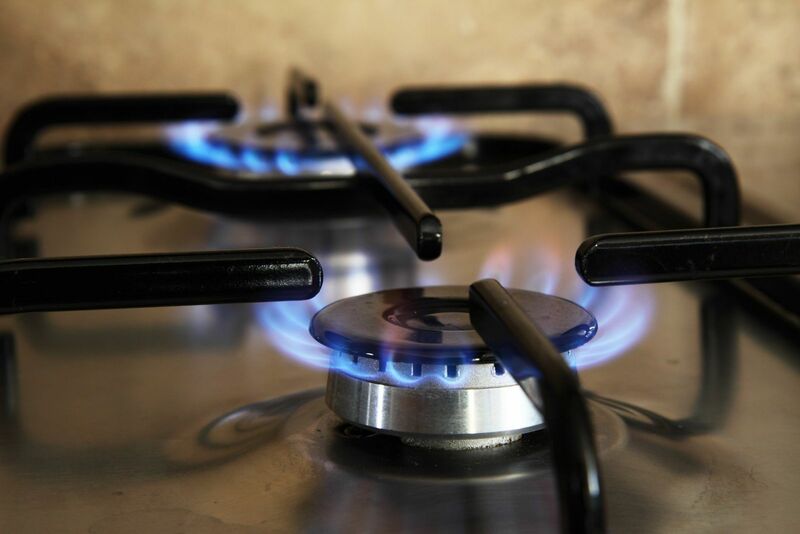
In June 2020, nearby NYMEX natural gas futures fell to a quarter-of-a-century low of $1.44 per MMBtu. In 2022, the range from high to low has been an incredible $6.39 per MMBtu, over 4.4 times the price level at the 2020 twenty-five-year low, which turned out to be a significant bottom for the energy commodity.
The peak demand season for natural gas runs from November through March, when inventories decline because heating demand rises. We are now in the heart of the winter in a year where international natural gas prices are significantly impacting U.S. prices of around $5.40 per MMBtu on December 20 after rising to over $10 earlier this year. The U.S. Natural Gas Fund (UNG) is the ETF product that attempts to track the wild bucking bronco.
Natural gas is an international commodity these days
Natural gas trading on the CME’s NYMEX division began trading in 1990. At that time, the flow of U.S. natural gas was limited to the North American pipeline network. The natural gas market has matured over the past decades. Massive discoveries of the energy commodity in the Marcellus and Utica Shale regions have increased reserves. Fracking resulted in lower production costs and efficiencies, causing supplies to rise. Since necessity is the mother of invention, processing gas into liquid for transport beyond the pipeline network increased demand. Today, U.S. natural gas travels worldwide on ocean vessels to countries with significantly higher prices. The bottom line is natural gas went from a U.S. domestic to an international marketplace, and the U.S. is one of the world’s leading producers.
The war in Ukraine pushed U.K. and Dutch prices to all-time highs
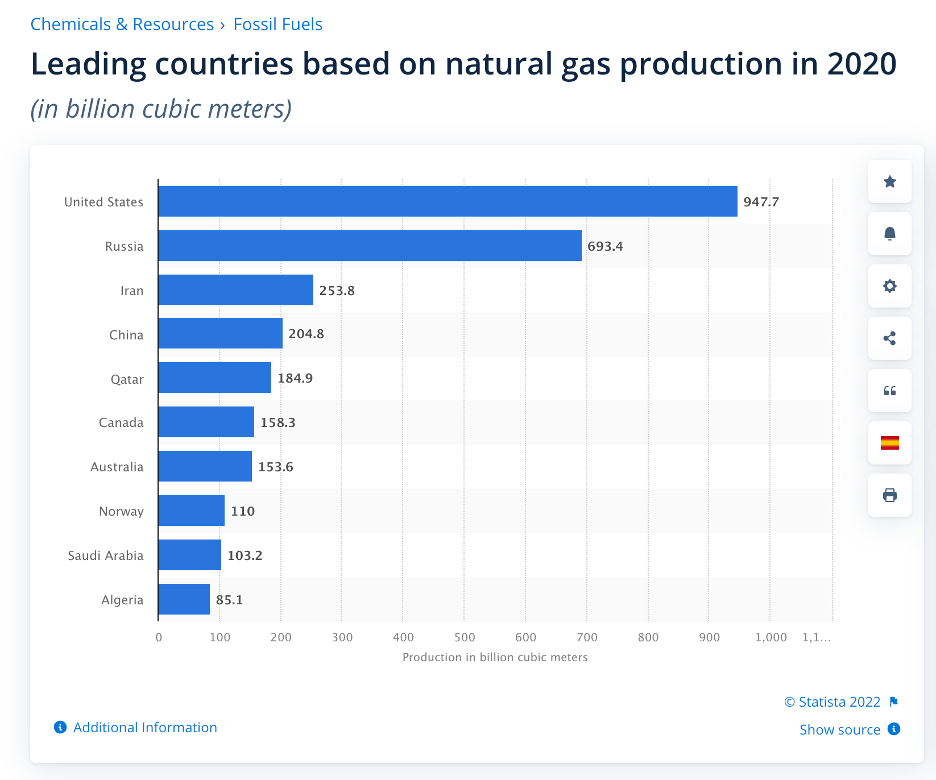
While the U.S. leads the world in natural gas output, Russia is the second-leading producer.
Source: Statista
Europe is highly dependent on Russian natural gas pipeline supplies. In 2022, the war in Ukraine, sanctions on Russia, and Russian retaliation have put natural gas in the crosshairs of the geopolitical landscape. Russia has limited, or in some cases, cut off natural gas supplies to “unfriendly” European countries and NATO members who support Ukraine.
The war pushed European prices to record peaks as supply concerns filled the natural gas market.
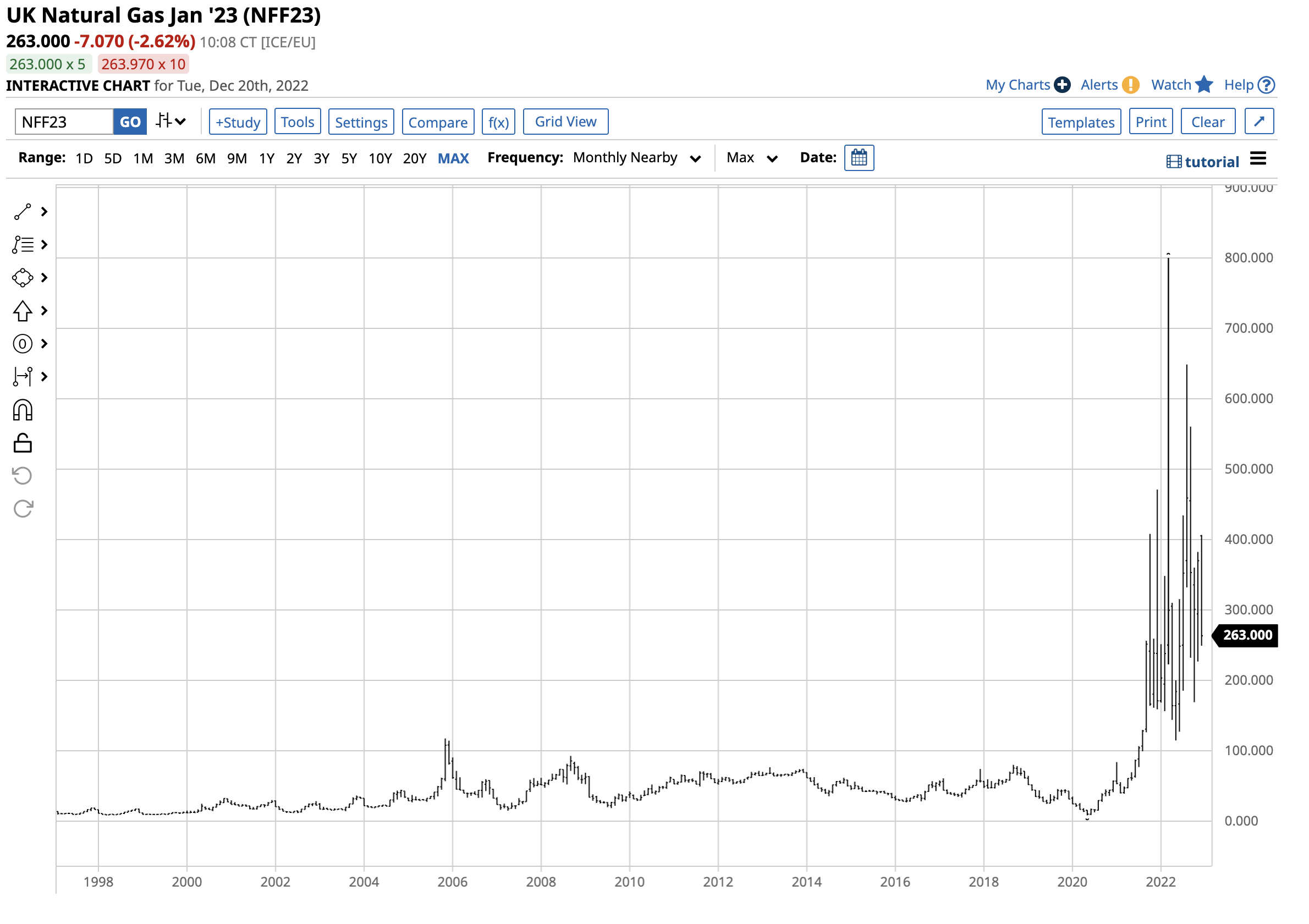
The chart shows U.K. natural gas futures exploded to a record high in March 2022. At just below the 265 level on December 20, U.K. natural gas remains significantly above the pre-2021 117 high.
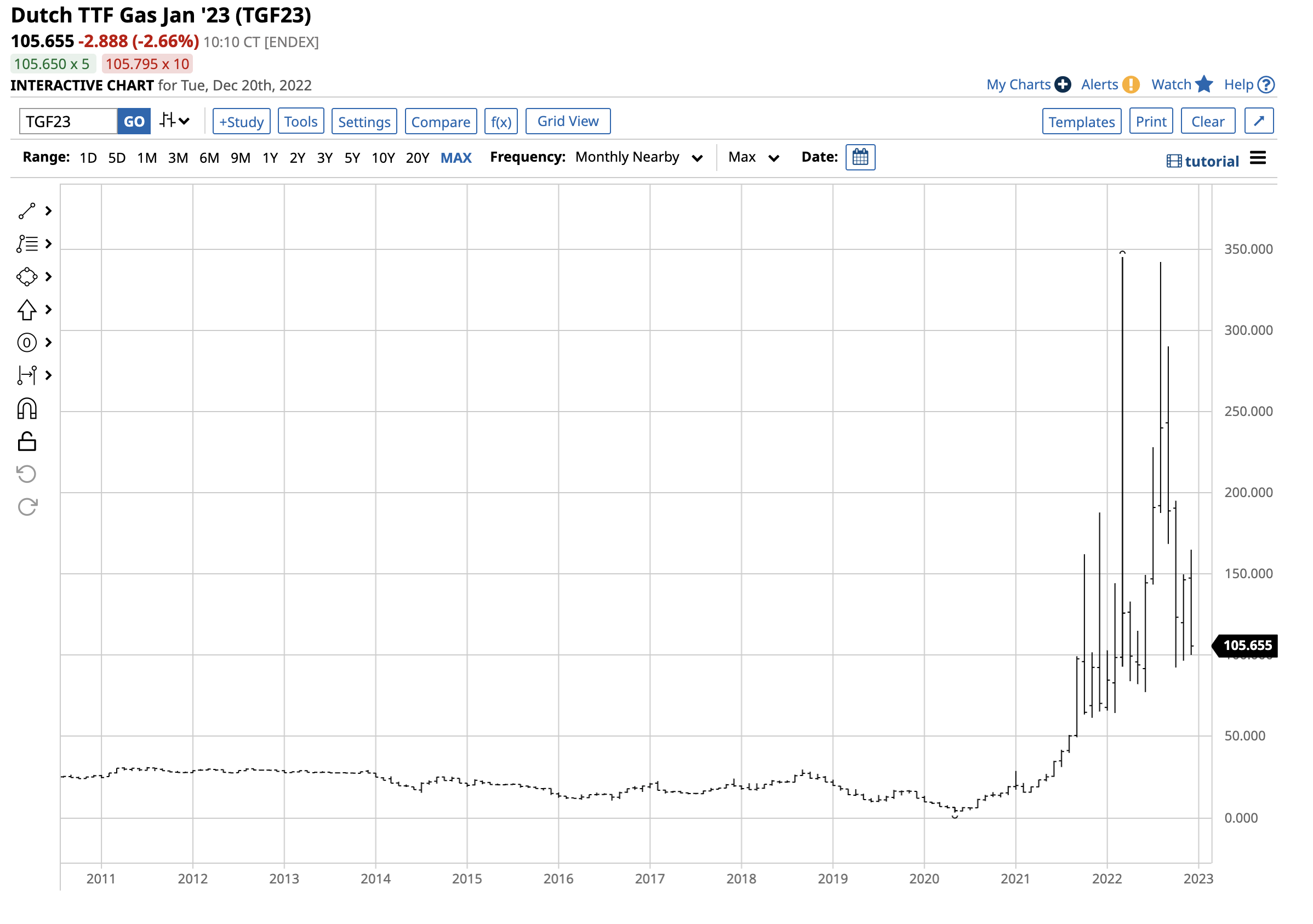
In the Netherlands, the natural gas price rose to a record peak in March 2022. At over the 105 level on December 20, natural gas remains at a record high compared to pre-2021 prices.
A multi-year high for U.S. benchmark prices
Since U.S. natural gas is a far more international commodity, with LNG traveling the world on ocean vessels, European prices have put upward pressure on NYMEX natural gas futures prices over the past months.

The long-term chart of U.S. NYMEX natural gas futures for delivery at the Henry Hub in Erath, Louisiana, shows that after making lower highs and lower lows from 2005 through 2020, natural gas broke out to the upside in late 2021 and followed through in 2022. While U.K. and Dutch prices reached all-time highs this year, U.S. prices rose to the highest level since 2008 when they probed above the $10 per MMBtu level in August 2022, a fourteen-year high.
U.S. energy policy does not support domestic production
The drill-baby-drill and frack-baby-frack days of the previous U.S. administration ended in early 2021. The Biden administration is addressing climate change by supporting the production of alternative and renewable fuels and inhibiting fossil fuel output. The U.S. output level in late 2022 can fulfill U.S. demand requirements, but exports to European consumers impacted by Russian retaliation are another issue. We are at the beginning of the peak season of natural gas demand during the winter.
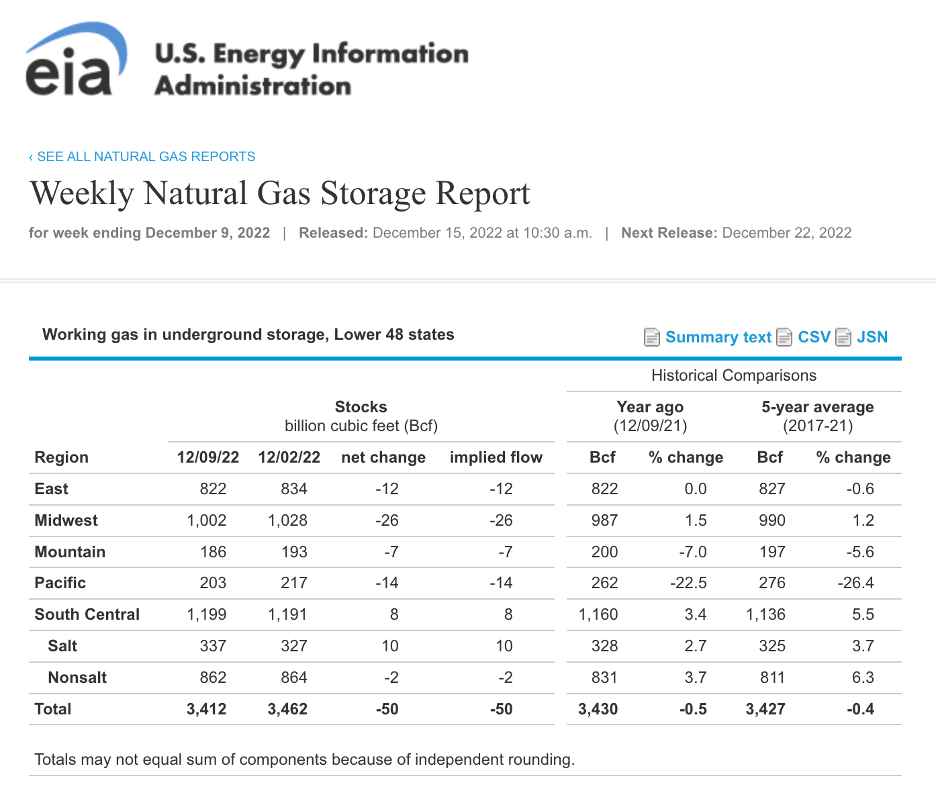
Source: EIA
The chart shows that at 3.412 trillion cubic feet in storage across the U.S., natural gas inventories were 0.5% below last year’s level and 0.4% under the five-year average for the week ending on December 9, 2022. While the stockpiles are stable for U.S. consumers, the global demand landscape has dramatically changed for the 2022/2023 winter, with European prices at record highs and availability at low levels.
In the current environment, the U.S. stocks do not support increased LNG exports to meet the robust European demand.
UNG follows NYMEX prices- Expect more implosive and explosive moves
We have seen wild price swings in the nearby NYMEX natural gas futures market in 2022, with the price trading from a low of $3.638 to a high of $10.028 per MMBtu. At the $5.40 level on December 20, the price was below the $6.833 midpoint.
The most direct route for a risk position in U.S. natural gas is via the futures and futures options trading on the CME’s NYMEX division. The U.S. Natural Gas Fund (UNG) provides an alternative for those seeking natural gas exposure without venturing into the highly volatile and leveraged natural gas futures arena. At around $16.86 per share on December 20, UNG had over $483.8 million in assets under management. The liquid ETF trades an average of nearly 7.5 million shares daily and charges a 1.11% management fee.
The most recent rally in January NYMEX natural gas futures took the price from $5.337 on December 6 to $7.105 per MMBtu on December 13, a 33.1% rise.

Over the same period, UNG rose from $16.30 to $21.67 per share or 32.9%, as the ETF did an excellent job tracking the NYMEX futures. However, UNG is only appropriate for short-term risk positions as the natural gas basis or the price difference between delivery months causes price distortions in the ETF over time.
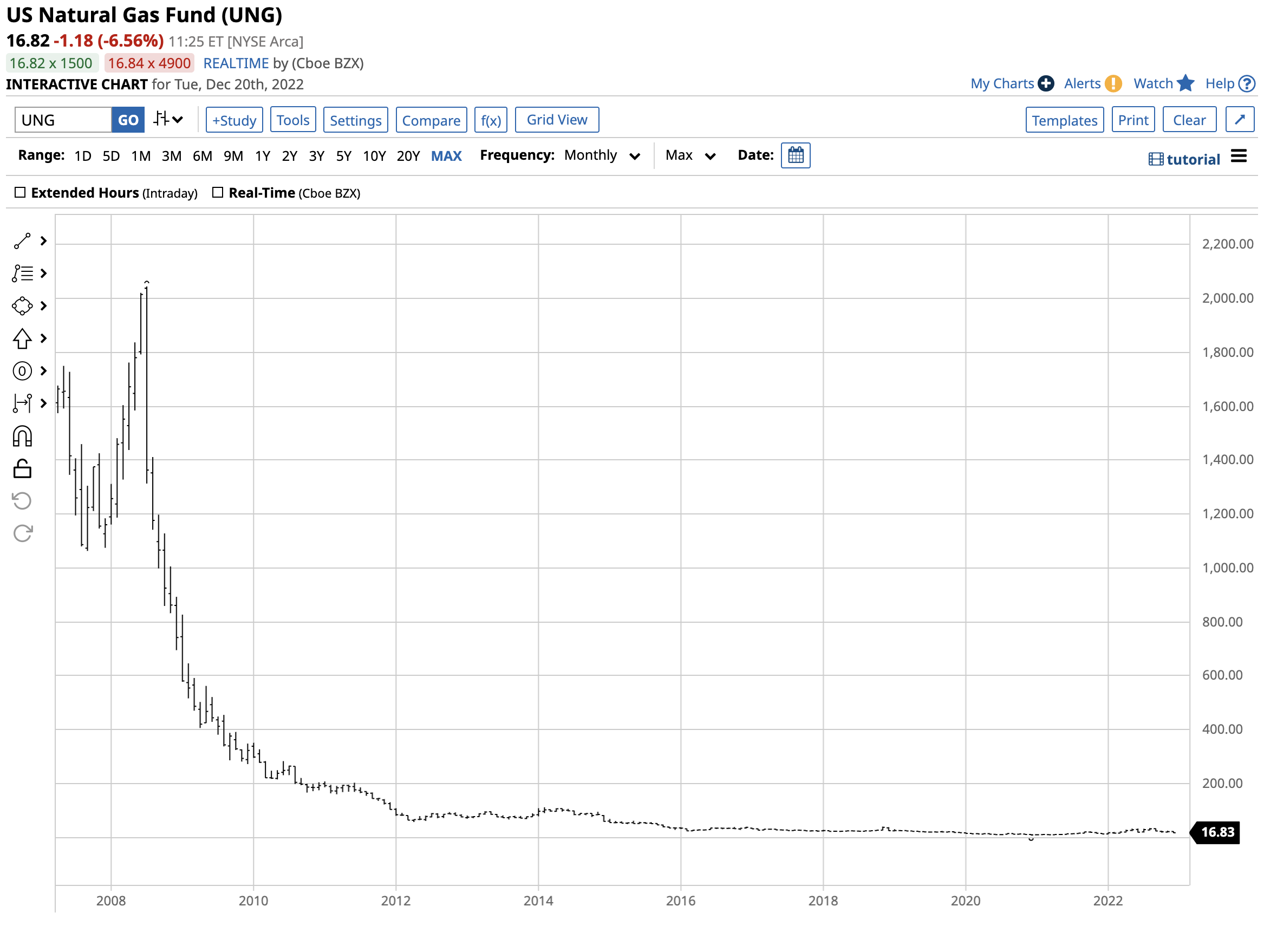
The long-term chart shows that while UNG rose from $8.89 in June 2020 to $16.82 on December 20, a 89.2% rise, nearby natural gas prices moved from $1.44 to $5.40, or 275% over the period. UNG is not appropriate for long-term investors.
As the war in Ukraine continues to rage in late 2022 and relations between Moscow and its European neighbors have deteriorated, expect natural gas volatility to continue. We could see a series of price implosions and explosions over the coming months as natural gas is an energy commodity in the crosshairs of the current geopolitical landscape. Natural gas offers lots of volatility for traders, but it is not a market for the faint of heart.
More Energy News from Barchart
- Nat-Gas Prices Plunge on the Outlook for Warmer U.S. Temps
- Crude Rises on Expectations for Stronger Chinese Energy Demand
- Crude Gains on Expectations for Stronger Chinese Energy Demand
- Crude Moderately Lower on Recession Fears and Partial Keystone Reopening
On the date of publication, Andrew Hecht did not have (either directly or indirectly) positions in any of the securities mentioned in this article. All information and data in this article is solely for informational purposes.

/A%20close-up%20of%20an%20AMD%20office%20by%20gehapromo%20via%20Adobe%20Stock.jpeg)
/A%20logo%20for%20Bending%20Spoons%20displayed%20on%20a%20smartphone%20screen%20by%20Timon%20via%20Adobe%20Stock.jpeg)
/ServiceNow%20Inc%20building%20in%20Silicon%20Valley-by%20Sundry%20Photography%20via%20iStock.jpg)