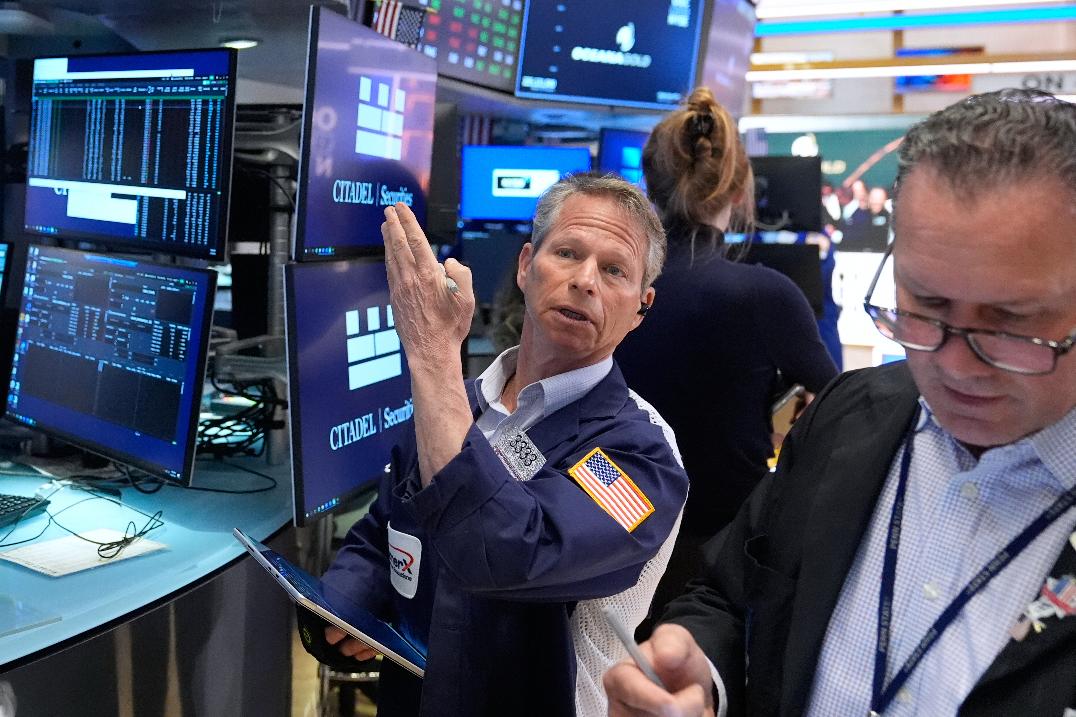
Stocks drifted mostly lower on Wall Street and oil prices slipped Friday ahead of planned U.S.-Iran talks following a shaky ceasefire agreement.
The S&P 500 inched 0.1% lower after a day of choppy trading. The Dow Jones Industrial Average fell 0.6% and the Nasdaq composite rose 0.4%.
The major indexes each notched a weekly gain for the second week in a row. They have been gaining ground this month amid optimism that the war with Iran could be heading toward a resolution. High-level talks between negotiators from Iran and the U.S. are planned for Saturday in Pakistan.
The benchmark S&P 500 has erased most of its losses from March and is just 2.3% short of its all-time high set in January. The market is still prone to big swings on developments around the war.
Oil prices have been behind many of the stock market’s sharp movements. They've risen sharply as shipping through the vital Strait of Hormuz essentially stalled since the war began.
Brent crude oil, the international standard, has gone from roughly $70 per barrel before the war in late February to more than $119 at times. Brent for June delivery fell 0.8% to $95.20 per barrel Friday.
A barrel of U.S. crude oil for May delivery dropped 1.3% to $96.57.
The situation leading into the peace talks over the weekend remains uncertain. Iran’s semiofficial Tasnim news agency claimed that talks wouldn’t happen unless Israel stopped its attacks in Lebanon.
The conflict is behind surging inflation in the U.S. in March. The government reported the biggest spike in inflation in four years as prices at the gas pump jumped. The inflation increase was just short of what economists expected.
Bond yields rose a bit following the latest inflation update. The yield on the 10-year Treasury climbed to 4.32% from 4.29% late Thursday.
Inflation has been a lingering concern for economists. Prices on a range of consumer goods and services are already stubbornly high, in part from the impact of extensive global tariffs. Higher gas prices are immediately felt by drivers at the pump, but they could eventually raise prices on everything from food to airfare as companies pass along higher costs for shipping and fuel.
Analysts are warning that there might be a drawn out impact from the oil supply shock in the months ahead.
“While I’m glad to see the effects to be less than expected in March, the effects in April are now more likely to be worse,” Jamie Cox, managing partner for Harris Financial Group, wrote in a research note.
Consumer sentiment slumped 10.7% percent in April, according to a closely watched monthly survey from the University of Michigan. It also shows that consumers are growing more worried about inflation, with year-ahead expectations surging to 4.8% in April from 3.8% in March.
Inflation remains a major concern for the Federal Reserve, which has signaled more caution amid worries about inflation reheating. The rate of inflation remains above the central bank's 2% target. The threat of rising inflation will likely mean the central bank continues to hold interest rates steady. Several Fed officials have also said a rate hike may be needed if inflation doesn’t cool.
Lower interest rates help boost stocks and other investments by lowering borrowing costs. Interest rate cuts also risk worsening inflation.
Most companies in the S&P 500 lost ground Friday, with health care and financial company stocks driving much of the decline. Eli Lilly and Co. fell 1.6% and Charles Schwab closed 2.5% lower.
Technology stocks with hefty values helped offset losses elsewhere. Nvidia rose 2.6% and Broadcom rose 4.7%.
All told, the S&P 500 fell 7.77 points to 6,816.89. The Dow dropped 269.23 points to 47,916.57, and the Nasdaq gained 80.48 points to close at 22,902.89.
Markets in Asia gained ground while markets in Europe were mixed.


/AI%20(artificial%20intelligence)/Ai%20chip%20by%20Quality%20Stock%20Arts%20via%20Shutterstock.jpg)

/A%20close-up%20of%20the%20Broadcom%20logo%20on%20a%20smartphone%20by%20Timon%20via%20Adobe%20Stock.jpeg)