



The 2022 injection season in the US natural gas market is winding down, and withdrawals from storage will begin this month. Heating demand during the winter tends to cause significant price swings in the natural gas market, but 2022 is no ordinary year for the energy commodity.
Natural gas futures have experience price explosions and implosions over the past months. The wild price swings in the US have been mild compared to the volatility in Europe, where the war in Ukraine continues to threaten supplies. On Friday, November 11, nearby December NYMEX natural gas futures settled at $5.879 per MMBtu. While the price is high compared to recent years, it was $4.149 below the August 2022 high and $2.241 per MMBtu above the January 2022 low for the year. While the energy commodity is closer to the low than the high, the potential for a continuation of explosive and implosive price action remains high in November 2022.
Price action that is not for the faint of heart
In 2022, NYMEX natural gas futures experienced the widest price variance in fourteen years.

As the chart dating back over the past twenty years shows, after making lower highs and lower lows since 2005, natural gas futures fell to a low of $1.44 in June 2020, where it found a bottom at the lowest price since 1995. In September 2021, natural gas futures moved above the November 2018 $4.929 per MMBtu high, breaking the bearish trading pattern in place since 2005.
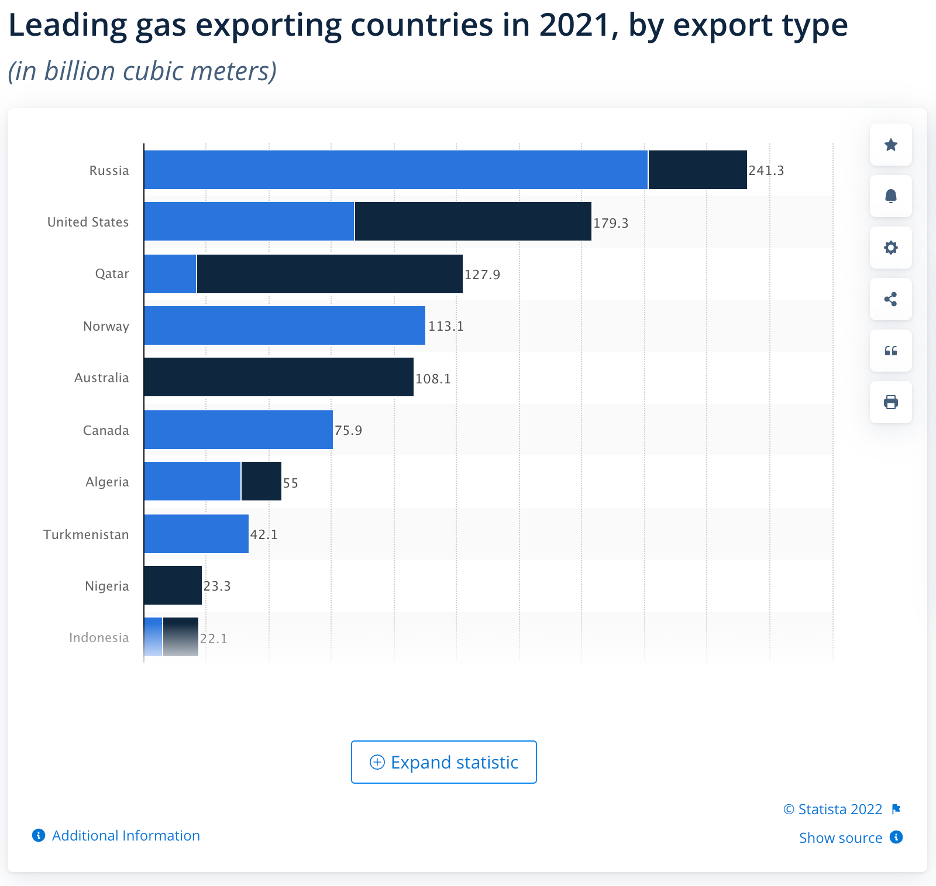
Meanwhile, the 2005 record high of $15.78 and 2008 lower peak of $13.694 per MMBtu came as a pair of devastating hurricanes hit natural gas infrastructure along the US Gulf Coast. In August 2022, the price rose to $10.028 per MMBtu, the highest level since 2008. Meanwhile, no act of nature caused the latest rally; the war in Ukraine was responsible. Russia’s aggressive invasion, sanctions on Moscow, and Russian retaliation caused the explosive and implosive price action this year. The US and Russia are the world’s leading natural gas exporting countries.
Source: Statista
The chart shows that Russia leads the world in natural gas exports, with Western Europe relying on Russian supplies. Russian retaliation against “unfriendly” countries supporting Ukraine has caused worldwide natural gas prices to soar and consumers to experience significant supply concerns. Meanwhile, US LNG exports have increased in 2022 to attempt to fill the void created by Russian sanctions. However, the US energy policy under the Biden administration that discourages fracking has caused the US to fall short of its production potential.
Inventories remain close to recent years as the natural gas market moves into the peak demand season
The natural gas injection season, where inventories build to meet the winter requirements, is ending this month. In a few weeks, the EIA will begin to report withdrawals from storage as US heating demand increases when the temperatures drop. Moreover, the increased global demand for US gas has caused LNG shipments to accelerate in 2022. Meanwhile, the inventories across the US are going into the peak season at levels that are close to recent years.

Source: EIA
At 3.580 trillion cubic feet as of November 4, US natural gas supplies were 1% lower than the level in early November 2021 and 2.1% under the five-year average for this time of the year.
Natural gas has become a far more international energy commodity over the past years as the advent of LNG has expanded its addressable market far beyond the North American pipeline network. With US supplies near the levels of recent years, the price action and potential supply problems in Europe have caused wild price volatility, which could continue over the coming weeks and months.
Europe prices remain high as supply threats loom large
A cold European winter with Russia limiting natural gas supplies to Western European countries supporting Ukraine could cause prices to return to the highs seen earlier this year. Moreover, sabotage of Russia’s pipeline network, impacting supplies, is possible with the war raging in Ukraine.
While European natural gas prices have moved lower from the 2022 highs, they remain at record levels compared to pre-2021 peaks.

The chart of UK natural gas prices shows that while it has declined from the record 800 high, at 274.43 on the January contract, it remains far above the pre-2021 117 high.

The chart highlights that in the Netherlands, natural gas prices fell from the 345 2022 high, but at 105.40 on the January futures, the price is far above the pre-2021 30.16 high.
Europe is preparing for what could be a frigid winter because of limited Russian natural gas supplies.
Significant moves offer opportunities for disciplined traders that go with the flow
The war in Ukraine has interrupted worldwide supply chains for food and energy. Natural gas is a commodity in the crosshairs of the war, given Russian dominance in gas exports.
We have seen US natural gas futures rise to over $10 per MMBtu for the first time in fourteen years and plunge to below the $6 level as the 2022/2023 peak heating season approaches in November. In Europe, prices rose to record highs and remained at all-time peaks compared to prices before 2021 in November 2022. These significant price moves have offered traders the opportunity to jump on short-term trends that have been explosive and implosive. Passive investors have watched the prices move higher and lower in head-spinning moves, while nimble and flexible trend-following traders have captured substantial moves on the up and the downside. The critical success factor has been approaching the natural gas market with a risk-reward plan, sticking to that program, and adjusting risk-reward based on the current, not the original execution, price levels. These criteria will likely continue to allow traders to seize volatile opportunities in the US natural gas arena over the coming days and months. There should be no bulls or bears in this wild market, only traders who wait in the reeds looking for the next significant short-term trend to develop.
BOIL and KOLD are leveraged short-term trading tools
The most direct route for a risk position in the US natural gas market is via the futures and futures traded on the CME’s NYMEX division. The Bloomberg Ultra Natural Gas ETF (BOIL) and its bearish counterpart (KOLD) provide alternatives to the futures arena for short-term traders.
The last two explosive and implosive moves in the US natural gas futures market were the rally from $5.325 on July 6, 2022, to $10.028 on August 23, an 88.3% rise. The price then fell 52.6% to $4.75 on October 24, 2022.
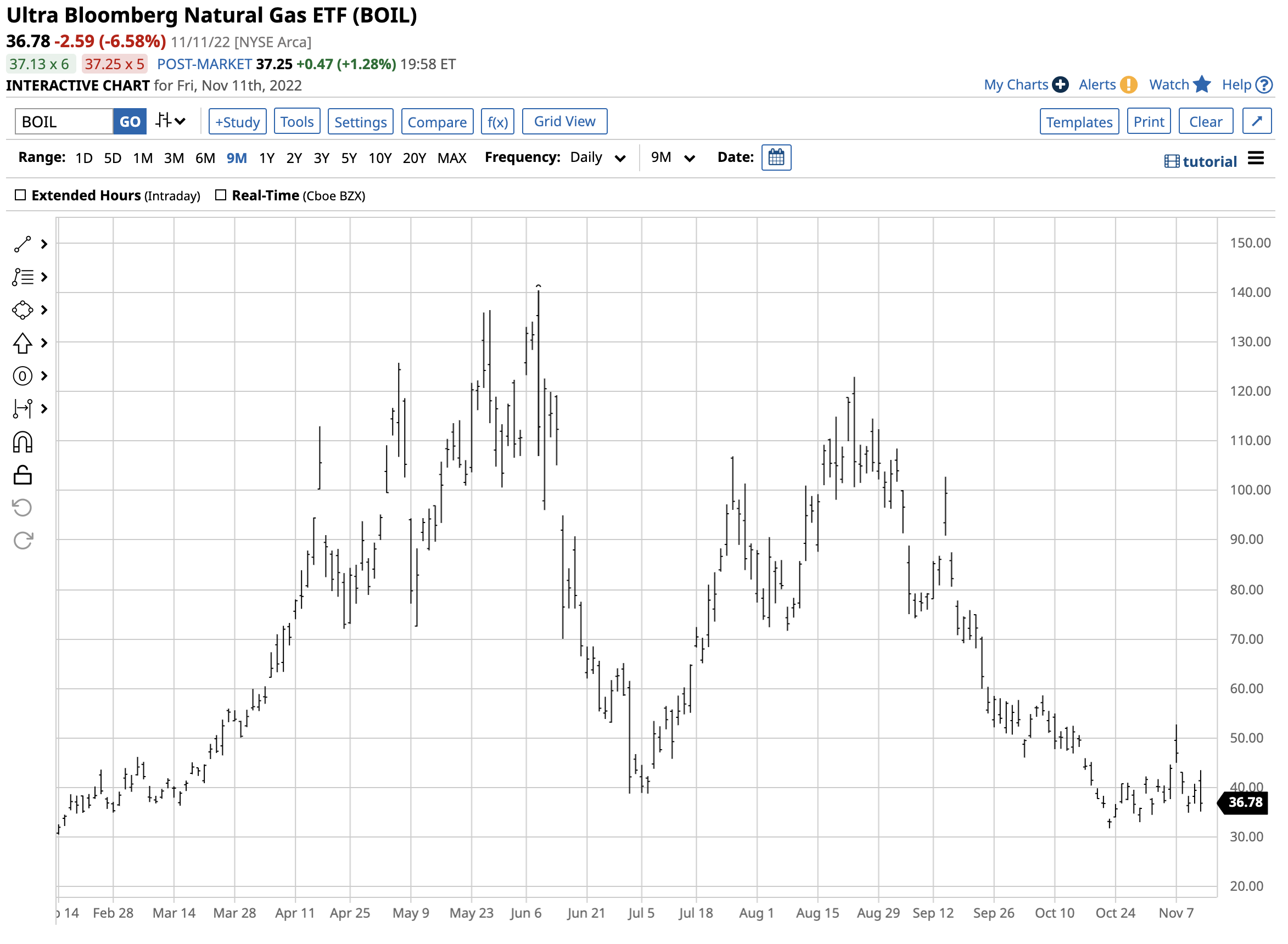
The chart shows that over the same period, the bullish BOIL product rose from $38.70 to $123.00 per share or 217.8%. BOIL collapsed to $31.68, a 74.2% decline when the futures traded below the $5 per MMBtu level. At the $36.78 level on November 11, BOIL is a liquid product with over $497 million in assets under management. BOIL trades an average of over 5.63 million shares daily and charges a 0.95% management fee.
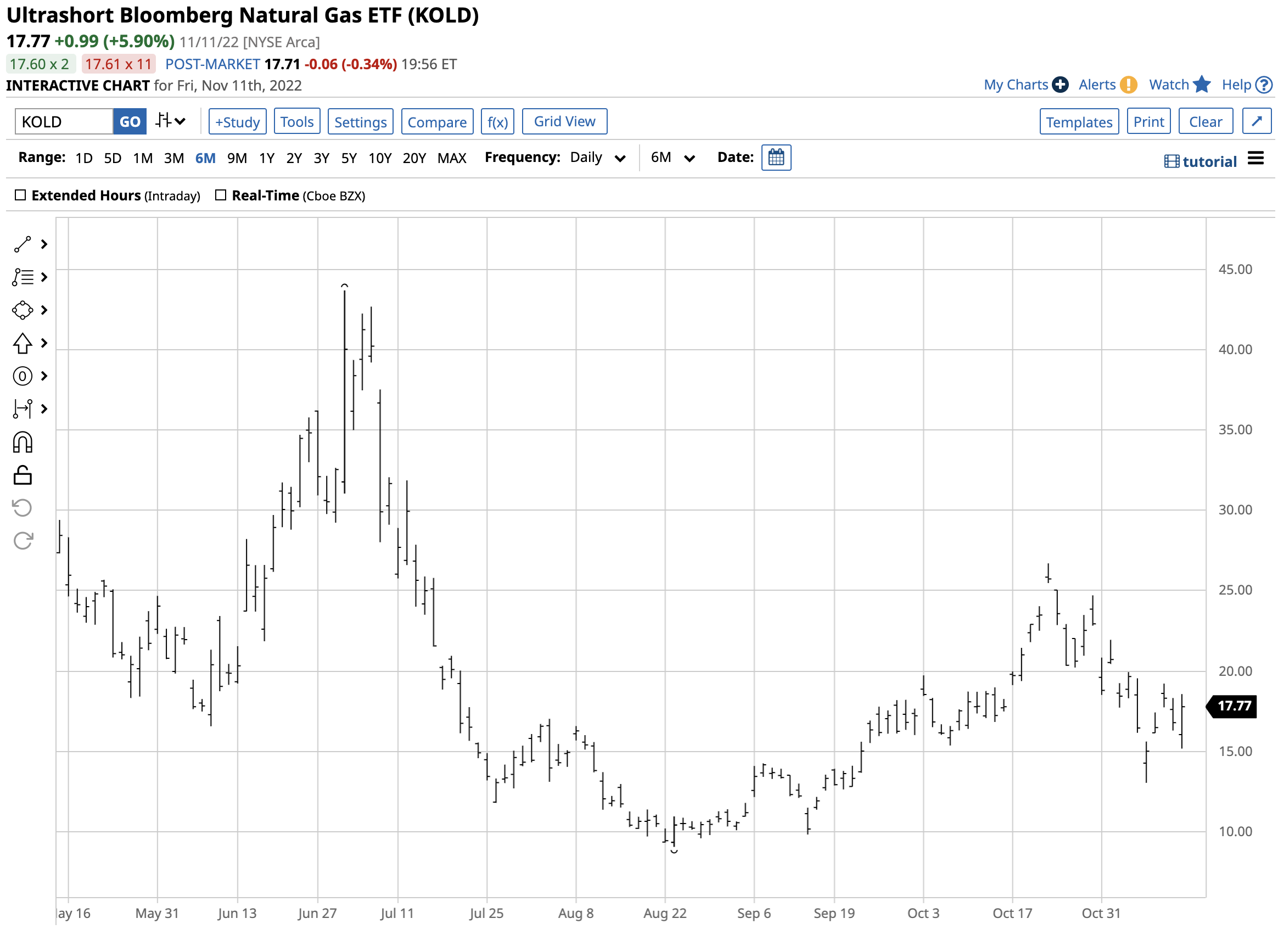
The chart of the bearish KOLD product shows the decline from $43.69 in late June to $9.06 on August 23, when natural gas prices reached the high. KOLD fell 79.3% over the period. The implosive price action lifted KOLD to a $26.69 high in late October, a 194.6% rise. At $17.77 per share on November 11, KOLD had $129.795 million in assets under management and traded an average of nearly seven million shares daily. KOLD charges the same 0.95% management fee.
BOIL and KOLD are leveraged instruments only appropriate for short-term risk positions in the US natural gas arena. Price and time stops are prudent as the products will lose value if the price moves in a contrary direction or natural gas volatility declines and the price action moves into a sideways pattern.
We could be in for a continuation of wild price action in natural gas. The recent price implosion took the price to half the level at the August 2022 high. We are moving into the peak demand season during a year that is anything but ordinary in natural gas, energy, and markets across all asset classes. Be careful in natural gas and expect the unexpected in the market where survival depends on disciple and risk-reward dynamics.
More Energy News from Barchart
- Nat-Gas Prices Slump on Concern U.S. Nat-Gas Inventories May Climb
- Crude Rallies on Dollar Weakness and Easier China Pandemic Restrictions
- Crude Climbs on Dollar Weakness and an Easing China Pandemic Restrictions
- Nat-Gas Prices Jump on Smaller Inventory Build and Colder U.S. Temps

/A%20close-up%20of%20a%20SpaceX%20sign%20by%20Sundry%20Photography%20via%20Adobe%20Stock.jpeg)


/A%20close-up%20of%20the%20SpaceX%20sign%20on%20a%20black%20building%20by%20IanDewarPhotography%20via%20Adobe%20Stock.jpeg)
/NVIDIA%20Corp%20video%20chip-by%20Antonio%20Bordunovi%20via%20iStock.jpg)